jamesenge: (eye)

Fiction set at upper-class British schools was a popular genre in the 19th and early 20th C, and murder mysteries were the dominant form of popular fiction in the early and mid-20th century, so it’s only natural that cross-pollination would create a subgenre: the murder mystery set at an upper-class school.

I’ve read three of these things: A Question of Proof by “Nicholas Blake” (really C. Day Lewis), A Murder of Quality by “John Le Carré” (really David Cornwell) and Was It Murder? by “Glen Trevor” (really James Hilton). And I can safely say at this point that the subgenre is not for me.

The cover of WAS IT MURDER by James Hilton; Bantam edition from March 1946

I didn’t set out to carefully explore this subgenre that I’ve found so tedious. I read the Le Carré book because it’s a Le Carré book—the second novel that features his burnt-out Cold Warrior, George Smiley. Of the three murder-at-school books named above, A Murder of Quality is probably the best, but it’s my least favorite of the Smiley books. It’s a small story that stands in the shadow of its most unpleasant character, possibly a caricature of a particular person, certainly of a type of person, that Le Carré knew and disliked. Le Carré had better luck mingling mystery elements with upper-class schools in some memorable sections of his greatest novel, Tinker, Tailor, Soldier, Spy. He’s writing from sympathy, rather than malice, there, and that usually pays off better in fiction.

I read A Matter of Proof because it was by C. Day Lewis, behind the false whiskers of Nicholas Blake, and because it, too, is part of a long-running and successful series, the Nigel Strangeways novels. I didn’t like it much, and don’t remember it well enough to review here but I paste in full a review I found at Goodreads.

In summary: this book is a mixed bag, but I don’t recommend it unless the prospective reader is already a huge fan of Nigel Strangeways. There is a modest spoiler in the comments below: caveat lector.

This was the first novel by “Nicholas Blake” (a pseudonym for the eminent British poet C. Day-Lewis) and it’s not completely unpromising. The setting, a British middle-class school for boys, was fairly original for a murder mystery at the time (paving the way for better books like Innes’ The Weight of the Evidence or Le Carré’s A Murder of Quality). There is some interesting detail about the lives of the school’s denizens and the tensions between them, and a bold use of the 3rd-person-omniscient point of view. Hardcore fans of the British “cozy” will find a lot to like here.

I’m less enthusiastic about the detective, Nigel Strangeways. In this book he was a bit of a Mary Sue (beloved of all, whether there was reason for it or not) and his bundle of mannerisms never raise his persona into a recognizable personality. More importantly, he and the narrative voice conceal relevant data from the reader, making it difficult or impossible to play the game of a classic mystery novel.

Worst of all is the solution, where a conveniently insane person explains everything and assumes all the blame. Any difficulties are swept away with the non-explanation “X was crazy”.

I understand that later books in the series have a good reputation, and I might give them a try sometime.

Then again, I might not. The classism, the narrative padding, and the abominable ending were all deeply annoying to me. De gustibus non disputandum est, as Nigel Strangeways would no doubt observe, looking down his nose at nothing in particular.

FYI: I read the ebook for Kindle produced by Agora Books. It was a high-quality ebook, free from the typos, missing or garbled text, etc., that often bedevil electronic editions.

posted June 21, 2021 on Goodreads

It’d be an egregious breach of netiquette, at least, to borrow the entirety of someone’s Goodreads review, except that I was the who one wrote it four years ago. I failed to post the review to my blog, because it was in that period when I’d forgotten I had one. I have also forgotten The Weight of the Evidence entirely, but Mr. Internet tells me that it’s set at a university and so slightly outside of the subgenre as I defined above.

Re Was It Murder? by James Hilton: I picked up at a bookstore yesterday. (It originally appeared as Murder at School under a pseudonym, but I latched onto the Bantam paperback from 1946.) I’ve never read anything by Hilton (author of Goodbye, Mr. Chips and Lost Horizon), but there was something on the first page that made me laugh, and the Bantam paperback was beautifully produced—the binding still tight after 84 years, and a set of endpapers that must’ve outclassed those of most clothbound books in 1946:

Endpaper art by Palacios. An academic gown and cap, inhabited by an invisible figure stands next to a gargoyle head among the clouds over the quad of a small public school in England.
Art by Palacios

The art is signed Palacios—the same Rafael Palacios, I think, who did the art and map for the first edition of Fletcher Pratt’s The Well of the Unicorn.

The copy I found, in good condition, was priced 2 bucks. There was no way I wasn’t going to buy it.

The book starts out promisingly enough. Hilton had not only gone to a small public school, like the fictional one in the novel, but had taught at one, and his father was the headmaster of one. The hero seems to be a light-hearted parody of Hilton himself. We find him writing poetry in his Islington flat, a rhymed octave about how English fathers never tell the truth of their own sexual entanglements and temptations to their sons

Therefore, in England now, on every hand
This proper study of mankind is banned.

Anyone who can shake hands with Alexander Pope at the beginning of a murder mystery has my attention. We soon learn that the hero, Colin Revell, has attempted and mostly failed at various stabs at journalism and is engaged in writing a modern epic in the verse and formless form of Byron’s Don Juan. “By the date at which this story opens it had grown to lack only two things: continuity and a publisher.” Snap! I figured this is a writer who didn’t take himself or his hero too seriously.

Revell receives an odd note from the new Headmaster of his old school, Oakington. The Headmaster has heard, from Revell’s former tutor at Oxford, that Revell has a talent for solving mysteries, and he asks Revell to come stay with him for a weekend and look into one at the school.

Revell, who is easily flattered and whose “soul yearned with Byronic intensity for something to happen to it”, readily agrees.

The mystery at the school is that one of the students, a boy named Marshall, died earlier in the term under unusual circumstances. The death was ruled accidental, but the Headmaster has some acquired some evidence that the boy anticipated his death, which in retrospect makes the circumstances a little more sinister. It’s not superclear what the Headmaster expects Revell to do, but he wants the matter looked into somehow, and Revell is willing to oblige.

Revell, unfortunately, has no clear idea how to proceed with a murder investigation and he’s not very good at it. The book loses its focus here, never to regain it, but we do get sharp portaits of some of the school’s staff. A couple more deaths occur and a third murder is attempted before the mystery is eventually cleared up—by someone else. Revell is, in some sense, the book’s hero but he’s not the detective, which is a problem for a mystery novel. Thirty-some pages are employed at the end of this rather short (250pp) book to explicate to the hero the events he’s just experienced, something that dampens the impact of the ending somewhat.

And the ending was pretty damp to start with. Very early in the book, suspicion falls on a character I’ll call X, to avoid spoilers. But so much suspicion is directed at X that it becomes clear X is only a red herring. Most of the evidence that could point to X also points at a character I’ll call Y. No one so much as mentions this, the kind of omission a writer makes when they’re trying to keep something under wraps. “The murderer is obviously Y,” I said to myself, and so it was, to the astonishment of the hero and no one else.

A mystery novel can be a pretty inept mystery and yet be worth reading if it’s a good novel. Sayers’ Murder Must Advertise is a good example. Hilton’s book doesn’t fall into that category because the scene in which the hero operates isn’t vividly drawn and his experiences (which might be described as an emotional affair) aren’t really that interesting. This is not his story, and Hilton’s insistence on putting him at the center of it is baffling in retrospect.

Hilton never wrote another straight-up mystery, which was probably for the best. This particular book, though not a success in my view, didn’t discourage me from looking up more of his work. Lost Horizon, in particular, has been on my horizon for decades; maybe I’ll get around to reading it soon. If so, you can count on me kvetching about it here.

As for as the “murder at school” subgenre goes, I think I’m done with it unless I come across one where the detective is actually a kid at the school. The stakes would be high; the danger would be greater; the likelihood of success more remote; and most of the characters in the story wouldn’t just be background scenery for Old Boy nostalgia, but something like actual people with distinguishing characteristics. That might have some interest.

Mirrored from Ambrose & Elsewhere.

jamesenge: (eye)

Last night at the movies: a daring raid on an 24-hour check-cashing place on Halloween night was planned by a thirtyish Laura Antonelli and a middle-aged Jim Backus, who had the Hawaiian shirt of Thurston Howell III and the mannerisms of a sinister Mr. Magoo. (Actually, Howell doesn’t seem to have worn a Hawaiian shirt. My subconscious may have been confusing him with the Hawaiian Punch guys.)

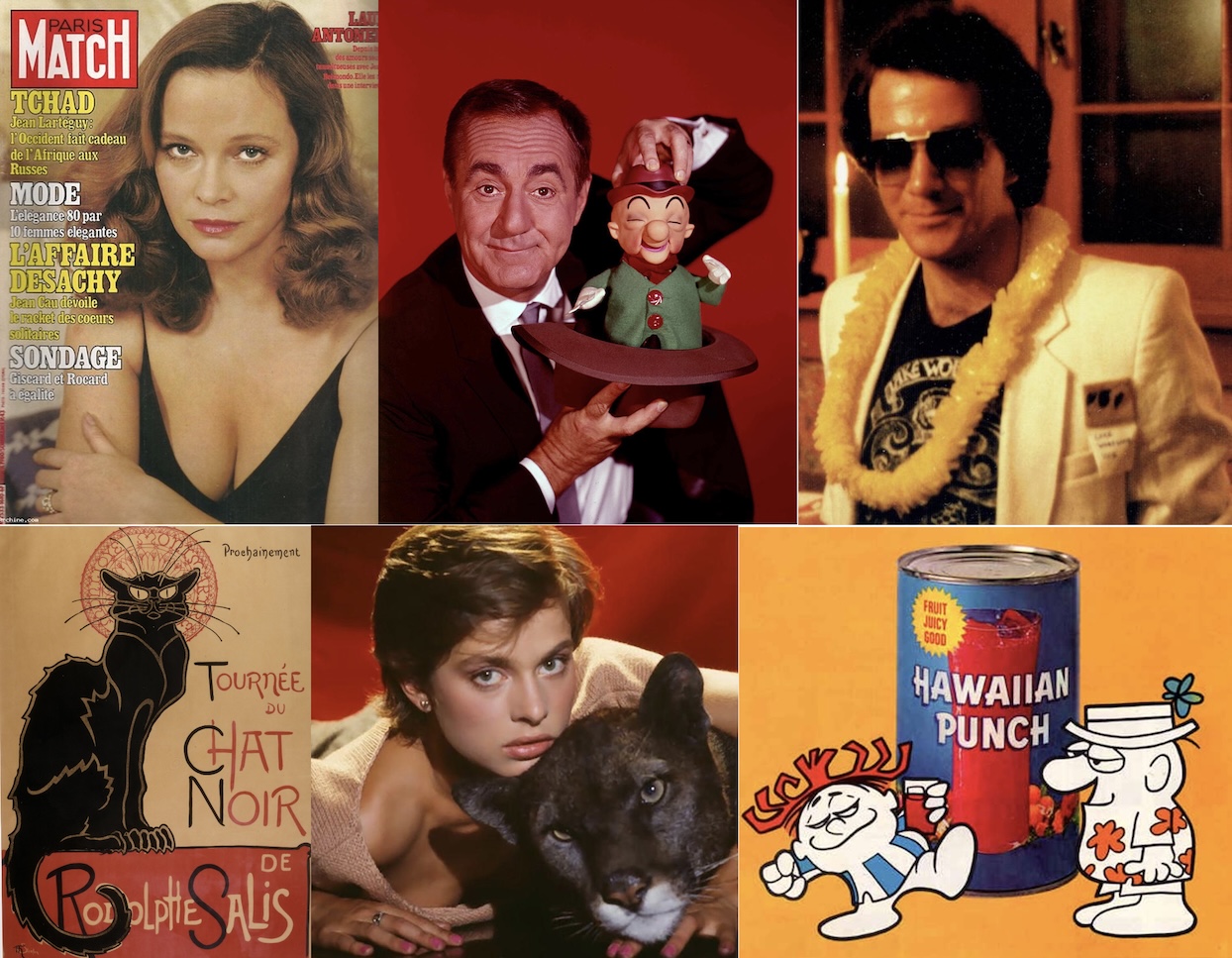
6 photos. See caption for details.
Dramatis Personae.
Upper left: Laura Antonelli on the cover of Paris Match (April 4, 1980)
Upper center: Jim Backus holding a Mr. Magoo doll in his hat.
Upper right: me, at a costume party as Lake Wobegon Vice (circa 1984)
Lower left: the famous Chat Noir poster.
Lower center: Nastassia Kinski and fuzzy friend (circa 1982)
Lower right: the Hawaiian Punch guys (puncher & punchee)

Antonelli had recruited me for the caper. Also figuring in the plot was a goofy black cat with pipe-cleaner limbs who was the only member of the gang that everyone liked, and a Kelly-green velvet frock-coat that was supposed to be part of someone’s disguise for the robbery. 

Antonelli’s plan-within-a-plan was that she and I would freeze out Magoo with the help of her friend (a Cat People-era Nastassia Kinski), who would pretend to be ill. While he was busy tending to her, Antonelli and I would commit the robbery by ourselves. 

Antonelli was acting crazy while Kinski was off roping Magoo, and I told her I was out. She wanted it too much; she was making mistakes; and I had to figure that, if she was ready to doublecross Magoo, she was likely to do the same to me. 

Antonelli was still trying to get me to change my mind when Kinski, on schedule, faked her illness. Antonelli insisted that Magoo take Kinski to the hospital. Magoo declined, looking on us with a kind of genial malice, and said that Kinski was Antonelli’s friend and she should take her—that he and I had things to talk about.

I figured that Magoo had tumbled to Antonelli’s plan, and I was interested to see what would happen next when I woke up.

Moral of the story: don’t watch two old crime movies before bed. Or: stay asleep longer.

Mirrored from Ambrose & Elsewhere.

jamesenge: (eye)

I watched a couple of pretty good new-to-me movies that could loosely be described as noir: Panique (1946) and The Window (1949). Both of them are based on fiction I haven’t read, but now kind of want to. Reviews follow, along with some spoilers. But neither of these movies is a mystery in the whodunit sense.

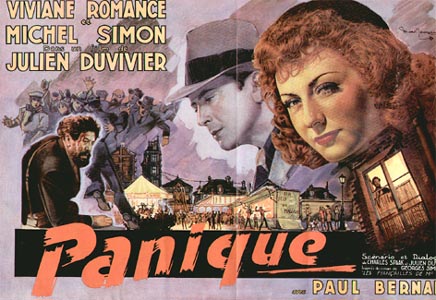
poster for the movie PANIQUE (1946)

In Panique, a guy who goes by three names, but is usually called Monsieur Hire (Michel Simon) falls under suspicion of having murdered a woman. The infallible signs that point to his guilt are: he’s always taking pictures of things, he’s Jewish, and people don’t like him. He’s quite aware of his universal unpopularity; at one point, he remarks that even his mom didn’t like him much.

In fact, he didn’t commit the murder, but he knows who the killer is, an auto-mechanic calling himself Alfred (Paul Bernard). When Hire sees a young woman named Alice (Viviane Romance) getting friendly toward Alfred, he tries to warn her off. When Alice asks Hire how he can be sure Alfred is the murderer, he tells her that he saw it happen while he was taking a slash in the vacant lot. When she asks him why he doesn’t tell the police, he laughs and says it’s against his philosophy.

Unfortunately for Hire, Alice is Alfred’s longtime girlfriend. They’re just pretending to meet for the first time, as he’s a career criminal on the run and she’s an ex-con who just got out of prison for a robbery he committed. Alfred and Alice manipulate feeling in the neighborhood against Monsieur Hire. Hire takes an interest in Alice, and she convinces him she likes him, primarily so that she can plant some evidence on him (the murdered woman’s purse).

In the climactic scene, the neighborhood forms a mob that attacks Monsieur Hire. He flees from them and the police, losing his camera in the process. He falls to his death, and Alice and Alfred figure that’s the end of it.

But it’s not. Hire was always taking photos of weird, ugly things, and one of the weird, ugly things he took a photo of was the murder. The police find the photo and they’re closing in on Alice and Alfred at the movie’s end.

Michel Simon gave a very likable performance of an unliked man. He has his principles and abides by them, and he carries the irrational hate of his neighbors on his shoulders without bending under the weight.

Viviane Romance apparently had a long career of playing femmes fatales in French movies. She renders Alice with weary charm; you can see why Monsieur Hire is taken with her, and you can fully understand why she prefers the loathsome Alfred.

Paul Bernard’s performance of Alfred was a little odd. He may have been a little old for the role of a youngish criminal. His face seemed very heavily made up, and he wore a lot of scarves and tweedy clothing you wouldn’t expect a mechanic to be wearing at work.

This movie marked the director’s return to French cinema after a wartime exile to the United States. It can be read as a commentary on the French who collaborated with the Nazis in WWII. The citizens who turn so readily on an innocent man are repugnant, as are the criminals who edge them on.

But Monsieur Hire shares some responsibility for the fatal predicament he finds himself in. If he’d been civic-minded enough to go to the police with what he knew, he might have lived peacefully and unpopularly ever after. On the other hand, what does a man owe to a community that hates him for no good reason?

The movie is based on a novella by George Simenon, Les Fiançailles de M. Hire (Monsieur Hire’s Engagement). I’m not a huge fan of Simenon, having bounced off a couple of different Inspector Maigret novels. But this book sounds like it might be worth checking out.

Okay, since it’s just you and me here in the absolute privacy of my blog, where no one ever comes, I’ll admit something. I watched The Window because Barbara Hale has the top billing. I always liked her in Perry Mason, where she played the unflappable Della Street, and I thought it would be fun to see her play the lead in something.

Maybe she did sometime, but this isn’t it. The main character in this movie is the kid, Tommy (Bobby Driscoll) who witnesses a murder. Nearly as important are the murderous upstairs neighbors, the Kellersons (a dead-eyed and terrifying Paul Stewart and a semi-ruthless Ruth Roman). Then there’s the kid’s kindly and frustrated father (Arthur Kennedy). Barbara Hale is Tommy’s mom, a relatively trivial role that anyone wearing a dress could have played as well. I guess she had a great agent; it’s too bad he didn’t get her a better part, though.

Tommy’s original problem is this: he’s a damn liar. He’s always making up some ridiculous story to get people to notice him, and it’s driving his parents crazy. One fiercely hot summer night, he sleeps out on the fire escape outside the family’s apartment. From that vantage point, he watches in horror as the couple upstairs rob and murder a man they’ve lured somehow into their apartment.

He tells everybody he can get to listen to him, but of course almost no one believes him. He’s the boy who’s cried “Wolf!” once too often.

There are two people who believe his stories of apartment-house murder, though: the murderers. Once they realize that their crime has been witnessed, they set out to silence the neighborhood storyteller once and for all.

The movie has a slow but not uninteresting start, carefully establishing Tommy’s fraught relationship with the neighborhood and with his frazzled parents. The pace picks up with the murder, as you might expect. The climactic sequence, which finds Tommy fleeing from the murderers in the empty hours of the night, through dark streets and abandoned buildings, is pretty harrowing.

The story that the film was based on is “Fire Escape” (a.k.a. “The Boy Who Cried Murder”) by William Irish (a.k.a. Cornell Woolrich). Woolrich has his fans, but I’ve never really been one of them. I did like The Bride Wore Black, though, and I’ve liked other movies based on his short fiction (e.g. the classic Rear Window). Now I’m thinking I should give his short stories a try.

Mirrored from Ambrose & Elsewhere.

jamesenge: (eye)

Some writers I take to with irrational intensity. Others, who may be equally good or even great, I don’t. Sometimes I understand the process involved; sometimes I don’t.

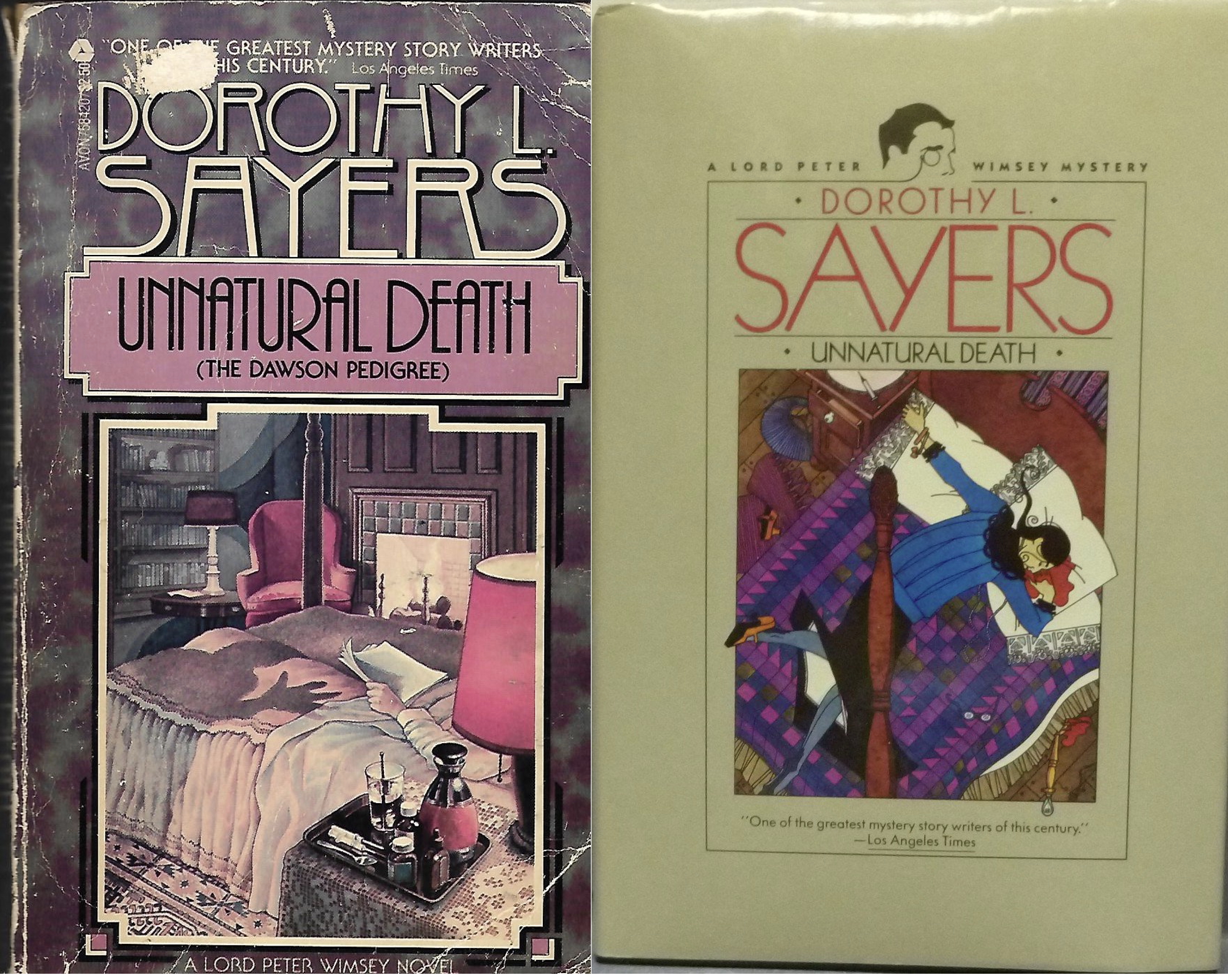
Two paperbacks of Sayers' UNNATURAL DEATH. Left: the art shows the bedroom of an elderly invalid; there are medicines on a tray on the side-table. The invalid is in the bed but the lampshade hides her face from us. In her left hand are some legal papers. Out of frame is someone whose shadow falls on the bed.Right: the art shows a middle-aged woman sprawling on a bed. Blood from her head is seeping onto one of the pillow cases. On the table next to the bed there is an empty syringe.
Left: a couple paperback editions of Unnatural Death from the 1980s

Sayers is one of the writers I took to as soon as I came into contact with her work. The Lord Peter Wimsey mysteries are good mysteries, and great genre fiction: urbane, erudite, witty, at turns moving and funny. But her ambitions as a writer and thinker were deeper and higher than mystery fiction: she was a scholar and translator of medieval Romance languages; she was a playwright and a Christian apologist. She was an Oxford graduate who worked at an advertising agency. She was a clergyman’s daughter who had a child out of wedlock. She was super-weird and didn’t really fit in anywhere, but insisted on doing good work everywhere she landed.

Her mystery novels were early entries onto my always-reread list. In my most recent desultory read-through of the series I’m up to Unnatural Death (1927), also known as The Dawson Pedigree, because American publishers love to slap alternate titles on British books, and vice versa. Spoilers abound in the ensuing discussion of the book, so be forewarned.

Several of the Wimsey books were adapted to television by the BBC in the 1970s, and a few more during the 1980s. Unnatural Death is not one of them, because the one of the plot-points hinges on a visual identification that isn’t made until the penultimate chapter. That works in a novel, and might even in a radio play, but not on TV, where the viewer is likely to shout at the screen, “Why can’t you see her? She’s right there!”

As a matter of fact, the BBC did adapt Unnatural Death as a radio drama, featuring Ian Carmichael (who so brilliantly played Lord Peter on TV in the 1970s) and a solid cast of voice actors. It’s very talky, as radio plays are apt to be, but Carmichael is always great.

There’s a lot to like about Unnatural Death, but when talking about a book of popular fiction that’s nearly a hundred years old, some warnings may be in order. Issues of race and gender come up. Sayers is deeply scornful of people harboring racial prejudice, but there are some characters in this novel who are bigots and speak accordingly. There is also some tacit discussion of same-sex activity in the book. It’s not as narrow-minded as you might think, but the murderer is pretty clearly coded as a lesbian. If you’re annoyed by that, you might want to skip this one.

At some point after the Lord Peter mysteries became reliable best sellers (circa 1935), Sayers was inveigled to write a biographical note about Lord Peter. She writes it in the person of Lord Peter’s maternal uncle, Paul Delagardie. It’s usually attached to Unnatural Death in later printings. Those interested can read it here.

The book proper opens with Lord Peter and his friend Inspector Parker sitting in a restaurant discussing their favorite topic: murder. Specifically, they’re arguing about a then-notorious series of poisonings in which Edward Pritchard apparently murdered a servant in his household, and later definitely murdered his mother-in-law and wife.

The death of the servant was investigated, but resulted in no action. When Pritchard’s mother-in-law died, her physician refused to supply a death certificate and wrote a letter explaining why to the Registrar (I guess: the equivalent of a county clerk). Again, nothing happened. This lack of action may have emboldened Pritchard to go ahead and murder his wife.

Sayers’ story begins in mid-argument, but Parker seems to have been saying that the mother-in-law’s doctor (who was also Mrs. Pritchard’s doctor) should have done more than he did. Wimsey argues the contrary, and says that Parker doesn’t understand what kind of hot water a physician could get in for making trouble about a death certificate.

At that point a guy at the next table horns in. He says that he’s a case in point. He declines to give his name or any identifying characteristics (he thinks) about the patient in question, but he tells the sad tale of how he lost his practice for demanding an autopsy for one of his patients, an old woman who had been fighting a long, slow battle against cancer, but in the end died with unexpected suddenness.

The physician may be professionally discreet, but Wimsey is professionally indiscreet, and he soon tracks down the death in question and where it occurred, and sends an ace investigator down to poke around and ask questions. This is Miss Katherine Climpson in her first but not last appearance in the series. She’s a kindly, middle-aged spinster with a mind like a steel trap who can ask questions without causing offense because no one takes old maids seriously.

Wimsey’s investigation eventually alarms the murderer enough that she starts killing again to cover her tracks. It’s these later murders that she’s eventually arrested for; it’s pretty clear that she did kill the old woman, but there is never enough evidence to charge her. There is some question of whether Wimsey himself bears a moral, if not legal, responsibility for these later deaths.

From pretty early on in the novel, there isn’t much doubt about who killed old Agatha Dawson: it was her great-niece, Mary Whittaker. The mystery lies more in how (since an autopsy showed no evidence of anything other than heart failure) and why (since old Agatha was expected to die eventually and the great-niece was sure to inherit as the closest relative).

The how is pretty good. It involves deliberately injecting an air-bubble into a vein, where it will go straight to the heart and stop it. Whether this would actually work or not I don’t know and don’t want to know, but it’s fiendishly plausible.

The why has to do with British inheritance law. There was a Property Act passed by Parliament in 1926 that changed inheritance rules for people who died intestate (i.e. without a will). Apparently it made the inheritance status of great-nieces at least ambiguous. Mary Whittaker tries, by hook and by crook, to get Agatha to make a will, but the old lady is pathologically terrified of wills and extremely stubborn. When persuasion and trickery fail, Mary resorts to murder, killing her great-aunt before the new Property Act comes into force in 1927.

Now that I’ve ruined the central mystery of the book for you, is there any point to going on to read the novel?

I think so. There are other mysteries involved, for one thing. But I don’t expect anyone would pick up this novel without having first read Clouds of Witness and maybe Whose Body? If you liked those, you’ll like this. It’s got a varied and vivid cast of characters: the aforesaid Miss Climpson, Mr. Bunter, who is the Jeeves to Wimsey’s Wooster, the distinctively different old biddies that Climpson worms info out of, the brash young biddy and dupe of the murderer, Vera Findlater; there is a distant cousin of Agatha Dawson who appears in the story and has the bad taste to be a person of color. He’s an agreeable guy who seems to pity (and be amused by) the shock his presence causes people who want everyone in the world, or at least everyone in England, to be white.

The year itself is kind of a character in the book. Sayers seems to have been glancing at the newspaper as she wrote: there are constant background references to news events of the day, such as the unrest in China around the Shanghai Massacre; the Property Act itself was still recent and in the news; and there was a brief total solar eclipse in June 1927 which makes its appearance on the novel’s last page. A copy of the American detective magazine Black Mask plays a role in a carefully staged murder scene. Bestselling authors of the mid-20s like Sheila Kaye-Smith and Michael Arlen both come up in conversation. The period detail is as dense as if this were a historical novel. The book isn’t set in some Neverneverland of quaint vicarages, each with a decorous corpse sprawled in the library. It brashly insists that it’s set Now, in this very modern year of 1927 AD.

We also get a lot of deep background on the Victorian Era, old Miss Agatha’s heyday. When she was just a young woman she took up with her school-friend Clara Whittaker and they settled down together. Clara was a fierce young woman who made a fortune in horse-trading; Agatha was the “domestic partner” (sic) who kept house. Everyone who knew them talks about them with admiration and respect. But the implication is as strong as it can be in a popular novel from this period that these two women are in a same-sex relationship.

Clara’s brother married Agatha’s sister. Charles Whittaker, Mary’s father, was the offspring from that union. Charles was super-mad when Clara left all her considerable fortune to her domestic partner Agatha Dawson. But Agatha proposed to make it up to Mary by leaving all the wealth to her… except that Agatha couldn’t be persuaded to make a will.

Mary Whittaker is the target of love and hate and fear in the book, but somehow she never quite comes into focus. It occurs to me that, in one of her identities, she’s the sort of woman that Sayers herself might very much liked to have been:

With her handsome, strongly-marked features and quiet air of authority, she was of the type that “does well” in City offices. She had a pleasant and self-possessed manner, and was beautifully tailored—not mannishly, and yet with a severe fineness of outline that negatived the appeal of a beautiful figure.

Sayers was herself someone who worked in an advertising office, but would probably not have been described this way. She’d had at least one same-sex “pash” for the French teacher at her prep school, from which she’d been discouraged perhaps in much the same terms that Miss Climpson tries to discourage Vera Findlater from her “pash” for Mary Whittaker. Sayers writes with feeling and (my guess is) from experience about sexually charged friendships between women.

In another one of Mary Whittaker’s identities, she may be more like someone Sayers feared she would become: a woman with a scandalous reputation living alone in London, insecure socially and financially.

It may be Sayers’ own turbulent feelings about her villain that keep Mary Whittaker from snapping into focus. Or it may be the inevitable effect of a story which is made up of different accounts from different people of the same events—Rashomon in Jazz-Age England.

This is not the best of the Wimsey mysteries, but it’s far from the worst. Sayers is flexing her muscles as a storyteller and seeing what she can do. The book is well worth reading. Unlike Mary Whittaker’s syringe, there’s definitely something in it.

Mirrored from Ambrose & Elsewhere.
Lured Lucy

Mar. 8th, 2025 10:44 pm
jamesenge: (eye)

D and I watched Lured (1947). It was watchable, maybe even rewatchable. With a script by Leo Rosten (of Joys of Yiddish fame), I expected it to be wittier than it was. But, given that it’s about the hunt for a serial killer, maybe it’s too light-hearted as it is. The mystery was pretty transparent, even though the red herrings in the story kept getting larger and neon-luminous. But the story moved pretty quickly, took some interesting turns, and made sense more often than not.

poster for the movie LURED (1947). Image shows a personal ad torn from a newspaper ("FAMOUS ARTIST seeks beautiful model" etc), a red carnation, and words in a scriptlike font reading "Don't answer this ad... Don't  Don't Don't Don't"The "Don't"s slide down into a pool of green water with ripple, as if something has just been dropped into it. The top cast and staff (available at the IMDb link) are listed on the poster, along with inset photos of the principal characters.
Screenshot

A very strong cast: Lucille Ball as the lead (as much as a woman is usually allowed to be the lead in a mid-century crime movie) was likable and convincing. George Sanders did his George-Sanders thing which works equally well if he’s a suave hero, a shifty spy, or a man-eating tiger. Borith Karloff chewed holes in the scenery in a wonderfully weird if small role. The secondary cast was full of character actors who appeared as murderers, crooks and third bananas in Universal’s Sherlock Holmes series (e.g. George Zucco, Alan Mowbray, Gerald Hamer).

Ball plays Sandra Carpenter, a taxi-dancer who becomes involved in the hunt for the serial killer after her friend becomes his latest victim. She clues the police into the fact that the killer is contacting his victims via the personals. She’s hired by the police to answer suspicious personal ads and keep the police informed. (I know this would never happen. Please direct all inquiries and comments to Messrs. Sirk & Rosten, who are dead and won’t mind so much.)

The joke, if it’s a joke, is that she’s constantly running into schemes to exploit young women in various ways. Only one of them is a serial killer, but they’re all creeps, and the movie implies that their name is legion. It’s the most realistic note in this not-very-realistic movie.

The murderer turns out to be the guy you knew the producers didn’t hire just to say two lines in three scenes. In the end, he’s caught red-handed. And true love triumphs over all, which is a weird feature of these softer-edged midcentury crime stories.

A painless 100 minutes for me, and a decent nap for D. Not quite up to the level of Sirk’s Thunder on the Hill (1951), which I saw for the first time recently and was deeply impressed by. But good enough to keep working my way through his filmography.

I’m always a little bemused that Lucille Ball didn’t have a bigger career in film. She was beautiful, had an expressive face and voice, projected intelligence, and (I’ll go out on a limb here) she was a gifted comic actress. But maybe that was the problem: comedy was the kids’ table in the studio system, and most of the seats were reserved for men.

Also: #EverythingIsStarTrek. In case you thought I’d forgotten that.

Lucile Ball depicted as a Starfleet captain, Voyager-era.
Artist unknown, but I’m pretty sure this image predates generative-AI boom.
Anyway, she has the right number of fingers.

Mirrored from Ambrose & Elsewhere.
Mail Call

Jan. 27th, 2025 11:34 pm
jamesenge: (eye)

Looking forward to (re)reading the vintage paperbacks. The history book is more for figuring out how teaching will work in the future, now that everything old is new again.

Three vintage paperbacks (THE INNER WHEEL by Keith Roberts; THE BOOK OF PTATH by A.E. Van Vogt, with a great Jeffrey Catherine Jones cover; SINNERS & SHROUDS by Jeffrey Latimer) and a trade paperback (NAZI GERMANY & THE HUMANITIES: HOW GERMAN ACADEMICS EMBRACED NAZISM edited by Bialas & Rabinbach).

I already have a copy of Van Vogt’s The Book of Ptath, his only novel on my “always re-read” list, with the same cover by Jeffrey Catherine Jones, but it’s getting too beat up to read. Keith Roberts is one of the 1960s-70s-era I should have been reading since I was a teenager but somehow I never glommed onto his books. Jonathan Latimer wrote some of the better scripts for the old Perry Mason show. I read one of his mysteries (Murder in the Madhouse) and thought it was okay-to-promising, so I’m going to try a few others.

Mirrored from Ambrose & Elsewhere.
December 2025

S M T W T F S
 123456
78910111213
14151617181920
21222324252627
2829 30 31   

Syndicate

RSS Atom

Most Popular Tags

Style Credit

Expand Cut Tags

No cut tags
Page generated Jan. 6th, 2026 05:38 pm
Powered by Dreamwidth Studios