jamesenge: (eye)

I’ve been following with interest Steven Silver’s great series of reviews of the Tor Double books at the Black Gate. His latest, scrupulously fair, review of Brackett’s The Sword of Rhiannon+de Camp’s Divide and Conquer reminded me of one of my favorite Latin sayings: de gustibus non disputandum est. Or, in the words of a cinematic classic:

“Your point of view is so different from mine.”
Michelle (Robyn Paris) in The Room (2003)

People get to like what they like and not like what they don’t like. Personally, I like The Sword of Rhiannon (a.k.a. Sea-Kings of Mars) a lot; it’s my favorite of Brackett’s sf/f novels. But I hadn’t reread it in a while, so I thought I’d see if I still found it good. (Spoilers: I did. Details and complications below.)

In the course of the reread, I thought of a much more effective pairing for Brackett’s novel: Zelazny’s Isle of the Dead. Both the Zelazny and the Brackett share the same conceit (men who overlap with gods), and they share some other weaknesses and strengths—so much so that I began to think that Isle of the Dead was at least partly inspired by and in response to The Sword of Rhiannon, something that had never occurred to me before.

First up: my thoughts about the older book, then the later, and finally some points of comparison.

The cover of THRILLING WONDER STORIES for June 1949; the uncredited cover art illustrates Brackett's story. We see a man with white skin and dark hair (and clothed in a silvery onesie with a wide leather belt) in front of a woman with white skin and dark hair (and somewhat clothed by leathery loin-gear and a sports bra). Both of them are wielding swords against sinister serpentine figures who crowd around them.

Re titles: Brackett’s book first appeared as a “Complete Novel” in the pulpy pages of Thrilling Wonder Stories (June 1949), under the title Sea Kings of Mars. It appeared a few years later in an Ace double as The Sword of Rhiannon (backed with REH’s Conan the Conqueror), and later editions always carried the Sword of… title in Brackett’s lifetime, so we can assume that it was the author’s preferred title. Sea Kings of Mars has a Burroughsian clang to it, but the Sea Kings are secondary or even tertiary characters in Brackett’s book. Rhiannon and the man he haunts are at the center of the story.

Left: Saunders' cover for CONAN THE CONQUEROR. Some guy in a pseudo-Roman costume is carrying a blonde woman and wielding a gladius and a fierce expression. I guess this is Conan?On the right is Schulz's cover for THE SWORD OF RHIANNON. A disembodied head floats over the grip of a sword with a glowing red jewel in its pommel. A man's hand is holding up the blade. In the background we see the opening of a cave with a desert city beyond. There are two small figures of a man and a woman in the lower right hand of the image, looking out toward the opening.
image snerged from ISFDb

The man in question is Matthew Carse. He’s an Earthman, but he’s spent most of his 35 years on Mars. He was trained as an archaeologist but (like Indiana Jones and Belloq) has “fallen from the purer faith” and is now a thief and a tombarolo. A weaselly Martian guy named Penkawr tracks him down in the mean streets of Jekkara, one of the most dangerous of the Low Canal towns of Mars.

Brackett’s Mars is one of her greatest creations: a desert planet laced with canals, in the spirit of Percival Lowell and ERB; a planet dying but not dead; a planet that suffers under the colonial power of Earth.

Penkawr needs Carse because of his skills as an archaeologist and a crook. The Martian has discovered an unbelievable find: the tomb of dark Rhiannon, villain-god of the ancient Quiru, lost for more than a million years. Penkawr knows that he can’t safely dispose of the tomb’s fabulous treasures, so he proposes a partnership to Carse. And he proves his claim by handing Carse the most fabulous of the aforesaid treasures: the sword of Rhiannon.

Carse agrees, insisting on a two-thirds share.

“<Penkawr> turned and fixed Carse with a sulky yellow stare. I found it,” he repeated. “I still don’t see why I should give you the lion’s share.”

“Because I’m the lion,” said Carse cheerfully.”

Penkawr: not so cheerful. When they get to the tomb of Rhiannon, he shows Carse a disturbing mysterious globe of darkness. While Carse, reverting to archaeologist mode, is rapt in wonder, Penkawr pushes him into the globe. The thief figures he can make a better split with a less leonine partner.

Carse, meanwhile, falls through space and time, haunted by a terrifying presence in the darkness. He comes to himself in the tomb of Rhiannon but now, as he swiftly realizes, it’s a million years in the past. Instead of a dying, desert world, Mars is a green world rich in lives and waters, being fought over by savage kingdoms, who have lost or never possessed most of the technology of the ancient, godlike Quiru.

Carse returns to a Jekkara a million years younger than the one he knew. In the older city, he was a respected member of the aristocracy of thieves. In this young, vibrant Jekkara he is instantly loathed because of his skin color. A mob attacks him because they believe he’s from Khondor, an alliance of piratical sea-kings with whom the Sarks and their subject cities (including Jekkara) are at war.

Carse is saved by a wily, fat rascal named Boghaz Hoi. This guy hails from Valkis and he has, as he says, “my own reasons for helping any man of Khond”. He’s also a thief and he recognizes the stuff Carse has as worth stealing. Once he examines it closer (having knocked Carse cold for the purpose) he realizes that they are relics of the sinister villain-god Rhiannon, already an ancient and mythical being in this much-younger Mars. When Carse comes to himself, Boghaz tries to persuade Carse to lead him to the tomb of Rhiannon, much as Carse persuaded Penkawr to do earlier in the story (and a million years later in history). But Carse is stubborner than Penkawr, and Boghaz too; they are still discussing the matter when they are arrested by the soldiers of Sark.

The Sarks put both Carse and Boghaz to work on one of their galleys, which is conveying Lady Yvain back to her tyrannical father, Garach, King of Sark. Scyld, the captain of the ship, claimed Carse’s valuables as his own, including the sword of Rhiannon, which Scyld does not recognize.

Is this the end of the story? Will Carse and Boghaz end their days chained to an oar in this slave-ship? Obviously not. But it’s a handy place for Carse to learn something about this world, so different from the Mars where he grew up.

For one thing, there are a number of nonhuman species in this world, the Halflings. The godlike, yet human, Quiru created Swimmers (amphibious pseudo-humans who can breathe under water), the Sky Folk (winged semihumans who can fly), and the snakelike Dhuvians, collectively known as the Serpent. Their distinguishing characteristics of the Dhuvians are high technology and evil.

Before the godlike Quiru left Mars, they imprisoned Rhiannon in his tomb as punishment for a terrible crime. The crime was lifting up the Dhuvians and gifting them with some portion of his scientific and technical knowledge. It is the Dhuvians who are the sinister power behind the empire of Sark, through which they hope to conquer and enslave the world.

Carse eventually comes to realize that, when he passed through the time portal in Rhiannon’s tomb, the villain-god attached his mind to Carse’s so that he could escape imprisonment in the black globe. Rhiannon periodically begs Carse to help him do something, but Carse rejects him—until he realizes that what Rhiannon wants is to destroy the Dhuvians, undoing the crime for which the Quiru imprisoned him.

Without going into spoiler-laden details, it suffices to say that Carse and Rhiannon, working alone or in tandem, succeed in destroying the Dhuvians, breaking the power of Sark, and freeing the subject cities like Valkis and Jekkara from the Sarks’ imperial dominion.

You practically can’t have a sword-and-planet story without a space princess. As someone once put it, the original template for the sword-and-planet story as defined by the Procrustean bed of ERB’s A Princess of Mars was: “a lone American (not a Canadian–not a Ugandan–not a Lithuanian–an American) is mysteriously plunged into an exotic other world which is both more advanced and more primitive than the earth he knows. He conquers all by virtue of his heroism and marries the space princess.”

Sword-and-planet became a more varied genre by the 1940s-1950s; Leigh Brackett herself helped to stretch the boundaries. But there is a space princess in this story, Yvain of Sark, and it’s not really a spoiler to let you know that Carse and her end up together despite some early antagonism. They end up fighting side-by-side against the Dhuvians. (That’s them on the cover of Thrilling Wonder Stories above.) Yvain is a likably tough and free-minded character, not just a storytelling cliché; she could easily be the protagonist of her own story.

In heroic fantasy, it’s not uncommon for the hero to kill the bad guy. In sf of the 1930s-1940s, the bad guy is frequently a nation. In heroic fantasy which is pretending to be science fiction (a decent quick-and-dirty definition of sword-and-planet), would the hero kill an entire nation or species?

Obviously not. Genocide is immoral, consequently not heroic. Right?

Right, but genocide is the happy ending of many a story in old-school space opera. Consider the Lensman series by E.E. “Doc” Smith, where it is frequently the task of the heroes to wipe out entire species, like the Overlords of Delgon, or the unspeakable Eich, or the shapeless amoral monsters of Eddore.

It’s Rhiannon, rather than Carse, who imposes the Final Solution on the Dhuvians, so one could argue that Carse is not responsible. But it’s Carse and the other protagonists who benefit. All faves are problematic faves, as we know (or used to). This is the most problematic element in this fave for me. It works in the universe of the novel because the Dhuvians are established to be 100% bad. In the real world, that’s a racist idea that should never pass by without being challenged.

A less serious problem—maybe not a problem at all—are the naming conventions. If you know anything about Welsh myth or Arthurian legend, you’ll be surprised to find Rhiannon a man (or a male, anyway) and Yvain a woman. Then there’s Scyld—but a book could be written, maybe should be written, about names in heroic fantasy. For the time being, when confusion arises, I recommend banishing it by chanting the wise words of an ancient song:

“repeat to yourself it’s just a show; I should really just relax.”

Boghoz Hoi is worth a mention before I move on, too. He’s a worthy addition to the long tradition of cowardly, selfish, semiheroic sidekicks going back to Falstaff, at least, and including space opera characters like Giles Habibula from Williamson’s The Legion of Space.

Another thing that cries out for mention when discussing Leigh Brackett is her absolute mastery of style. This doesn’t matter to some readers; the text is just a screen through which they see the story. They don’t hear or see the shape of the words. But for those that do, reading Brackett is like listening to music.

Here’s the moment when Penkawr shows Carse the sword of Rhiannon:

The thing lay bright and burning between them and neither man stirred nor seemed even to breathe. The red glow of the lamp painted their faces, lean bone above iron shadows, and the eyes of Matthew Carse were the eyes of a man who looks upon a miracle.

You either like this sort of thing or you don’t. If you like it, you will like this book a lot.

As noted above, the Tor Double paired Brackett’s short novel with another by de Camp, but a better match (it seems to me) would have been Zelazny’s Isle of the Dead (Ace, 1969).

A stony island arising from a calm sea against a background os stormy clouds. The heart of the stony island is full of tall, dark cypresses. In the foreground, a small boat carrying an upright figure wrapped in a white shroud approaches the island.
Böcklin’s Isle of the Dead (version III)
snerged from Wikimedia

Isle of the Dead is a multi-media experience. There’s the original paintings (sic: multiple versions) by Böcklin. (See above.) Then there’s Rachmaninov’s tone-poem inspired by the painting.

There’s a pretty good Val Lewton film, starring Boris Karloff, that makes use of the same setting. The monster in this film is a real one, and very timely: a crazy person who forces people to live and die in accordance with his demented ideas. Boris Karloff plays the RFK jr. role in this classic.


Last and (honesty compels me to admit) least there is Zelazny’s Isle of the Dead, a heroic fantasy pretending to be science fiction.

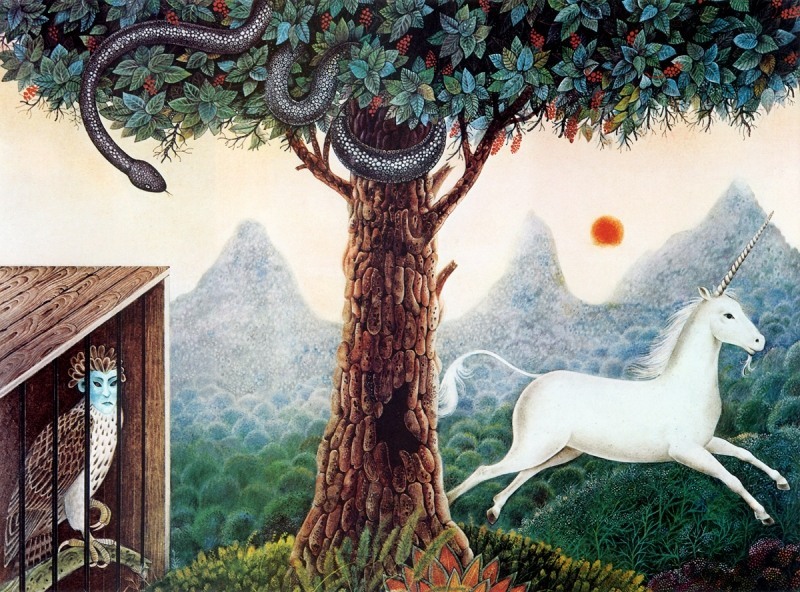
Left: a tree seems to grow out of the heart of a man dead and buried; in the background, green alien faces with empty skull-like eyeholes seem to watch. Center: Shimbo, Shrugger of Thunders (a heroic manlike figure haloed by light and armed with bow-and-arrows) is seen atop a cliff somewhat like the Isle of the Dead in Böcklin's paintings. There are cypress trees on either side of him. Below, sprawled in the foreground, is Belion, a nonhuman with green scaly skin and three pairs of arms, who watches Shimbo's approach with seeming alarm.
Left: Diane & Leo Dillon’s cover of the first edition (Ace, 1969).
Center: J.H. Breslow’s cover for a later Ace edition (1974).
Right: Philippe Caza’s cover for the French translation ( J’ai Lu, 1993).
All snerged from ISFDb.

Is Isle of the Dead sword-and-planet? The way I just described it may imply “yes”. Others might say “no”.

This is, one might argue, a pretty standard science-fiction novel by the standards of the 1960s, featuring a high-technology culture with frequent space travel. How could a science fiction novel with realistic technology like FTL ships, laser weapons implanted in fingertips, and resurrection technology possibly qualify as a kind of fantasy?

Well: remember that not-exactly-serious definition from above: “a lone American (not a Canadian–not a Ugandan–not a Lithuanian–an American) is mysteriously plunged into an exotic other world which is both more advanced and more primitive than the earth he knows. He conquers all by virtue of his heroism and marries the space princess.”

The hero is an American from the late 2oth century. He is plunged into an exotic future world by a series of STL interstellar voyages, during which he is in suspended animation. He finds himself in a universe which is more advanced than the one he came from (the aforesaid FTL ships etc), but also more primitive: the most advanced people in the galaxy, the Pei’ans, live in a low-tech environment, engage in something very like magic, and practice an ethos dedicated to elaborate revenge. There’s even a space princess in the story, who the hero ends up with. So maybe this story is sword-and-planet, or at least adjacent to it

The hero, Francis Sandow, learns the wisdom of this ancient race and becomes a Dra—both a priest in the ancient Strantri religion, and a worldmaker—someone who can use tremendous technological and personal forces to reshape worlds. This is a godlike power, and each Dra is associated with one of the countless gods of the Strantri religion in a mystic ceremony where the would-be Dra and the god become entangled with each other.

Sandow is a reasonable person, even and you and I are, and he doesn’t believe this nonsense for a moment. The stuff about being a god is just metaphorical: “It is a necessary psychological device to release unconscious potentials which are required to perform certain phases of the work <of worldbuilding>. One has to be able to feel like a god to act like one.” As far as Sandow is concerned, Shimbo, Shrugger of Thunders, whose image lit up when Sandow passed it during the confirmation ceremony, is just a figment of his imagination—a mask he wears, a tool of his trade, not a god.

Maybe so. But others feel differently. Shimbo has an ancient enemy among the gods: Belion the Destroyer. Gringrin Tharl, a Pei’an fundamentalist, who resents the revisionist attitude of Sandow and the other worldmakers, undergoes the confirmation ritual and becomes identified with Belion. Then Gringrin (or Belion) launches on a centuries-long quest for revenge against Sandow, who doesn’t even know he exists. This climaxes when Gringrin (or Belion) kidnaps a half-dozen of Sandow’s friends, lovers, and enemies, both living and dead, and challenges Sandow to come and get them from the Isle of the Dead.

This not being a fantasy novel (unless it secretly is), the Isle of the Dead is located on a world named Illyria which Sandow himself created on commission centuries before. Gringrin/Belion acquired it and has been corrupting it as part of his/their revenge against Sandow/Shimbo.

In the end, Sandow has to go alone, on foot, to the river Acheron and the Isle of the Dead to confront his enemy, who is wearing a face he will not expect.

This is the summary of a ripping yarn, in my view. Does Zelazny actually deliver one?

Well, yes and no. Zelazny has to get his hero from a mundane world to a magical one (cf Nine Princes in Amber, where Corwin wakes up in a 20th-century hospital suffering from amnesia and has to grope his way into the magical world he senses but does not understand or remember). From my point of view, this is hampered by the fact that Sandow, at the story’s beginning, is kind of an unlikable character, rich and crassly materialistic “eating fancy meals <and> spending my nights with contract courtesans” as he himself puts it.

Once he gets jolted into motion, the story works a little better for me. There is a long detour to justify the idea that Gringrin could scientifically resurrect the dead from Sandow’s past and be holding them prisoner in the narrative now. I found this somewhat tedious, and no more convincing than if a sorcerer waved a wand to get the same result. But this is the kind of narrative furniture that you stumble over when you’re dealing with one of these heroic fantasies disguised as sf.

It’s when Sandow lands on Illyria and begins walking toward the Isle of the Dead that the story really begins to fulfill its promise. Sandow considers the gods to be convenient fictions, made for the benefit of mortals. The gods themselves have different ideas, and bring the situation to mortal conflict in conflict with the wishes of the mortals involved. But, in the end, it is Sandow, not Shimbo, who strikes the deciding blow and emerges, still-breathing if badly wounded, from the final confrontation.

So: good things and bad things here. Good things include some vivid characters (especially Nick the dwarf, who blazes like a comet through the second half of the book, and the would-be Dra Gringrin Tharl who acts as both enemy and sidekick to Sandow), and some entertaining Raymond-Chandler-in-space passages filtered to us through Sandow’s narrative persona.

On the down side: Zelazny, like Brackett, was one of the great stylists of 20th-Century sf/f, but he’s not working at the top of his game here. De gustibus, etc, but I don’t find his descriptions of the Isle of the Dead anywhere near as evocative as the paintings, the music, or even the movie focused on the same scene. Zelazny also displays his willingness to go for the cheap laugh, at the expense of more important values. The planet Illyria has three hurtling moons, similar to but different from Barsoom’s. They are called Flopsus, Mopsus, and Kattontallus—Flopsy, Mopsy, and Cottontail. I can see Zelazny smiling to himself as he typed these names out, but they disrupt the heroic scene that Zelazny is setting. And the last scene of the book includes the most unforgivable line in the Zelazny canon: “Forgive me my trespasses, baby.” Urgh.

Also: Zelazny’s women tend to be malicious, to the extent that they’re not passive, and this novel is more evidence of that. Some women are passive, of course, and others are malicious. It’s the regularity with which these tropes appear in Zelazny that makes my teeth grate. In this way, Zelazny is somewhat less modern than his older contemporary, Brackett.

One of the things that makes me think that Zelazny is riffing on, or replying to, Brackett’s novel is that genocide comes up a couple of times. One doesn’t hear Zelazny murmuring, “Never again”, but at least the act is problematized in a couple ways.

Another is, as I mentioned above, the central conceit of both books, where a man acts (willingly and unwillingly) as the vehicle of a god. In both books, the man and god struggle for control. In both books, the final end is achieved only when the man and god can bring themselves to work in tandem.

And both are heroic fantasies with a candy-coating of super-science—magic, by Clarke’s Third Law.

I don’t seem to have any great thumping conclusion to put here, but maybe my patient readers feel like they’ve been thumped enough.

In summary, these works of heroic fantasy have some flaws, but remain worth reading. Forgive them their trespasses. Maybe someday someone will do the same for you.

Mirrored from Ambrose & Elsewhere.

jamesenge: (eye)

A cartoon from an old (1927-vintage) issue of The New Yorker. It made me smile, even though it’s probably supposed to appeal to class and ethnic biases.

Cartoon of a shop window for "J.M. Dumkupf—Plumber".The window displays a version of the Hellenistic statue group of Laocoön and his sons being consumed by snakes, except in this version the snakes are serpentime pipes.The caption: "on beautifying the city."
cartoon by O. Soglow (?) in The New Yorker issue for Sept 17, 1927

“Look, my dear friend Amaryllis Partington-Smith-Symythe-Vanderbilt-Smythington-Smyth–a banausic of foreign abstraction, decorating his shop-window with classical statuary! Très amusant!”

“Wasn’t your dad a fruit-peddler named Rabinowicz?”

“SHUT UP, YOU WHORE!”

Mirrored from Ambrose & Elsewhere.

jamesenge: (eye)

Executive summary: Immortality, Inc., Sheckley’s first novel, is a fast-moving tour of wonders and horrors, well worth reading, even if its individual parts are greater than the novel as a whole.

A man's face surveys a chaotic image-scape: the supine body of a man with futuristic devices attached to his head, a ghostly image of a man in the forground on the right; in the right background, the silhouette of a man in some kind of tunnel, with another manlike figure near him. A bubble containing the angry face of a man with a dark bird overhead is seen at the right edge of the image, surmounting a chaotic columns of bubbles and flashes. A network of lines, like root networks or nural branches, connects the various zones of the imagescape.
Wally Wood‘s illustration for part 1 of the serial version of Sheckley’s novel

The novel goes by a number of different names. It originally appeared as a Galaxy serial (Oct. 1958-Feb. 1959). Then-editor Horace Gold never saw a title he didn’t want to change, so that version was called (as you see above) Time Killer.

Four Sheckley covers. The Avalon version at left features a white guy in a white hoodie and loose white trousers standing in a spacescape. Right of that is the cover of Bantam's edition featuring some abstract shapes, a naked man in profile, and what looks like a man with his skin off. Next to the right is the tie-in version for FREEJACK. Furthest to the right is the cover of NESFA's DIMENSIONS OF SHECKLEY. The cover painting depicts the aging Sheckley's face in the midst of a wild and beautiful cosmos.
Sheckcovers! Artists, from left to right:
Ric Binkley, Louis Glanzman, Cutten Paste, Bob Eggleton

Another version (abridged without Sheckley’s approval) appeared as Immortality Delivered (Avalon, Dec 1958—before the Galaxy serial was completed). This was soon followed by an unabridged version from Bantam with the title Immortality, Inc. That title, presumably Sheckley’s preferred one, was stable over succeeding editions. (Here’s hoping the text was, too.) The movie was filmed (badly, it would seem) as Freejack (1992).

I first read the book in the early 90s in the undistinguished tie-in version, which I’ve somehow retained over the decades when more beautiful and/or valued books have been lost by the wayside. I reread it this time in the NESFA collection Dimensions of Sheckley which I strongly recommend (along with its companion volume The Mask of Mañana, an omnibus of Sheckley’s short fiction).

The distance in time and space between my two reads of this book was so great that it was almost like reading the novel for the first time. I remembered nothing of the characters or the plot. But after I was fairly deep into the book, its central fantastic idea began to ring a bell with me.

And, to be honest, the plot and characters are not very memorable. The hero, whose name I had to look up to write this paragraph, is a guy named Thomas Blaine. He’s a fairly well-off white guy, living in and around New York City in 1958. His job is that of junior yacht designer at a well-respected firm. Anyway, that’s his job title. Other people do the creative work; he draws deck plans, deals with promotions and advertising and liaisons with other firms. It’s an unextraordinary life, as he is well aware, but it satisfies him well enough, and then he dies. This happens on page 1.

Blaine wakes up in someone else’s body in 2140. He has some trouble getting settled in the 22nd century (I’ll go into that in a minute), but he eventually gets the job of office boy in a yacht designing firm. He’s so good at the office work that he gets promoted to junior yacht designer; the premise is that he’ll do the design work if somebody comes in wanting an antique 20th-century-style yacht. That doesn’t actually happen much, so he mostly draws deck plans, and deals with promotions and advertising and liaisons with other firms. Eventually he has to flee to the other side of the world to save his (?) life and ends up in Nuku Hiva. He takes a job as Master Boatwright at a boatyard. It’s interesting work and he takes to it well. But after he writes a few promotions that bring the yard more business, he starts to spend more time in the office; he deals with promotions and advertising and liaisons with other firms.

Maybe you see why it’s hard to remember the guy. With three completely different shots at life in two different centuries and two different bodies, he always ends up with the same old life. It would be different if he had some sort of fierce calling that burned its imprint into every path he chooses, but he’s just a guy who drifts along via the path of least resistance. Other characters are even less vividly drawn.

It might seem as if I’m grinding an axe to decapitate this book, but I really just want to get the duller stuff out of the way and get into the good stuff.

The fantastical idea at the core of the novel, and the way Sheckley explores it, is the best thing about the book. This idea is that the mind is detachable from the body. Given the proper highly scientific technology (not magicthat is right out), the mind can be extracted from its original body and inserted like a floppy disk (ask your grandparents, kids) into someone else’s body; in yet another process, a mind can be strengthened so that it can exist without a body at all. Decades of mental and spiritual discipline can achieve the same end (we’re looking at you, Stoicism!) but in the 22nd century anyone can have this benefit of life after death—if they can afford to pay for it.

This implies the existence of a scientifically provable afterlife (not necessarily religious—but not necessarily not). Also ghosts, who can haunt you in a very real and disturbing fashion. It also implies werewolves (e.g. if somebody’s mind gets stuck inside a wolf). Likewise zombies: if somebody’s mind gets attached to a body that isn’t fully capable of sustaining life anymore. Also: a novel kind of travel, smuggling a mind from body to body until it reaches safety.

All of these things receive some attention in the book, and it’s fascinating to see the changes Sheckley rings on his idea. For instance: reincarnation and “hereafter insurance” are expensive—strictly for the upper classes. But if a rich old person wants to be reincarnated (i.e. have his mind shifted to) a healthy young body, they could pay a poor person to surrender their body in return for the assurance of an afterlife.

In the image, a man holding a futuristic weapon looks at the image of a woman in a viewscreen as she lights a cigarette.
“Watch out, lady: those things can kill you.”
Ed Emshwiller’s illustration for Sheckley’s “The Seventh Victim” from its first appearance in Galaxy (April 1953)

The fact that people can survive death has, in the story, a lot of implications, the most startling (and plot relevant) of which is this: murder isn’t always a crime. For instance, a rich person who was assured of an afterlife could go out in style by commissioning a hunt with a crew of professional assassins as the hunters and himself as victim. This idea of people being hunted by other people goes back, at least, to Connell’s “The Most Dangerous Game”; Sheckley had treated it before in “The Seventh Victim” and would return to it again, but the version here is fitted to Sheckley’s notion of a proven afterlife. Blaine gets involved with a couple of these human hunts; in one of them he’s a hunter; in the other, he’s the quarry.

The plot is mostly an excuse to run Blaine through the horrors and wonders of his new century, and does a pretty good job of it. Blaine is snatched from the moment of his death into the future, courtesy of the Rex Corporation. It’s a stunt to prove they can do it, even though it’s arguably illegal. And, it turns out, corporate brass decide they’d rather not have done it: the head of the corporation axes the project and Blaine is out in the cold, trying to find his way through a world that has no place for him. His steps are being dogged by a zombie, for reasons that neither Blaine nor the zombie fully understand, but which make sense when Sheckley unveils them. Blaine is also haunted by ghosts, one friendly and one unfriendly, and the details of how you deal with ghosts (whether it be self-defense or just communication) are interesting and convincing, without ceasing to have a certain eeriness.

As a sword-and-sorcery writer I wanted more straight-up adventure. In particular, a fight with a werewolf or twelve would have brightened things up a bit. But Sheckley, alas, does not go there. Blaine’s journey through the underground city of zombies and his conflict with the malicious polyergeist who’s making his second life hell are some compensation for this.

For the 21st-century reader, a few things in the book were a little unsatisfying. The character you think is slated to be the hero’s girlfriend is, in fact, slated to be the hero’s girlfriend. There is one other woman in the plot; she and the hero also have sex. That’s why women appear in this story; otherwise the characters default to male. There’s a bit about the Chinese colonizing Mars. One character invites Blaine to a meal of Martian food, and Blaine is excited to try it, but it just turns out to be the same as the Chinese-American food Blaine already knows. That’s mildly amusing. But then the hero asks his host if “the Martians” also opened a lot of laundries, and is gratified that the answer is yes. Chinese exist to launder clothes and produce Chinese food, just as women exist for the hero to have sex with. Sheckley’s future world is haunted by mid-century ethnic and gender stereotypes. There’s not a lot of this, thank God, but the book would be better without any of it.

One has a sense that Sheckley is trying to say something about life and about human identity in this story. I’m not sure his grasp matches his reach, here, but the ambition propels him and his hero to some interesting places.

It could easily be 30-some years before I reread this book again (since I’m not planning on dying). But if and when I do, I expect I’ll enjoy it then, too.

Mirrored from Ambrose & Elsewhere.

jamesenge: (eye)

The Surprised Eel on their Patreon gives us a very nice piece of writing that usefully complicates some over-simplified worldmaking advice.

screenshot of the Surpised Eels Patreon post linked in the sentence above

One thing that leapt out at me was this:

“Of course, your fantasy world doesn’t have to work like the real world, but most people’s fantasy realms operate with the same basic rules of physics as our own.”

Both parts of this statement are true, but I’m not convinced the second part ought to be true.

Fantasists are missing a bet if they unthinkingly accept the restrictions of our reality for their invented reality. If your Elfland is just like Poughkeepsie, you might as well set your story in Poughkeepsie.

If it’s not like Poughkeepsie, you have the liberty of saying “Water runs uphill in Vrandobogia” or “The river divides here because the twin daughters of the River Vrand had a quarrel” etc.

Scientists & historians must have fidelity to facts. Fantasists must have fidelity only to our dreams.

[ETA:

TL;DR version: In fantasy worldmaking, the impossible is not only possible; it is desirable.]

Mirrored from Ambrose & Elsewhere.

jamesenge: (eye)

If an evil fate cast me back in time to the late 1930s, and I were compelled to join one of the factions emerging in the tempest-filled teapot of early sf fandom, I would probably side with the Futurians. They were a bookish lot, forward-thinking on class and gender, as a rule, and insisted so hard that science fiction should be better that they actually made it better. A good share of the best writers of the 1950s were Futurians (e.g. Judith Merril, Frederik Pohl, C.M. Kornbluth, Asimov in his last worthwhile period), not to mention editors (Donald A. Wollheim, for instance, but also less heralded names like Larry Shaw and Robert A. Lowndes), agents (the aforesaid Pohl, and the more successful Virginia Kidd), and an artist or two (e.g. Hannes Bok, also a gifted writer), not to mention the first serious critics of science fiction, who were also notable for their own fiction: Damon Knight and James Blish. They were unquestionably a force for good.

The cover of Knight's group biography, THE FUTURIANS (1977)

And also, possibly, a force for bad. There is a counter-current in American sf from this period, one less concerned with correctness, maturity, and literary standards, one that embraced science fiction’s identity as a form of fantasy with technological furniture, one that embarrassed serious people with its ridiculous paintings of brass-brassieres covering pulpy pages awash with adventure fiction.

Great writers emerge from this tradition, too: Ray Bradbury, Leigh Brackett, Ross Rocklynne, etc. (Nobody remembers Ross Rocklynne nowadays, except weirdoes like me, but he had some great moments.) But they didn’t win Hugos (if we exclude retro-Hugos, as I think we should).

Part of this is due to timing: the pulps, strictly speaking, were dying or dead by the time the Hugos got under way. But part of it is shame. Leigh Brackett and Edmond Hamilton and other heroic pulpsters went on publishing widely read adventure fiction in the 50s and afterwards; it just wasn’t the kind of thing that was respectable enough to garner awards. And the case could be made that Bradbury was the most important writer of sf in the 1950s, one who burst through genre limits and gained the much-coveted respect of the literary mainstream. But he was too clearly a fantasist to be taken seriously by the serious people of 1950s science fiction.

Confessional sidebar: I kind of hated Bradbury as a teenager, or thought I did. On the other hand, I read a lot of him. As an adult I can look at Bradbury and see clearly the childishness in his work that both repelled and appealed to me. At his best, Bradbury’s naivety is a strength that allows him to see the nakedness of emperors, and also the wonders/horrors that clothe the world. At his worst, it’s a squeaky affectation.

Of the Futurians, no one was more Futurian than James Blish. Behind his false whiskers as “William Atheling, jr.”, he was a harsh and demanding critic of science fiction. In propria persona he published fiction widely in the 1950s, frequently selling to John W. Campbell’s Astounding, a market impenetrable to many a Futurian.

He was also a relentless hack. I’m not even talking about the Star Trek books (which helped keep the show alive in the now-distant days when home-video and streaming markets didn’t exist). He was a publicity flack for the Tobacco Institute, a lobbying/marketing group whose activities led to many people’s deaths (including, ironically, Blish’s own). He wrote a sword-and-planet adventure novel, Sword of Xota (later reprinted as The Warriors of Day).

The cover of SWORD OF XOTA features a woman wearing a shocked expression, holding a retro-futuristic phone handset to her ear. She seems to be on a spaceship: behind her is a bank of scientific machinery and a porthole. The cover of THE WARRIORS OF DAY is an abstract representation of several human faces against an even more obscure background.
Left: Sword of Xota’s first appearance in 1951, art by Allen Anderson.
Right: the cover of The Warriors of Day from 1967, art by Armand Weston

And he published a couple times in Planet Stories, pulpiest of the pulpier sf/f pulps.

As critics, Damon Knight and James Blish normally sang in harmony, but there was at least one issue they disagreed about: the type of sf written by A.E. Van Vogt. It involves throwing at the reader constant twists and turns, new events, new characters, new ideas until the reader shouts, “This must be good!” (or just shuts the book and does something else). Blish called it the “intensively recomplicated” plot, and held that it could be done well. Knight called it the “kitchen sink” plot and was doubtful (although he did attempt one when he was in his 40s, Beyond the Barrier).

Blish’s Okie stories (collected in Earthman, Come Home) are intensively recomplicated stories (as Knight noted in reviewing them), but so are the two pulpier fictions Blish published in Planet Stories. Because I came across it first, I’ll talk about the later one, “Blackout in Cygni”, from the July 1951 issue. After I discuss Blish’s story, I’ll say a few words about the rest of fiction in the issue. Spoilers for these 70-plus-years-old stories follow.

The cover art depicts a stalwart blonde hero brandishing a sword, embracing a stalwart brunette heroine brandishing a dagger, both of them floating mysteriously in midair, surrounding by nonhuman bad folk with horns on their hats, against a bluish background of two cratered worlds.
Planet Stories, July 1951; art by Allen Anderson

Blish’s “Blackout in Cygni” is fairly ridiculous. It has a stalwart space hero, villainous space pirates, a glamorous space princess (or the equivalent), a shocking plot twist and a surprise ending. (Those last two are different, here.) It won’t make you feel different about humankind or enable you to see new colors in your soul. But the stock elements of the story work, I think, because of Blish’s dedication to the intensively recomplicated plot—his confidence as a writer, that he can pull it off, and his confidence in the reader, that they’ll be able to keep up.

The first page of "Blackout in Cygni" from PLANET STORIES (July, 1951). In the uncredited artwork: on the left, a stalwart heroine in a revealing costume fights against a male figure wielding some kind of raygun. On the right, a stalwart hero kicks a bad guy in the face. The background is a chaotic scene of rioting, surmounted by a viewport displaying a space scene.

Our hero is Dirk Phillips, first officer of the interstellar space-liner the Telemachus. The ship’s lower decks are packed with immigrants “in Supercargo” (which I think of as an officer in charge of cargo, not a place on a ship; it’s not clear whether Blish is unaware of this usage or if he just doesn’t care). But we find our hero stalking through D-Deck (for upper-class passengers) after getting off from a shift in the control room. Dirk hates these rich passengers and wishes the upper decks could be peeled off the ship and left behind.

But the ship is facing other dangers than class conflict. (Or is it? Hold that thought if you read the story.) A space pirate known only as Jason has been preying on the spacelanes that the Telemachus is spacelining. Nobody knows how Jason grapples with his prey in subspace; it’s supposed to be impossible.

On top of that, there’s another terror in space: darkness. Crew and passengers in spaceships whose lights failed on interstellar journeys through subspace have gone mad, the ships returning only with “a cargo of madness and death.” The cause is not fully known, but the symptoms can be treated: fail-safe nightlights powered by safe, friendly radioactivity are installed throughout modern starships, and the standard procedure is for the ship to drop out of subspace if lights fail.

Faster than you can say “As you know, Bob”, the Telemachus is afflicted with a blackout. Plus, the nightlights that are supposed to keep people from going crazy fail. Someone has replaced them with lights powered by fallible electricity, not good old reliable radioactivity.

Dirk figures it out, as you have probably already figured it out: the pirate Jason has an agent on the starships he attacks. This agent engineers a blackout at a given point in the journey; the ship drops out of subspace; Jason and his cutthroat crew pounce on the ship they’ve been waiting for once it appears in normal space.

The questions that emerge as Jason’s craft approaches the Telemachus are: who is the hidden agent of the space pirates? And: can something be done to defend the ship from the pirates? These questions will be answered; the day will be saved; the good guys will live happily ever after. It’s that kind of story. The secret villain is, interestingly enough, a politically powerful media mogul who wants Earth’s new colony to fail, because he fears it will diminish his power.

Is the story worth reading? Maybe. It’s pretty short, given all the stuff that happens in it; the pace is brisk. The nightmarish moments of the blackout have a certain power, although they might have more if they had a little more space in the story. The mystery is resolved intriguingly, if not 100% plausibly, and the space-princess (technically just a newscaster who is also the daughter of a bigwig on the governing Centrale Council) displays significant agency; she’s not just a prize for the hero. If you like efficiently told, deliberately old-school space adventures, or if you’re interested in Blish’s work, then yes: read this thing. If not, then maybe not.

One of the features of Roman comedy (think: A Funny Thing Happened on the Way to the Forum) is that little-to-no time is spent on character development. The audience knew the stock characters before the play began: the senex (old man), the matrona (Mrs. Senex), the adulescens (dopey young lover), the amica (sweetheart of the adulescens), the leno/lena (pimp), and most importantly, the low-class character who is smart enough to solve the problems the upper-class people can’t solve for themselves: the servus callidus (clever slave) or parasitus (parasite). The entertainment lay in the complicated, fast-moving stories the poet could get these familiar characters into. The intensively complicated sf story (whether by Van Vogt, Blish, or Charles Harness) has satisfactions something like Roman comedy.

Blish’s other story in Planet is a lot weirder, but I’ll talk about that another time.

The longest story in this issue is Poul Anderson’s “The Virgin of Valkarion”.

art by Earl Mayan

Anderson is the old-school sf writer with the widest range, in a bunch of ways. In 1951, he was already one of the most promising young writers in the Silver Age of John W. Campbell’s Astounding, and had a couple of different future histories in hand (which would eventually coalesce as “The Psychotechnic League” series and “The Polesotechnic League”/”Terran Empire” mega-series), and he was soon to blossom as one of the great writers of heroic fantasy in the 20th century with towering and influential work like The Broken Sword (1954) and Three Hearts and Three Lions (serialized 1953; book version 1961).

The quality of his fiction varies wildly, too. He was one of the great writers of mid-century sf/f, but his writing wasn’t always great.

This one is not Anderson’s very best, but it’s not his worst either. In it, Anderson is engaged in unabashed space opera, with a flashier, splashier style than the sedate, gray pages of the middle-aged Astounding would allow.

What’s it like? It’s like this.

“Tonight, so spake the Temple Prophecy, a sword-scarred Outlander would come riding, a Queen would play the tavern bawd, and the Thirty-Ninth Dynasty should fall with the Mating of the Moons!”

The setting is an unnamed planet with two moons and a medieval level of technology. Our hero, Alfric, is the sword-scarred Outlander of the prophecy. He’s coming to the capital city of the Empire of Valkarion to find employment when he’s attacked by assassins sent by the Temple of the Two Moons. He defeats them and enters the city, wondering what the powerful Temple priests have against him.

The last descendant of the imperial line is a woman, Hildabord, and in this savage period (1950s America, I mean) women weren’t considered capable of ruling. The High Priest of the Temple, Therokos knows this is the time of the prophecy. He figures that it means barbarians (like Alfric) will come in and extinguish the Empire. His plan is to do away with Hildaborg and rule as Theocrat. But Alfric and Hildaborg fall in together (I bet you didn’t see that coming) and backed by her Household Guards Alfric defeats the Temple’s minions and by the next morning is well on the way to establishing the 40th Dynasty by marrying Hildaborg.

No surprises here. The conduct of the story is mostly pretty competent, if generic.

One scratch from the poisoned missile of the southern blowguns was enough to kill a man. Alfric yelled and flung his hengist at the brush. The sword whined from its scabbard, flamed in his hand.

A hengist is a kind of horse. (Hengist means horse in Old English, but Anderson doesn’t expect his audience to know that; this is just the “call a rabbit a smeerp” principle in action.) By “flung” the narrator seems to mean that the hero rode hard at the brush that was concealing the blowgun-wielding assassins. That’s not so great. But there’s a touch of poetry in the description of the sword, and some of the other descriptions where Anderson is scrabbling to make emotional contact with the reader, sometimes successfully. But Alfric is not a particularly memorable hero—just a cut-rate Clonan. Anderson could and would do better.

The lead novelette of this issue is by an old favorite of mine, Ross Rocklynne.

Rocklynne first appeared on my radar via his story “Time Wants a Skeleton” from the heroic age of Astounding Science-Fiction. Harrison and Aldiss included it in The Astounding-Analog Reader and it kind of blew my mind.

The cover of ASTOUNDING for June 1941. The cover art, illustrating the Rocklynne story, shows a stalwart spaceman in a blue spacesuit striding across an alien landscape; behind him is a ghostly skeleton, apparently mimicking his movements.
Hubert Rogers’ cover art,
illustrating the lead story for the issue

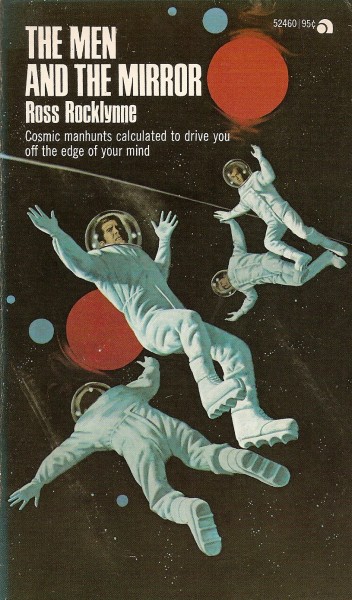
I kept my eyes peeled for Ross Rocklynne books, and soon found an Ace paperback, The Men and the Mirror. Years later, I found his The Sun Destroyers, as half of an Ace Double. And that’s it, apparently–all the Ross Rocklynne books there are or likely to be, unless some public-spirited publisher takes on the project of The Collected Ross Rocklynne.

Left: the art depicts a couple guys in spacesuits as they slide around a frictionless mirror; colored planets in the background are also reflected on the mirror.Right: the art depicts a flaming object striking a bluish world or sun.
left: Waldman’s art on the cover of The Men and the Mirror;
right: uncredited art adorning the cover of The Sun Destroyers

Rocklynne’s story in this issue of Planet is not a lost classic, but it does have its interest.

The art, splashing across two pages, depicts (in the background on the left) a spaceship grounded on a plain; ant-sized human-beings are visible around the rocket's tail-fins. In the foreground, on the right, is some kind of ground vehicle; two men are fighting in the open door of the vehicle as the driver looks on in dismay.
art by Herman Vestal

As the title “Slave Ship to Andrigo” might suggest, this story is about some sinister cultural practices. It’s kind of a noir-in-space story. The viewpoint character, Hawk Stevens, is a scumbag who crashed out of the Space Academy five years earlier. He’s now the captain of the Selwyn, a spaceship full of scumbags, the scumbaggiest of which is a pious fraud named Corpin. Their business model involves going to a planet called Andrigo, abducting a bunch of the natives (who are intelligent plants), and selling them into slavery.

The problem: the Andrigans or “Greenies” are somewhat telepathic—enough so that they can spot someone who’s approaching with hostile intent; then they scatter and can’t be found.

The solution: Johnny Single, Hawk’s one-time sidekick at the academy. Johnny stayed in school, graduated, got the girl—Hawk’s girl, or so he’d thought—and went to work at a straight job. But now Johnny’s out of work and comes to Hawk for a job on his ship. Hawk gives him the job, because he’s the perfect catspaw for the Greenies. They won’t suspect anything, as long as Johnny doesn’t know anything.

The kidnapping of a shipload of Greenies goes off without a hitch. But that’s the moment smarmy hypocrite Corpin has been waiting for. He and his gang inside the crew pull off a mutiny. From that point on it’s Hawk and his disillusioned friend Johnny against the rest of the crew. They’d be doomed except for two things: Hawk’s knowledge of his own ship, on the one hand, and on the other the Greenies, who unexpectedly hold the balance of power in the struggle.

The end of the story finds the Greenies safely back home, the mutineers kicked off the ship, and Hawk on the road to something like redemption.

Like I said: not a lost classic, but morally complicated in a way that old-school space opera doesn’t usually get credit for being.

Illustration: a bedraggled man in a spacesuit, lying in the wreckage of a spacecraft, gestures at bloblike alien lifeforms that appear before him.
Herman Vestal’s illustration for “Sign of Life”

I’d never heard of Dave Dryfoos before reading “Sign of Life” and after a glancing at his ISFDb page I didn’t know much more. He published a couple dozen stories between 1950 and 1955 (of which this is the third) and then seems to have disappeared from the science-fiction firmament. (The Science Fiction Encyclopedia has a little more detail, but not much.)

This is a pulp tragedy. The main character is going to die, as the writer helpfully tells us in the story’s fourth word. He’s George Main, lone survivor of Earth’s first expedition to Venus, but not destined to survive long. Their mission was to find out if there was life on Venus. Main discovers that there is, but a kind of life so strange that he has trouble recognizing it. When he does, he spends the rest of his brief life getting them to recognize that he is a kind of life—so that someone or something will survive as a witness to the life and death of Main and his shipmates.

Not a bad story; I’ll certainly read more from Dryfoos, although there doesn’t seem to be much more. Writers come and go; it looks like Dryfoos was a promising writer who left the field before his promise could be fulfilled. Maybe he went into advertising, or some other spiritually rewarding occupation.

Screenshot from MAD MEN. A businessman with an eyepatch and some scrapes on the side of his face looks sternly toward someone off-camera.
Aaron Stanton as Ken Cosgrove in Mad Men. IYKYK
Illustration for "Monster"; artist unknown. It the image, a man is firing a raygun toward the sky. Falling on the ground around him is the shadow of a monstrous flying beast.

“William Morrison” (the pseudoplume or nom de nym of Joseph Samachson) was a much more prominent sf writer in his day than Dryfoos ever was; he wrote a couple of Captain Future novels, some standalone novels of his own, and a long run of stories from the early 1940s to the late 1950s. But until I read this story (and then looked at his ISFDb page), I had never heard of him. Sic transit gloria mundi.

The situation in this story: Earth colonists on Mars are in terrible danger from giant predatory animals much like monsters. The solution, when it arrives unexpectedly, is obvious in retrospect: you get a monster of your own.

I ended up liking this story, though it strained my patience a couple of times. It sometimes reminded me (not in a good way) of George O. Smith’s Venus Equilateral stories, in which there is much space devoted to the dumbness of managers. On the other hand, I’ve had to deal with some clueless managers myself. Is there any upper limit to human stupidity? Contemporary history suggests otherwise.

Also, by the end of the story it was less like Smith and more like Clifford the Big Red Dog. I’ll be keeping an eye out for Morrison’s name or pseudonym in future forays into the past.

A young woman in a swamp fires a raygun at some bloblike alien beings.
illustration by Herman Vestal

I have not read much by J.T. M’Intosh, but I have yet to read anything by him that was worth the trouble. That includes this story. De gustibus non disputandum.

Illustration for "The Timeless Ones". The image shows a man and a woman, both in uniforms, in the control room of a spaceship. Outside the viewport there 9 hooded figures, standing in the yard of a farmhouse.
Herman Vestal is the artist.

Frank Belknap Long was a long-lived and prolific writer of sf/f, and his name was familiar to me, but I don’t think I’d read anything of his before now.

“The Timeless Ones” is maybe a little long for the thin story it tells, but there’s some (not wholly unsuccessful) attempt at establishing an air of mystery and danger. FBL got his start writing Lovecraftian horror and it shows here (in good and bad ways, I think).

The story involves Ned and Cynthia Jackson, a husband-and-wife team in command of the “contact rocket, Star Mist“, whose job it is to make a circuit of recent colony worlds and check on how they’re doing. They’re returning to a “green world… five thousand light years from Earth” which FBL never names, unless I missed it. They’re looking forward to seeing one family in particular, the Sweeneys, who had the kind of settled, peaceful life that the Jacksons have come to envy in the ten years since their last visit.

They land on the green world, but there has been no growth in the colony since they’ve left. On the contrary, most of the colonists have disappeared, probably died; only the Sweeneys are left. Since the Jacksons last saw them, they have not aged, including the children. There’s something odd about the Sweeneys’ mental state, too, and they have miraculous abilities, like teleportation and walking through walls.

It turns out that they’ve developed a symbiotic relationship with an alien race they refer to as “the Green People”, who are somehow identified with the Druids of Celtic Europe. (By the authority vested in me as a PhD in Classical Studies, I hereby state that the historical and cultural content of the story is pretty weak—about pulp standard, I guess.) Anyway, the other colonists did not develop a similar relationship and now they’re gone. Burned in Wicker Men, for all I know.

The Jacksons decide not to report back to Earth and instead go to join the Sweeneys in symbiosis with the Green People, where they will find a house already waiting for them

It was designed for gracious living; but whether the Druids, in their inscrutable wisdom, wished mankind well or ill, who could say?

I feel as if it’s Long’s job to say, but on this inconclusive note the story ends.

Not one for the reread list, I think, but I might have a look at Long’s other stuff sometime.

A man in futuristic garments (like Superman
Herman Vestal’s illustration for Vance’s “Temple of Han”

Now we’re talking. The next story, “Temple of Han” is by one of the greatest sf/f writers of the 20th century, Jack Vance. This is early work, a little rough around the edges, but is a solid fantasy adventure with some futuristic furniture—classic space opera.

Our hero is a rogue named Briar Kelly. (That’s not a typo.) He lives in an Earth colony on a world (which Vance does not name) fifty light years from Sol. The dominant species (which Vance also does not name) doesn’t like the “Earth-things” (as they refer to human beings), and there is no obvious reason why they should. Kelly, for instance, has snuck into the temple to their god Han and stolen a green jewel which they were planning to offer their god in a once-in-seven-years ritual.

Before you can say YAGLA, some unknown mystic force has thrown the planet across the universe, so far from Earth that the colonists are now helpless against the locals. The locals start to murder the colonists on an hourly basis unless and until their jewel is returned.

Kelly may be a thief, but he’s not completely worthless, and he goes back to the temple with the jewel to offer himself up to the locals’ justice and revenge. The chief priest is prepared to accept the jewel and Kelly’s life, but does not propose to spare the lives of the other “Earth-things”. He explains to Kelly how serious the infraction is: the hard-won jewel was slated to be taken through a magical—I mean highly scientific portal to the Place of the Gods, where it would be received by Han himself.

Kelly takes the jewel and crashes through the portal himself; he confronts Han among the other YAGLAs who inhabit the Place of the Gods. With his own cunning and bravery, and a lot of help from one of the YAGLAs who doesn’t like Han, Kelly triumphs and returns to the nameless planet, now in statu quo ante except that the locals can’t call on Han anymore, as there is no Han anymore.

I guess this means they can now be safely crushed under the boots of thieving Earthfolk. Vance was not the kind of guy who worried about that sort of thing, although some space operators did (e.g. the Rocklynne story in the present issue, or editor Jerome Bixby’s story “Small War”, which would appear in Science Fiction Quarterly a few years later).

The central conceit of this story (mundane man goes through portal to confront strange gods) re-appears in Vance’s Cugel story, “A Bagful of Dreams”. The latter story (eventually folded into Cugel’s Saga) benefits from more than a quarter-century of Vance’s experience in writing fantastic adventure about scurrilous characters. But the earlier story is still worth a read or two.

In the illustration, a rocket is seen from above, spiralling down toward a coastline, leaving a trail of exhaust.
uncredited art for Mack Reynolds’ “Mercy Flight”

Mack Reynolds is one of the more baffling figures of mid-century science fiction, at least to me. He almost invariably got hold of really interesting ideas for his stories. For instance, what would happen if African-Americans did as bigots were constantly proposing and went back to where they (or their ancestors) came from? That’s the subject of Reynolds’ El Hassan series, a post-colonial nightmare or fantasy. Interesting, but I can’t recommend it as fiction. Or: what if corporate warfare were literal, not figurative, fought by mercenaries under strict rules and broadcast as entertainment? That’s the subject of Reynolds’ Mercenary from Tomorrow. Interesting, but I can’t recommend it as fiction. Or…

But maybe you see where I’m going here. Reynolds always has an interesting idea. But I’ve yet to read anything by him that I feel I could hand to a friend and say, “This is good. You’ll like it.”

That includes the present story, “Mercy Flight.” In it, a spaceship pilot named Phil Mooney has recklessly lifted off from Luna to bring a sick girl to an Earth hospital before she dies. But his radio has failed: it can broadcast but not receive. A disastrous crash-landing seems imminent, but is avoided by the efforts of a great many people. The last page of the story has Mooney congratulating himself on his heroism and self-reliance—blissfully unaware of the many people who made his happy landing possible.

This story is the sound of Reynolds biting the hand that frequently fed him: John W. Campbell jr. JWC loved stories of tough, self-reliant heroes, and Reynolds just didn’t buy that crap. He was a card-carrying Socialist who looked at his present and any possible future with a critical eye.

I just wish I liked his fiction better. It’s talky, not well-written, and full of cardboard characters. But if you wanted to give his work a try, this would be a relatively painless sample.

Along with the name and date of the magazine, the illustration features a stalwart spaceman with blasters in both hands, above and next to a space lady in a bubble-helmet and a miniskirt, against a background of stars, planets, and spaceships.
artist unknown; header illustration for the ToC

OK. Uff da. If I’d known how long this was going to take, I might not have ventured on it. Kudos to you for plowing through it all. (If you didn’t, of course, you’ll never see this.)

There’s another Blish space opera banging around in the ether of my imagination these days, but I’ll talk about it (and its issue of Planet Stories) another time.

Mirrored from Ambrose & Elsewhere.

jamesenge: (eye)

Past Me is sometimes a deadly enemy. For instance, he only left me two pieces of pizza from the other night so that I could celebrate the first day of True Summer with the Breakfast of Champions–cold pizza and hot tea, ideally enjoyed sometime in the early afternoon. Two pieces! Hardly worth getting out of bed for.

On the other hand, he’s sometimes a solid friend. A week or two ago, he ordered some books in anticipation that they would arrive this week for the beginning of my sort-of vacation. It’s a pretty good stack.

photos of 5 books: TWILIGHT OF THE GODS by Edmond Hamilton; RIME ISLE by Fritz Leiber; THE WATERS OF CENTAURUS and A HANDFUL OF TIME by Rosel George Brown; THE DRAGON MASTERS backed by THE LAST CASTLE, an Ace Double by Jack Vance.

I have an ebook of the DMR book, which collects some of Edmond Hamilton’s mythological fantasies, but I liked it so much I wanted a physical copy.

I’ve been on kind of a Rosel George Brown kick, lately. She was a talented writer who tragically died of cancer when she was just getting started. Maybe I’ll have more to say when I’ve worked through these.

Like all right-thinking people, I must have four or five copies of The Dragon Masters and The Last Castle in different formats. But I’ve long wanted the one Ace Double edition that collects them both, and now I do.

Rime Isle (Whispers, 1977) collects “The Frost Monstreme” (first seen in Flashing Swords 3) and “Rime Isle” (serialized in Cosmos, where I read it with bated breath lo these many years ago). But they really belong together as a single short novel. They were, of course, collected together in Swords and Ice Magic (Ace, 1977), with a great Michael Whelan cover. But, if I’m being honest with you (as is my practice, since it’s just you and me here in the absolute privacy of my blog, where no one ever comes) the other stories in Swords and Ice Magic are less than essential Leiber. It’s nice to have them by themselves, and as a bonus this edition is illustrated by Tim Kirk, one of my favorite fantasy artists from the 70s.

Photo of two books: the ACE Double of The Last Castle, backed with THE DRAGON MASTERS, and the cover of RIME ISLE without its dust jacket.
Left: the flip side of the Vance double-novel.
Right: the cover of Rime Isle without its dust jacket.

I like the embossed volcano-in-a-glacier on Rime Isle‘s cover.

Close-up of the volcano embossed on the RIME ISLE cover.

This edition came with an unexpected bonus: signatures from the artist, the designer, Stuart Schiff (the genius behind the journal Whispers and Whispers Press), and Leiber himself.

signature page from RIME ISLE
Title page of RIME ISLE, signed by Kirk and featuring decorations including a frosty, frozen, seascape and a wily-looking dragon.

So: Past Me. Not totally a bad guy. But you can’t trust him with your pizza.

Mirrored from Ambrose & Elsewhere.

jamesenge: (eye)

Not trying to subtweet anyone, particularly my students, whose papers I’m wading my way through. But I’ve had a lot of occasion today to think about the identification of “great” with “first/inventor”. If some creator/creation is a a great example of something, and maybe the most famous example of a thing, there is a tendency to treat them/it as the first instance of the thing.

e.g.

“Bozo invented the tradition of modern clowning, setting the stage for the great clowns of the late-20th century, like Crusty and It.”

This seems like it’s just a compliment to Bozo. But it actually erases earlier, maybe even more important clowns like Emmett Kelly. Celebration of Y shouldn’t cause the erasure of X.

Black-and-white pictures of clowns. Left: Emmett Kelly in his sad-hobo makeup. Right: someone in Bozo makeup.

Not sure where the source of the first=best error lies. It could be from sports culture, where the second person across the finish line is nowhere near as glorious as the first. Or maybe it’s from science/technology, where the second guy to split the atom is not the guy who gets the Nobel Prize. 

Those standards are not wrong, but they’re typically not going to apply to the arts. Think of all the misconceived arguments about who “invented” science fiction, as if it were the telephone or the radio.

The opposite error is the myth of progress–that later=better. So novels published in 2025 are marginally better than those published in late 2024, but not as good as those that will appear in 2026. That tendency may be true of computer hardware, but is never going to be true of writing, music, the visual arts, etc.

A still greater error is spending endless hours on social media rather than doing work that has to be done, in the vain hope that elves will come along and do it for me. That’s a mistake.

OR IS IT

A still from THE WONDERFUL WORLD OF THE BROTHERS GRIMM (1962), illustrating "The Shoemaker and the Elves".
Screenshot

Mirrored from Ambrose & Elsewhere.

jamesenge: (eye)
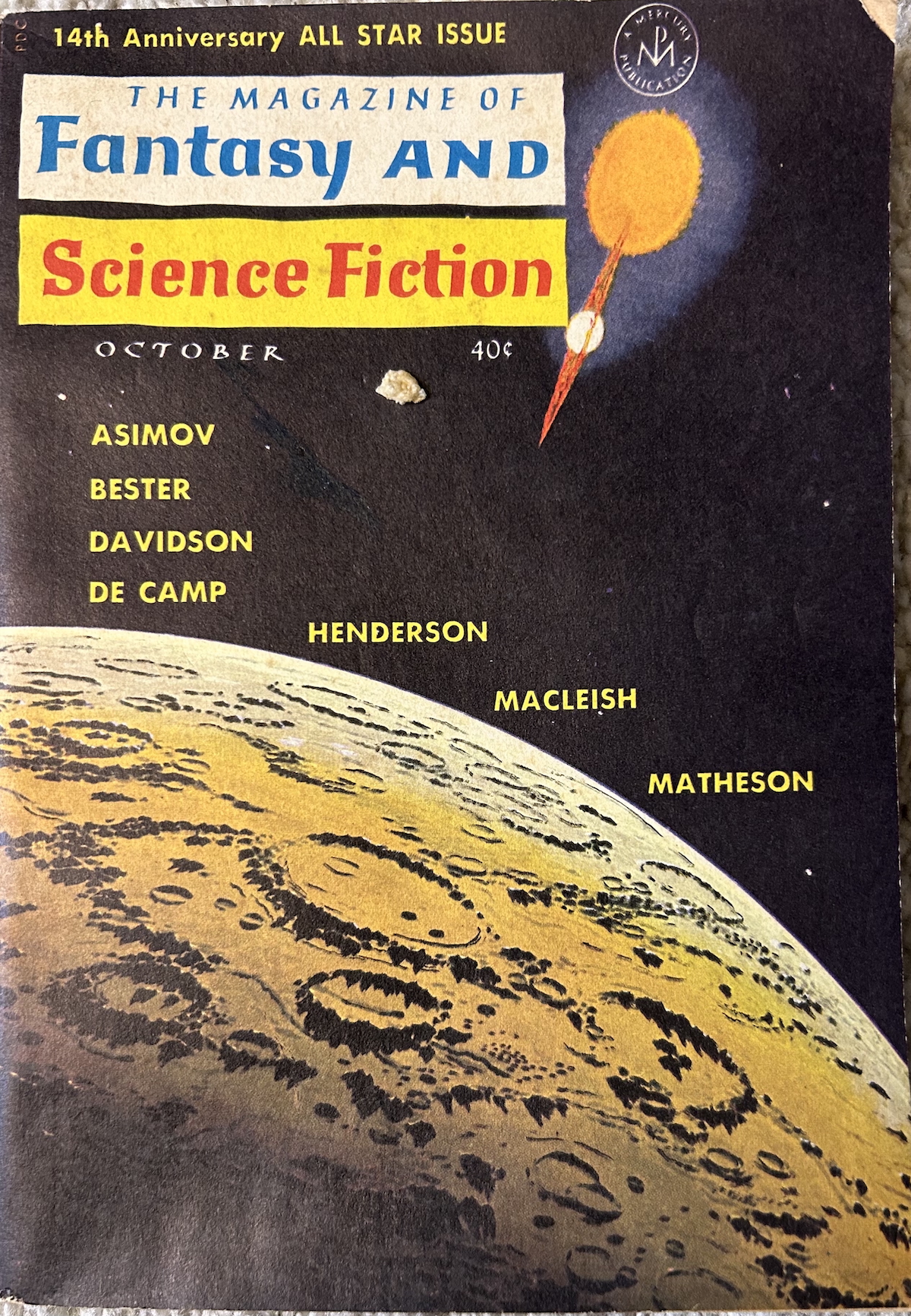
the cover of F&SF for Oct 1963; image is an astronomical painting by Bonestell of a lifeless cratered planet or planetoid in orbit around a binary star

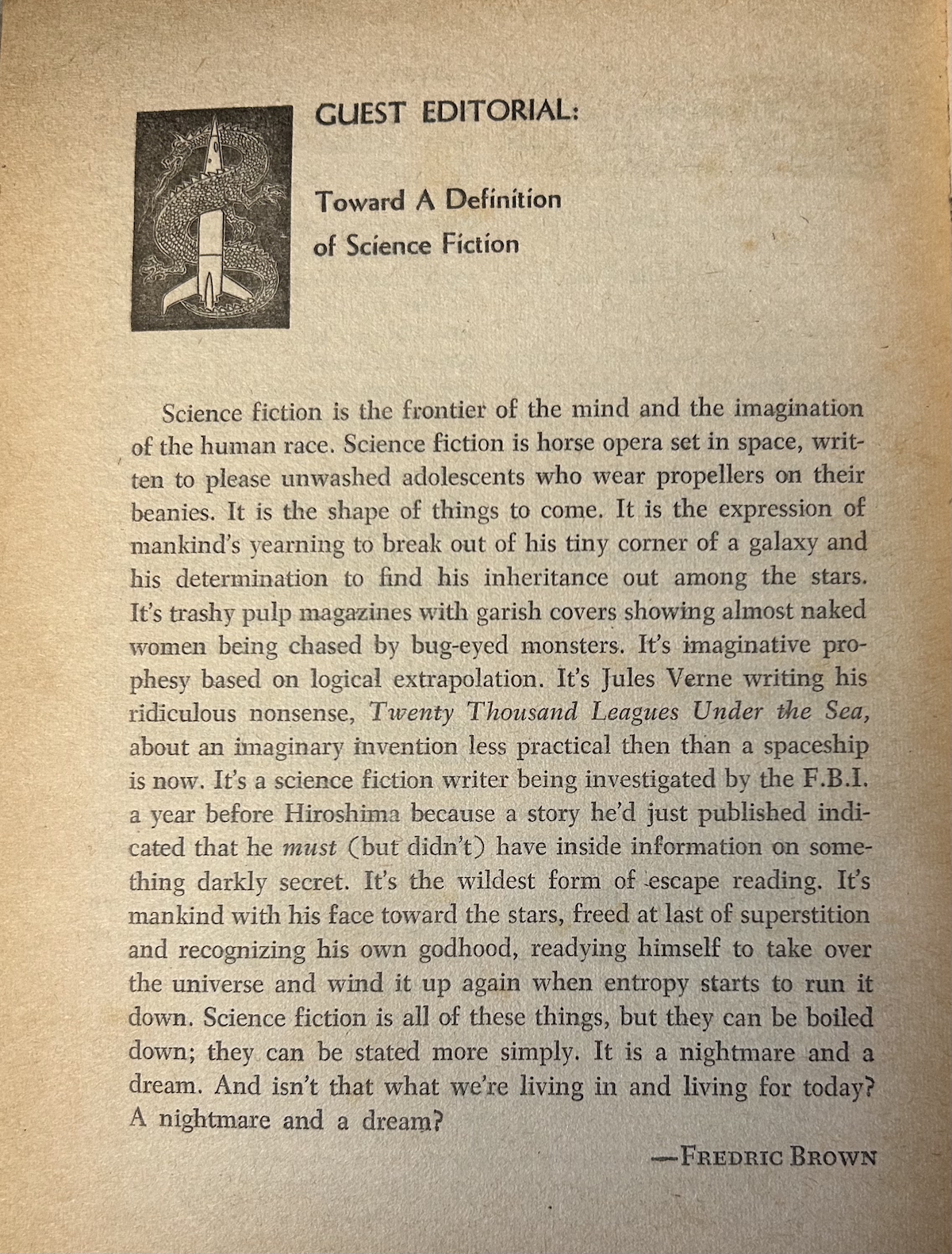
Much of the short paragraph below by Fredric Brown is outdated and/or not meant to be taken seriously. But I like his conclusion about sf, which I would broaden to include fantasy (as sf often did in those now-distant days: note the dragon wrapped around the spaceship in the image).

“It is a nightmare and a dream. And isn’t that what we’re living in and for today? A nightmare and a dream?”

image: a dragon wrapped around a spaceshiptext:Guest Editorial: Fredric Brown: Toward a Definition of Science FictionScience fiction is the frontier of the mind and the imagination of the human race. Science fiction is horse opera set in space, written to please unwashed adolescents who wear propellers on their beanies. It is the shape of things to come. It is the expression of mankind’s yearning to break out of his tiny corner of a galaxy and his determination to find his inheritance out among the stars. It’s trashy pulp magazines with garish covers showing nearly naked women being chased by bug-eyed monsters. It’s imaginative prophecy based on logical extrapolation. It’s Jules Verne writing his ridiculous nonsense, TWENTY THOUSAND LEAGUES UNDER THE SEA, about an imaginary invention less practical than a spaceship is now. It’s a science fiction writer being investigated by the FBI a year before Hiroshima because a story he’d just published indicated that he _must_ (but didn’t) have inside information on something darkly secret. It’s the wildest form of escape reading. It’s mankind with his face toward the stars, readying himself to take over the universe and wind it up again as entropy starts to run it down. Science fiction is all these things, but they can be boiled down; they can be stated more simply. It is a nightmare and a dream. And isn’t that what we’re living in and for today? A nightmare and a dream?

Mirrored from Ambrose & Elsewhere.

jamesenge: (eye)

Pedantry is an occupational hazard for someone in my profession(s), so I’ve been trying to nail down the salient trait(s) of a pedant, mostly in order to watch for them in myself.

The cover of Cyrano's LE PÉDANT JOUÉ in the Londres edition. The cover painting is from an anonymous French painter circa 1580 depicting actors of the commedia dell'arte.

A few stabs at the target:

A pedant is someone whose acquisition of knowledge has impeded their ability to perceive and/or to reason.

A pedant is someone whose desire to prove someone wrong exceeds their desire to understand what that person is saying.

A pedant is someone whose impulse to educate has impaired their ability to learn or understand.

A pedant is someone who weaponizes knowledge in an attempt to achieve social dominance.

Mirrored from Ambrose & Elsewhere.

jamesenge: (eye)

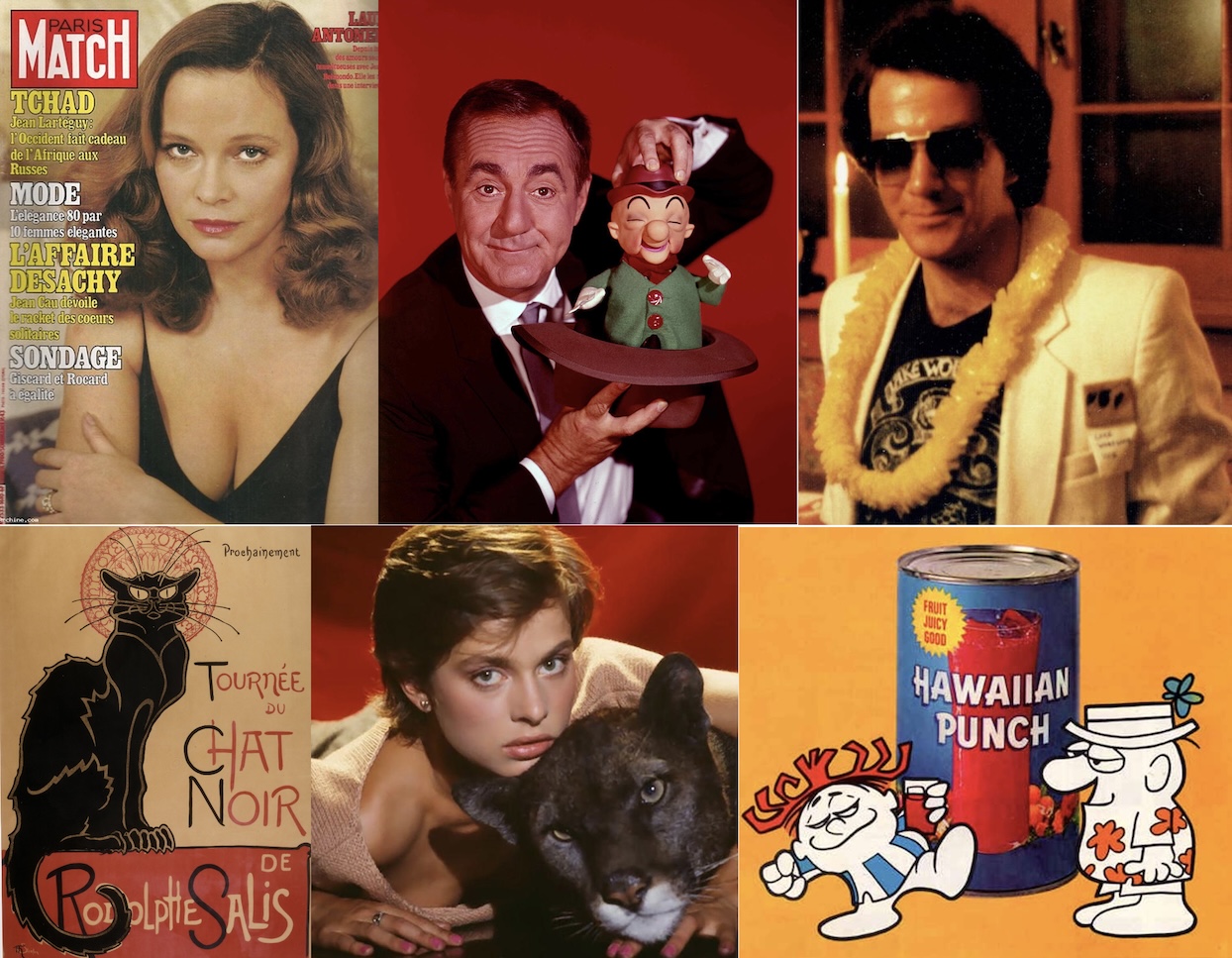
Last night at the movies: a daring raid on an 24-hour check-cashing place on Halloween night was planned by a thirtyish Laura Antonelli and a middle-aged Jim Backus, who had the Hawaiian shirt of Thurston Howell III and the mannerisms of a sinister Mr. Magoo. (Actually, Howell doesn’t seem to have worn a Hawaiian shirt. My subconscious may have been confusing him with the Hawaiian Punch guys.)

6 photos. See caption for details.
Dramatis Personae.
Upper left: Laura Antonelli on the cover of Paris Match (April 4, 1980)
Upper center: Jim Backus holding a Mr. Magoo doll in his hat.
Upper right: me, at a costume party as Lake Wobegon Vice (circa 1984)
Lower left: the famous Chat Noir poster.
Lower center: Nastassia Kinski and fuzzy friend (circa 1982)
Lower right: the Hawaiian Punch guys (puncher & punchee)

Antonelli had recruited me for the caper. Also figuring in the plot was a goofy black cat with pipe-cleaner limbs who was the only member of the gang that everyone liked, and a Kelly-green velvet frock-coat that was supposed to be part of someone’s disguise for the robbery. 

Antonelli’s plan-within-a-plan was that she and I would freeze out Magoo with the help of her friend (a Cat People-era Nastassia Kinski), who would pretend to be ill. While he was busy tending to her, Antonelli and I would commit the robbery by ourselves. 

Antonelli was acting crazy while Kinski was off roping Magoo, and I told her I was out. She wanted it too much; she was making mistakes; and I had to figure that, if she was ready to doublecross Magoo, she was likely to do the same to me. 

Antonelli was still trying to get me to change my mind when Kinski, on schedule, faked her illness. Antonelli insisted that Magoo take Kinski to the hospital. Magoo declined, looking on us with a kind of genial malice, and said that Kinski was Antonelli’s friend and she should take her—that he and I had things to talk about.

I figured that Magoo had tumbled to Antonelli’s plan, and I was interested to see what would happen next when I woke up.

Moral of the story: don’t watch two old crime movies before bed. Or: stay asleep longer.

Mirrored from Ambrose & Elsewhere.

jamesenge: (eye)

In my ceaseless quest to avoid useful work, I recently opened up an old magazine from my double-stacked shelves of old sf/f zines, this one being the January 1963 issue of The Magazine of Fantasy and Science Fiction.

“This is good,” I said to myself. “I’m very successfully avoiding work. But how can I extend this evasion successfully into the future?”

There being no one else there, I was forced to respond: “I have access to the issues for that whole year, in physical and or electronic form. I could read and write reviews of them all!”

So that’s what this is.

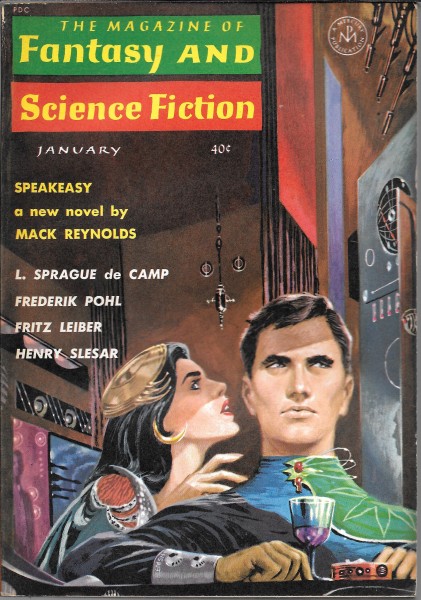
The cover of F&SF for January 1963. Listed on the cover is “Speakeasy: a new novel by Mack Reynolds.” Other authors named are L. Sprage de Camp, frederik Pohl, Fritz Leiber, and Henry Slesar.The cover painting by Emsh depicts a young man and woman wearing futuristic clothing in a high-tech environment. The man has a drink in front of him and is looking away to his left; on his right, the young woman is whispering something in his ear.
Ed Emshwiller is the artist; the art illustrates
Mack Reynolds’ novella “Speakeasy”
Read the rest of this entry » )

Mirrored from Ambrose & Elsewhere.

jamesenge: (eye)

Wild dreams last night, part of which seemed to take place in cat heaven. I was in the house where I grew up and we were looking frantically for my daughter’s cat, Clarkus Maximus.

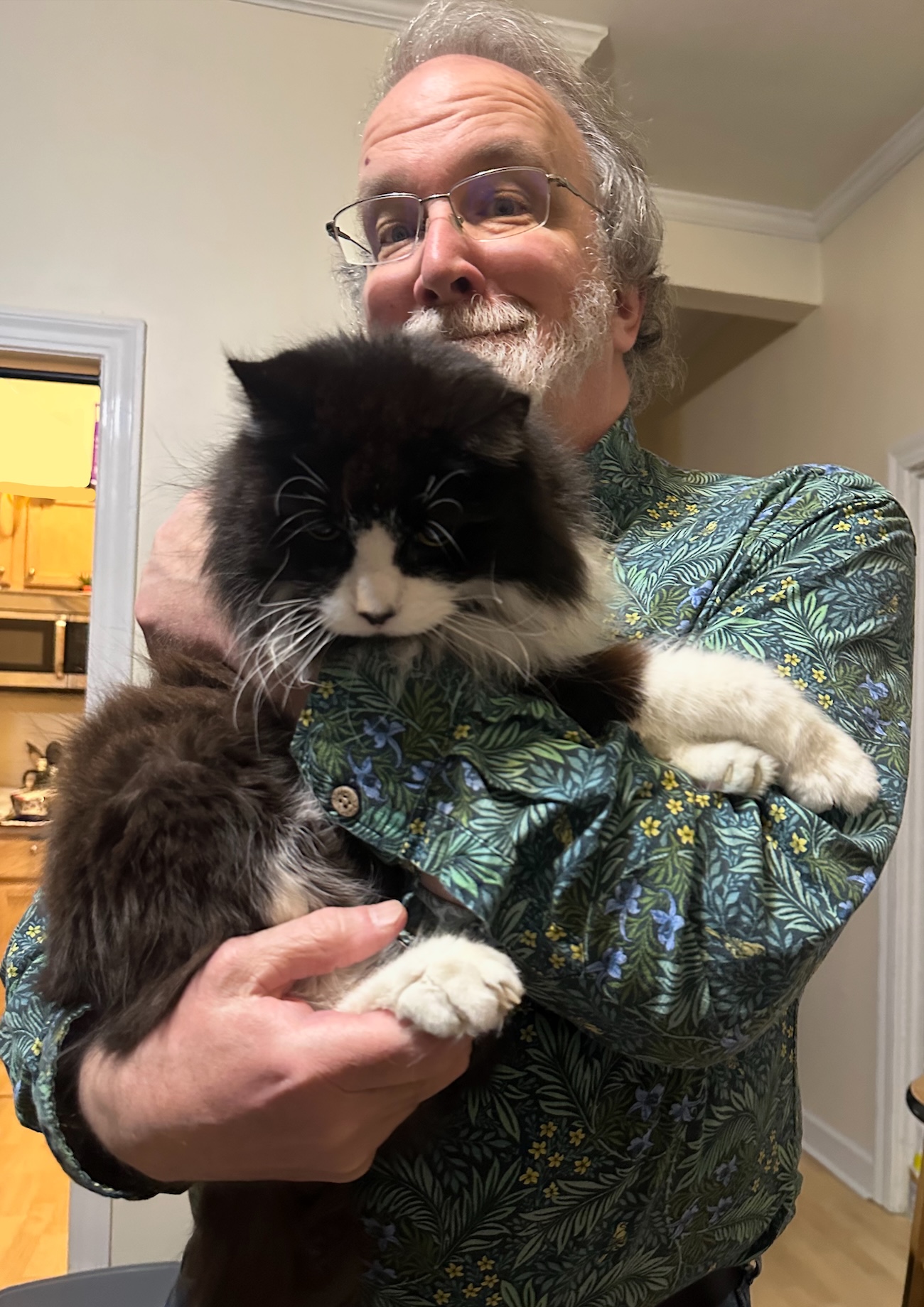
A sizeable black-and-white cat with fairly long fur in the arms of a grinning, balding, graying man with fairly long fur.
The clarkiest of Clarks, in the arms of the oversigned.
(April 2025)

We found him, safe inside in the house, but then I went out through the side door and was amazed. Where the house next door and the backyard should have been was a great, sunny plain like the African savanna, speckled with all sorts of cats, including some I used to know like Fritz the Cat Leiber Pfundstein Enge. It was especially great to see him again.

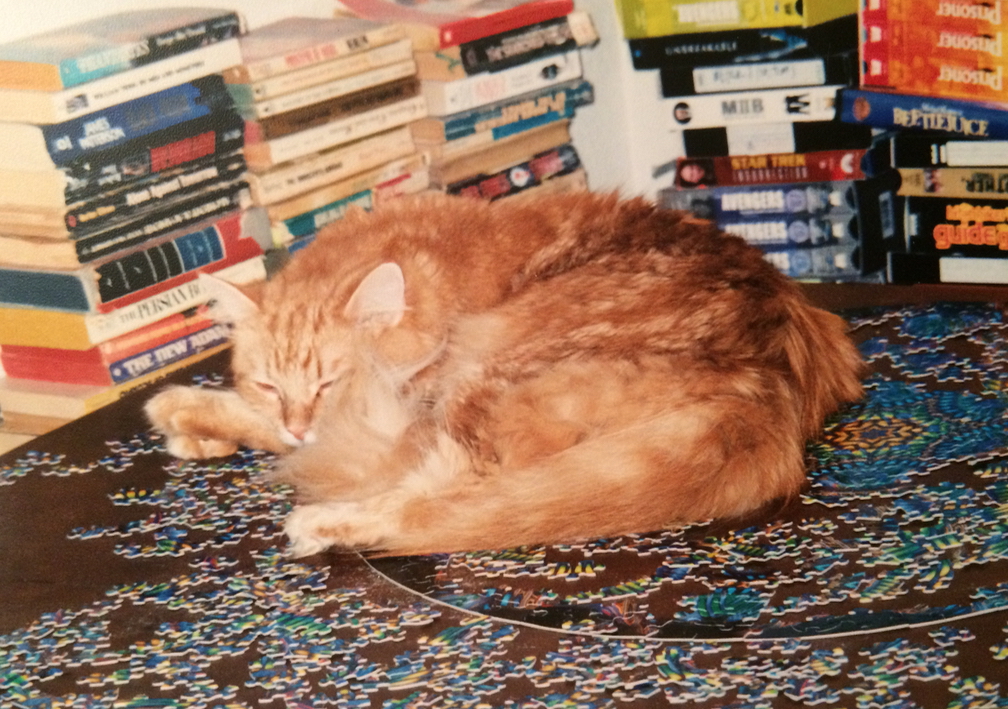
A largish orange cat with longish orange fur, lying atop a half-finished puzzle. In the background are stacks of books and videotapes.
Fritz, puzzling over something.
(some time in the early 2000s)

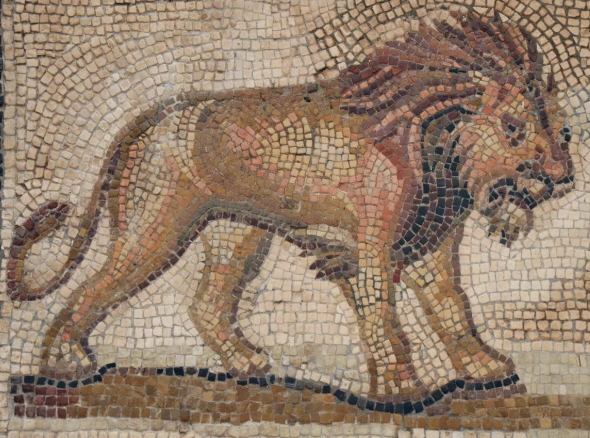
Presiding over it all was a giant, peaceful lion. I could tell by the expression on his face that he didn’t like me being there, and my dreams turned to a different and darker theme.

Roman-era mosaic of a lion, currently in the Archaeological Museum in Seville.

Mirrored from Ambrose & Elsewhere.

jamesenge: (eye)

In summary: The Swords of Lankhmar has a slow start. In fact, it has two slow starts. But once the beat drops, as it were, the story swings into action and lots of weird things happen at an increasingly rapid pace. This is a story on a bigger canvas than Leiber usually allows himself, but remains a sword-and-sorcery adventure by virtue of its action and its wry, scurrilous details. A solid entry in the long-running series about Fafhrd and the Gray Mouser, ergo an essential read for the sword-and-sorcery fan. Don’t read it if rats freak you out, though.

Details (and spoilers) follow.

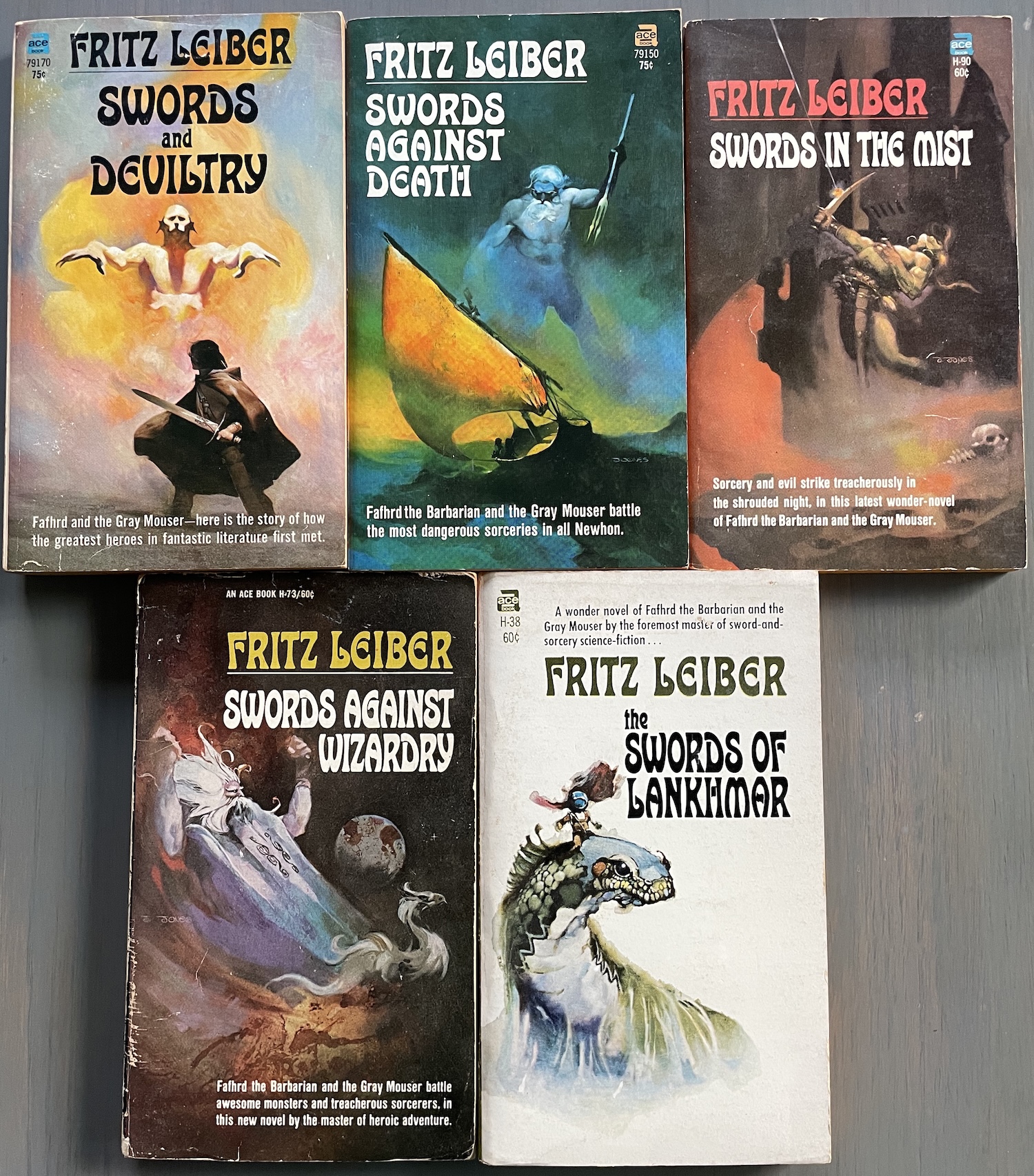
Photo of the first edition of Leiber's THE SWORDS OF LANKHMAR. The cover copy reads "A wonder novel of Fafhrd the Barbarian and the Gray Mouser by the foremost master of sword-and-sorcery fiction..."The cover art by Jeffrey Catherine Jones depicts a snaky sea-monster, on whose head is riding a person wearing a cape and a diving helmet.
No lies detected in the cover copy.
Cover art by the thrice-greatest Jeffrey Catherine Jones.

This book is generally accepted as the only novel in Leiber’s Fafhrd and the Gray Mouser series —and it is. And it isn’t.

What’s a novel? Can we call a book a novel when it’s a set of stories about the same characters, collected into a single volume, ostensibly in chronological order? We can, because we can do anything we want, but some people will reject that label.

Some people, especially genre readers, describe this kind of a book as a fix-up, because that’s what Van Vogt did when he smashed his brilliant, crazy magazine stories from the 1940s into incoherent paperback novels in the 1950s.

I reject this label for Leiber’s F&G books or for the Lancer Conan books (or, for that matter, Wodehouse’s Jeeves stories, collections of which were sometimes marketed as novels) because these are fundamentally different enterprises. Van Vogt rewrote his stories for book publication, screwing them up in the process. In contrast, Leiber rewote his stories with a light and skillful hand, creating connective material (including whole new stories) to fit his existing stories (mostly published in magazines) into a re-imagined chronology for his Ace collections.

I consider these to be a kind of novel, the episodic or picaresque novel, a kind of book with a long but mostly forgotten tradition in English. But I’m not going to be mad if people feel differently. We’re all friends here, and if you’re not then get the hell out.

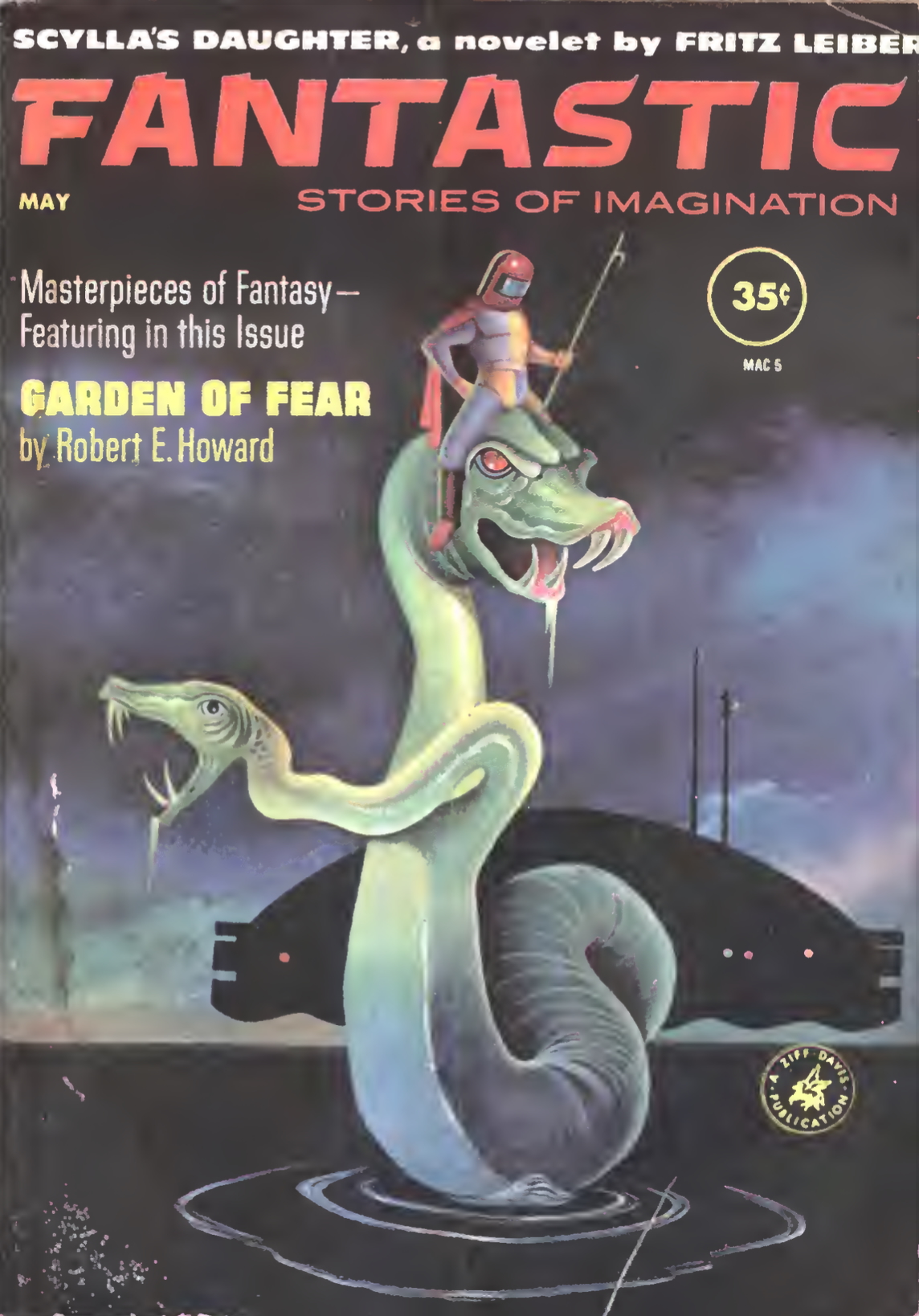
But The Swords of Lankhmar is a slightly different beast than the rest of Leiber’s F&G books. In 1961 he’d published a novelette called “Scylla’s Daughter”. Rather than stuffing it into a collection, he wrote a long continuation of the novella, and published the whole thing as a standalone novel in 1968. The volume has no descriptive table of contents and no interior chapter or section titles, just numbered chapters. This is pretty typical for books of the period, but makes The Swords of Lankhmar an outlier in the F&G series, and maybe less user-friendly than the other volumes.

I. Chapter One: a kind of prologue

For this volume, Leiber wrote a brief introductory scene in which Fafhrd and the Gray Mouser return to Lankhmar after a long absence, and are met with a bunch of people who are mad at them, mostly because of unpaid bills.

They face swords, staves, and sorcery, and because this is the first few pages of the novel they defeat their attackers with ease in a scene full of stylized, even cartoonish action. After they’ve done this, the herald of Glipkerio Kistomerces, Lankhmar’s weird Overlord, steps forward to recruit them for a mission.

He doesn’t explain what the mission is, and the next scene will find them embarked on the mission, where necessary background detail will be worked in. So why is this scene even here? Why not just begin where the story actually begins?

The answer lies in real-world chronology (as opposed to Leiber’s invented chronology). This is the first of the Ace F&G volumes to actually appear on bookstands. Leiber had been writing about the Mighty Twain for 30 years, but The Swords of Lankhmar would have been the first time many readers encountered them. This opening scene was clearly written to introduce the Twain and their adopted city.

Does it work?

Hard to say. I like the comradely back-and-forth between the two, which contains one of my favorite lines by the Mouser. They’re talking about why the people they’re approaching are mad at them. Fafhrd says that the Mouser should have paid his dues to the Thieves Guild.

“It’s not so much the dues,” the small man said. “It slipped my mind to split with them after the last job, when I lifted those eight diamonds from the Spider God’s temple.

The big man sucked his tongue in disapproval. “I sometimes wonder why I associate with a faithless rogue like you.”

The small man shrugged. “I was in a hurry. The Spider God was after me.”

I love that bit. Frequently when I’m late arriving somewhere, I apologize by saying, “The Spider God was after me.” This has the virtue of silencing all questions (at the possible risk of someone trying to have me committed). Some of the other stuff works as well, I’d say.

But the action is too cartoony to be taken seriously. Fafhrd and the Mouser deflect death spells and armed mobs with remarkable, almost tedious ease; they slay or drive off the sorcerers and thugs, and are left alone and conveniently unwounded by the end of the non-adventure.

Since this was not my introduction to the Mighty Twain, I can’t really tell if it does its job in creating reader interest in the main characters. I can tell you that I skim over this or skip it on rereading.

II. Chapters Two through Six: “Scylla’s Daughter”

Vernon Kramer provided the cover art depicting a two-headed snaky sea-monster. On one of the heads sits a guy wearing a red cape and a diving helmet. He holds a fishing spear in his left hand. Behind them we see the silhouette of some kind of high-tech hovercraft.
The first appearance of “Scylla’s Daughter”, in Fantastic (May 1961)

As chapter 2 opens, we find the Twain far from Lankhmar, engaged in an extremely cushy gig. They are on a grain ship, one of several being sent under the protection of Lankhmar’s navy from Lankhmar’s Overlord to his wavering ally, Movarl the Lord of the Eight Cities. Also on the ship is the Demoiselle Hisvet, a Lankhmart of high status, daughter of the grain merchant Hisvin. She and her twelve highly trained white rats are part of the gift package that Glipkerio is sending to Movarl to shore up his doubtful loyalty to their alliance.

What could go wrong? “Practically everything,” you say, and right you are.

For one thing, this isn’t the first grain fleet sent by Glipkerio to Movarl. It’s the third. The first two were destroyed in transit by some unknown attacker, and the present fleet is being pursued by an unknown ship that sneaks along just under the horizon. In addition another weird craft has been seen drifting across the sea, like a black cloud flecked with lights.

There’s a lot of exposition in the first eleven pages of this section, and not a lot of event. We learn that Fafhrd can imitate the love-cry of a sea-monster. We meet a German-speaking, sea-monster-riding traveller in time and space named Karl Treuherz (“Charlie Trueheart”). We hear the legend of the Thirteen: a shadowy rumor that all kinds of animal are ruled by an inner council of thirteen super-intelligent beasts. Slinoor, the captain of the Squid (the ship F&G and co. are travelling in), thinks that the Thirteen of Rats are none other than the twelve rats in Hisvet’s care, with the freakish Hisvet herself as the 13th rat.

Fafhrd and the Mouser talk this last idea down. For one thing, it’s obviously superstitious nonsense. For another, they’re horny.

How horny? Horny enough that the idea of Hisvet being part-rat doesn’t turn them off. The Twain side with Hisvet and her rats in a quarrel that develops between the passengers of Squid and the captain, backed by the naval captain Lukeen, who’s often stopping by Squid to shout at people, insult them, and spit in their face.

Through fair means and foul, the Mouser and Fafhrd succeed in allaying the crew’s suspicions about Hisvet and her ratty comrades. The Twain are rewarded with a special dinner in Hisvet’s cabin, where she sends them kisses and other favors by way of her attendant Frix.

But Slinoor is not convinced. He dopes the food sent to Hisvet’s cabin, hoping to take Hisvet and her partisans unaware. Fafhrd and the Mouser fall into a drugged stupor, but Hisvet and Frix, warned by the white rats, don’t eat the food. When the sailors start to break down the door to the cabin, the rats and the women arm themselves and sneak away into the ship’s hold through a trap door. The sailors drag the unconscious Fafhrd and the semi-conscious Mouser up to the deck and tie them up. From this vantage point, the Mouser witnesses the increasingly chaotic battle that the sailors fight against the ship’s rats, black and white, resulting in a total victory by the rats.

At some point during the banquet scene the story transitions from a slow, unsettling tale to a fast-paced nightmare. The leaders of the rats (Hisvet, her father Hisvin, and one of the white rats named Skwee) reveal themselves. Hisvet is fond of torture and murder as part of her romantic games, and it looks as if Fafhrd and the Mouser are going to play a role in her fantasies, when Fafhrd (waking belatedly from his opium-daze) summons the solution to their problems as only he knows how. (“Hoongk!“)

The opening part of the story requires some patience from the reader. It’s not a good introduction to the heroic pair, but if you already know them it’s agreeable to see them lounging around and enjoying themselves for once. The first thing the Mouser says in Chapter 2 is “Fat times in Lankhmar!” They’re not exactly in Lankhmar when he says it, but those-who-know will recognize the callback to “Lean Times in Lankhmar”, published in Fantastic only 18 months before “Scylla’s Daughter”. (The Ace collection including it, Swords in the Mist, would appear on the stands later in the same year as The Swords of Lankhmar.)

The balance of the story is a lot more lively. And everything in the slow opening section gets used again, and significantly, in the action-packed part of the story, right down to the ship’s kitten who has a love-hate relationship with Fafhrd.

This novelette began life back in the 1930s as a long, meandering story set on Earth in the reign of the Roman emperor Claudius I. Leiber was deeply enamored of Robert Graves’ historical novels, especially I, Claudius and Claudius the God. And why not? They’re some of the greatest historical fiction ever written. For a while he pursued the idea of making the Mighty Twain heroes in a series of historical fantasies, where they would be reborn or somehow emerge on Earth once every hundred years or so.

“Adept’s Gambit” is the only complete story that survives from that period, but there also is a lengthy fragment from “The Tale of the Grain Ships” (which appeared in the New York Review of Books, May 1997, and in the collection Strange Wonders, Subterranean 2010). It’s fairly interesting, with zero apparent overlap with “Scylla’s Daughter”. In it, the Mouser emerges from the sewer into the kitchen of Claudius’ palace and interacts with the kitchen staff and some others, including Claudius himself. On balance, I’m glad Leiber shook off the shackles of history and put the Twain back into imaginary world fantasy where they belong.

“Scylla’s Daughter” was a worthy addition to the series, but it pales in comparison to the balance of the novel, which finds Leiber at or near the top of his game.

III. Chapters Seven through Sixteen: The war between the Lankhmars

The rest of the book is a braided plot, where we follow four distinct series of events until they all tie together at the novel’s conclusion.

In one strand we follow the adventures of Fafhrd, travelling solo. The Mouser left him in Kleg Nar, Movarl’s city on the north coast of the Inner Sea. He’s been having fun drinking and gambling and sleeping with a woman named Hrenlet. But Hrenlet sneaks a cow into his bed and sneaks away with Fafhrd’s money, and Fafhrd has to get out of town rapidly. He’ll travel to Lankhmar via the land route, despite an invasion of Mingols and more eldritch horrors, visiting the Twain’s patron sorcerers, Ningauble of the Seven Eyes and Sheelba of the Eyeless Face, along the way.

The Mouser sailed with Squid back to Lankhmar, hoping to get the reward of bringing the good news of how they saved the grain fleet from rats. When he gets to the Overlord’s palace, he finds that Hisvet and Hisvin have already sold Glipkerio on their own version, where they were the ones who saved the fleet from the rats. They pretend now to be helping Glipkerio fight off an ongoing invasion of rats from Lankhmar Below. The Mouser consults Sheelba for help, and Sheelba gives him a magic potion that, he is told, will put him “on a footing to deal with the situation”. He ends up unexpectedly rat-sized, trying to spy out the counsels of the Thirteen who rule ratkind.

A third strand follows events in the palace, focused on the depraved Glipkerio and his long-suffering servants. Glipkerio is a cowardly sadist whose only real happiness lies in two things: watching his servants be tortured and dreaming of escape from the world of Lankhmar, which he thinks doesn’t appreciate him.

The fourth strand is a running third-person omniscient narration of the degenerating situation in Lankhmar, as the rats of Lankhmar Below become increasingly aggressive toward the inhabitants, human and other animals, of Lankhmar Above.

All the braids tie into a single knot at the story’s climax, when Fafhrd summons supernatural aid of the direst kind to battle the monstrous tide of rats, the Mouser foils the wily leaders of the rats, and the ship’s kitten from Squid emerges to save the day (or at least help save it).

IV. Chapter Seventeen: epilogue

It won’t have surprised you to hear that the rats are defeated, but it also probably won’t surprise you that Fafhrd and the Mouser don’t get credit for it. If they did, then their status would change from outsiders to insiders, and the series would end, or at least dramatically change. Leiber isn’t ready for that. So the last chapter finds Fafhrd and the Mouser, reunited with each other and their sweethearts of the moment, riding out of Lankhmar in search of new adventures.

Final comments:

A. Theatricality

This is the most theatrical of Leiber’s novels, even including The Big Time (which Poul Anderson claimed would work as a stage play) and A Specter Is Haunting Texas (which is about an actor). It even has a character, Frix, who murmurs stage directions to herself and lingers on the stage long enough to see the drama play out before making her own spectacular exit, concluding the climactic scene.

In the aftermath, the Mouser jokingly accuses Fafhrd of being a scene stealer. When Fafhrd objects to being called an actor, after all he’s been through, the Mouser says

“Halfway around the Inner Sea you say . . . and nevertheless time your entrance perfectly! Why you’re the greatest actor of them all!”

Leiber was, in some sense Fafhrd as he admits in “Fafhrd and Me” and elsewhere. But Fritz Leiber jr. was also the son of Fritz Leiber sr., a once-famous (and infamously vain) Shakespearian actor. If the vanity that Leiber jr. repeatedly attributes to the Mouser reminds him, consciously or unconsciously, of Leiber sr., these lines could read as wish-fulfillment on the author’s part. An avatar of his stagey father is awarding him the highest accolade in the family business (which Leiber jr. early pursued, but didn’t excel or persist in).

B. Weird sex.

clipart of a man with a megaphone; the text reads "Hey, Guys! Let's talk about WEIRD SEX!"

It can get very weird indeed with Leiber. When Fafhrd accuses the Mouser of having a penchant for childlike women, it’s only the truth. We saw it when he briefly retired to become a respectable extortionist in “Lean Times in Lankhmar”; we saw it when he had an affair with the Eyes of Ogo in “The Two Best Thieves in Lankhmar”; and we see it here, in his obsession with the treacherous, sadistic, and at best semi-human Hisvet. She would seem to be of an age to legally consent, but much is made of her girlish figure. The Mouser never does find out in this novel how much of Hisvet’s anatomy comes from her rodent ancestry, but he never tires of trying to find out.

Fafhrd, on the other hand, is having sex with Kreeshkra, a female Ghoul, a race of people with invisible flesh so that they appear to be animated skeletons. They also enjoy killing and eating people who aren’t Ghouls, but she hasn’t killed Fafhrd. Yet.

Then there’s Glipkerio’s and Hisvet’s separate obsessions with torture. They are obviously not Our Heroes, but Leiber’s frequent returning to this theme (Hasjarl in “The Lords of Quarmall” had the same kink) might be a little disturbing.

How do we deal with this? Should we deal with it, or just toss Leiber into the memory hole?

Not the latter, I’d say. We don’t have to assume that Leiber is advocating human/rat sex, for instance, just because he depicts it as happening in this imaginary world. I’d say the same for the rest of the sexual variations Leiber depicts.

C. What kind of series is this?

Back in 1952, James Blish distinguished between two types of story-series: template and evolving. A template series is when all the stories in the series are written around a character or set of characters that are essentially changeless. Each installment is a new adventure, but at the end of it the hero(es) will still be around to have another adventure.

A lot of great genre fiction has been written on this template model. Consider Sherlock Holmes, for instance, or Jeeves & Wooster, or any of the pulp heroes from the 30s-40s, like The Spider!, The Shadow, Doc Savage etc. Almost all TV shows used to be on the template model. Series like this can go on as long as the audience is willing to pay attention.

Evolving series are where the writer(s) permit their characters and situations to change and grow, even at the risk of disrupting the premises of the series and bringing it to an end. One of Blish’s examples for this is the Foundation series where, once the premises of the series are solidly established, Asimov throws a Mule-sized wrench into Seldon’s Plan. But what Blish really wants to talk about are his own Okie stories, nowadays available as the tetralogy Cities in Flight. A more recent example would be Le Guin’s Earthsea series or her Hainish series, where the main characters tend to be transformed by the end of the book.

Leiber’s Fafhrd and the Gray Mouser stories began as a template series. Whenever it looked as if the characters or their relationships were going to permanently change (e.g. in “Lean Times in Lankhmar” or “The Two Best Thieves in Lankhmar”), it was just a fake out and pretty soon the Mighty Twain are on the road again seeking new adventures together.

The first collection of F&G stories (Two Sought Adventure, Gnome 1958) and the first three Ace Books installments of the series to actually appear (The Swords of Lankhmar, January 1968; Swords Against Wizardry, July 1968; Swords in the Mist, September 1968) are all stories of the template type.

But already with “The Unholy Grail” (Fantastic, October 1962) Leiber was starting to do something different. In creating a backstory for his heroes (continued, of course, with “The Snow Women” and “Ill-Met in Lankhmar”), Leiber became committed not only to the idea that his heroes could change, but that they had already changed. Whether we like what he was doing, he knew what he was doing when he wrote the origin stories of the Twain (collected as Swords and Deviltry, May 1970) and then embedded the earliest F&G stories in that retroactive continuity (Swords Against Death, July 1970).

The template stories were now just an island of stability in a pair of long adventurous careers, presenting only stage two or even stage three of the heroes’ lives.

Lots of people who like Leiber and like this series really dislike Swords and Deviltry. This is interesting to me, and also weird to me. Some people talk about “The Cold Women” as if it were The Eye of Argon. Others more guardedly say that it’s not a good introduction to the series.

For my money, both views are mistaken. But I think (looking at the shift from a template series to an evolving one) some people just really prefer the template model. For those with this preference, it’s best to look at the books as collections of stories and skip the ones that give them the ick.

The end of the 1960s was a rough time for Leiber. His beloved wife Jonquil died of cancer; he fell off the wagon for another harrowing round of alcohol and drug abuse. But he never stopped writing. His greatest novel (Our Lady of Darkness, a.k.a. “The Pale Brown Thing”) and some of his best short fiction (e.g. “Catch That Zeppelin”) lay ahead of him.

And as the 1970s wore on, he turned away from Fafhrd and the Gray Mouser’s past and started thinking about how they would change in the future. The long-running series would change and change again in the next collection, Swords and Ice Magic (Ace, July 1977). I’ll talk about that one another time.

Mirrored from Ambrose & Elsewhere.

jamesenge: (eye)

A couple years ago I set out to review all of Fritz Leiber’s books about Fafhrd and the Gray Mouser—foundational texts for sword-and-sorcery and for my personal imagination. I knocked off the first three (or four, depending on how you count) pretty quickly. (See my review of Swords and Deviltry here, my writeup of Swords Against Death and Two Sought Adventure here, and my misty water-colored memories of Swords in the Mist here.) Then I ground to a halt.

A photo of the Ace editions of Leiber's SWORDS AND DEVILTRY, SWORDS AGAINST DEATH, SWORDS IN THE MIST, SWORDS AGAINST WIZARDRY, and THE SWORDS OF LANKHMAR, cover art by Jeffrey Catherine Jones.

Why? In a single word: Quarmall. “The Lords of Quarmall” is not the least interesting of the stories about Fafhrd and the Gray Mouser, but it is by a fairly long chalk my least favorite, one that I almost always skip in rereading the saga, and it occupies roughly half the space in Swords Against Wizardry, the fourth volume in the Ace series collecting all the stories of the Mighty Twain. (I’m sure there are those that love the story. De gustibus non disputandum.)

But “The merit of an action is in finishing it to the end,” as Genghis Khan remarks, so here goes.

Is this book a novel? I’ve flogged that dead horse enough, possibly, so I’ll just say that the answer is absolutely yes. Or maybe no.

Anyway, the lion’s share of SaW‘s words belong to two unequal-sized novellas, “Stardock” and the aforesaid “Lords of Quarmall”, supplemented by an introductory episode, “In the Witch’s Tent”, and an interlude in Lankhmar, “The Two Best Thieves” in Lankhmar”. We’ll tackle them in the order that God and Leiber intended, but for once there’s no complicated backstory to the—no, of course there is, this being a Leiber book. But don’t worry about it. You’ve seen worse already.

I. “In the Witch’s Tent”

We find the Mighty Twain in the deep north, far out of the Mouser’s comfort zone. They’re in quest of a stash of legendary jewels said to be atop Stardock, the tallest mountain in their world of Nehwon. They stop in Illik-Ving, last and least of the Eight Cities, to consult a witch about their journey. While that’s happening they’re attacked by rivals on their quest, and take an unconventional route to escape.

This is just an episode, acting as an introduction to “Stardock” and written years later than the longer story. (It first appeared in SaW in 1968, whereas “Stardock” was first published in Fantastic three years earlier.)

But I like it a lot. It’s got some great back-and-forth between the heroes; the story, such as it is, moves swiftly, and there’s rich, disturbing detail about the witch and her tent.

Plus, there’s a kind of audiobook. In the 1970s, there was a company named Alternate World Recordings that released LPs of great sf/f readers reading their stories. The best one, in my view, was Ellison’s “Repent Harlequin,” Said the Ticktockman. It’s not only a great story, but Ellison was a professional performer at the height of his powers. I also had, at one time, Theodore Sturgeon’s recording of Bianca’s Hands, and a couple others, among them Leiber’s reading of his mythic fantasy Gonna Roll the Bones. There was some space on the B-side of the LP (ask your grandparents, kids, or your hipster friends), so they added a recording of Leiber reading “In the Witch’s Tent.

Cover of the Alternate Worlds Recording album "Gonna Roll the Bones as read by the author Fritz Leiber".The cover art by Tom Barber shows a sinister figure with a skull face and a slouch hat. Stars are visible in its shadows. It holds a pair of skull-like dice in its gloved hand.

Leiber had briefly been a professional actor in his even-then-distant youth, but he didn’t stick with it and had lived a pretty hard life of alcohol and drug abuse. His voice is wavery in the recording. But he reads skillfully and with zest. I wish we had more of his voice.

A technical issue about the writing. Le Guin, who was the greatest stylist in American fantasy, wrote a great essay about style in fantasy, “From Elfland to Poughkeepsie”. In it, she took aim at two giants of sword-and-sorcery.

Fritz Leiber and Roger Zelazny have both written in the comic-heroic vein…: they alternate the two styles. When humor is intended the characters talk colloquial American English, or even slang, and at earnest moments they revert to old formal usages. Readers indifferent to language do not mind this, but for others the strain is too great. I am one of these latter. I am jerked back and forth between Elfland and Poughkeepsie; the characters lose coherence in my mind, and I lose confidence in them. It is strange, because both Leiber and Zelazny are skillful and highly imaginative writers, and it is perfectly clear that Leiber, profoundly acquainted with Shakespeare and practiced in a very broad range of techniques, could maintain any tone with eloquence and grace. Sometimes I wonder if these two writers underestimate their own talents, if they lack confidence in themselves.

I think Le Guin’s mistaken here, partly because she may underestimate the power and poetic impact of colloquial American English. Leiber knew exactly what he was doing in exchanges like the one below, and the literature of fantasy would be poorer without them.

“Shh, Mouser, you’ll break her trance.”
“Trance?” … The little man sneered his upper lip and shook his head.
His hands shook a little too, but he hid that. “No, she’s only stoned out of her skull, I’d say,” he commented judiciously. “You shouldn’t have given her so much poppy gum.”
“But that’s the entire intent of trance,” the big man protested. “To lash, stone, and otherwise drive the spirit out of the skull and whip it up mystic mountains, so that from their peaks it can spy out the lands of past and future, and mayhaps other-world.”

The clash of symbols between the Mouser and Fafhrd here is audible and intentional. The Mouser uses “stoned out of her skull” in one way, and Fafhrd understands it in another, investing the trite slang with mystic import. That’s not lack of confidence on the writer’s part; that’s complete understanding of the instrument he’s making music with.

II. “Stardock”

Fafhrd and the Gray Mouser arrive at a range of mountains in the Cold Waste, along with a snow-cat (a kind of lioness of the north) named Hrissa. Their task is to climb Stardock, but if climbing an unclimbable mountain weren’t enough of a challenge, they face human rivals with both weather-magic and werebear servants at their command, not to mention invisible enemies riding invisible flying bird-fish through the snows, and the occasional hotblooded furry snake-monster.

A monochrome image. At the center if Fafhrd, a large barbarian, pointing at something out of frame, while the Gray Mouser looks on in dismay. surrounding them are elements from the story: a roaring bear, the Heart of Light, some Ice Gnomes, the snow cat Hrissa, a masklike woman's face only half visible.
Gray Morrow’s illustration for “Stardock”, from Fantastic (Sept, 1965)

The clues to Stardock’s treasure were scattered around the world by the mountain’s savage yet sorcerous ruler, who’s looking for new seed to infuse into his people’s thinning bloodline. Fafhrd and the Mouser conquer the mountain despite all, sleep with a couple of invisible princesses, escape the more brutal attempts to collect their seed, and make it safely back to the base of the mountain, which is more than their rivals can say.

The ascent of Stardock is one of the great mountain-climbs in fantasy fiction, matched only by Juss and Brandoch Daha’s ascent of Koshtra Pivrarcha in the mighty Worm. It’s harrowing and dense with authentic detail. Leiber mentions in “Fafhrd and Me” how he climbed the occasional rock himself, and he dedicates “Stardock” to Poul Anderson and Paul Turner “those two hardy cragsmen”. No doubt they swapped a few stories.

A must-read for the sword-and-sorcery fan.

a black-and-white outline of a mountain against a somewhat abstract skyscape
decoration by Keith Henderson from Eddison, The Worm Ouroboros (1922)

III. “The Two Best Thieves in Lankhmar”

The Mouser and Fafhrd have fallen out on the long road back to Lankhmar. They split the loot and take different paths to fence their valuable but hard-to-dispose-of jewels from Stardock. Their different paths bring them to the same place at the same time: the intersection of Silver Street with the Street of the Gods in early evening. There the aristocracy of Lankhmar’s thieves are gathered, and the Twain grudgingly admit to each other that they’re the best of the lot.

Or are they? Before the end of the night they’re shorn like sheep and heading out of town by different routes.

This is just a transitional piece, to link “Stardock” with “The Lords of Quarmall”, but it’s nicely done. There’s some nice writing, and some nifty worldbuilding touches for the city of Lankhmar; we get a first mention of Hisvin the merchant, who’ll figure largely in The Swords of Lankhmar, and we see a lot of the thieves of the City of the Black Toga, including one intruder from another world: Alyx the Picklock, heroine of a wonderfully weird set of stories by Joanna Russ. Russ borrowed Fafhrd for her first story about Alyx (“The Adventuress”, a.k.a. “Bluestocking”), and this is Leiber nodding back at her.

IV. “The Lords of Quarmall”

The cover paintings are by Emsh.Left: The Gray Mouser and Ivivis watching with shock as Gwaay rots from a sorcerous attack; Gwaay is surrounded by sorcerous figures. Right: the Gray Mouser and Fafhrd duel while a sorcerous red-eyed figure looks on.
The covers of Fantastic (January 1964 and February 1964) in which “The Lords of Quarmall” was serialized.

Okay. Here we are. What’s not to like about this novella?

There’s a lot to like about it, that’s for sure. For one thing, it includes the only substantial writing in the saga from Harry Otto Fischer, who invented Fafhrd and the Gray Mouser in correspondence with Fritz Leiber in the 1930s. He’d written about 10,000 words of a story and ground to a halt. With his approval, Leiber took his draft and wrote 20,000 more words, fitting in sections from Fischer as he did so.

In the novella, Fafhrd and the Mouser both find themselves in the subterranean realm of Quarmall as it comes on a crisis of succession in power. The current Lord of Quarmall is about to die, setting up a battle between his two sinister sons: sadistic, twisted Hasjarl and kindly, murderous Gwaay. Unbeknownst to each other, Fafhrd has gone into the employ of Hasjarl and the Mouser has been hired by Gwaay.

One of the two sons has to win the coming battle, and that means that their two bodyguards must come into mortal conflict. Unless there’s some third way for things to go. (Spoilers: there is.)

An interesting setup, certainly, and there are some good things along the way.

However, I find the pacing in this story to be off. For instance, the first 10 pages of the novella are just the Gray Mouser and Fafhrd each being bored in their respective places in Quarmall. Boredom is a difficult subject for fiction: it’s hard to depict it without boring the reader, and there’s seldom any point in doing it. Doubling these scenes by having Fafhrd and the Mouser go through almost exactly the same discontents doesn’t make it more interesting. Boredom in stereo is still boring.

Things start to pick up when the sorcerous stalemate between the two awful brothers breaks down. That’s forty-five pages into the story, but better late than never. In the end, Fafhrd and the Gray Mouser will face each other in battle, like Balin and Balan in Malory’s Morte d’Arthur, but less tragically, while Hasjarl and Gwaay settle their sibling rivalry in the only way that can satisfy them both, and the next Lord of Quarmall reveals himself.

It’d be interesting to figure out which parts of the stories are Fischer’s and which are Leiber’s. I spotted a couple passages I think may have been written by HOF rather than FL. One is the long infodump in the form of a letter sent to Fafhrd from Ningauble. It’s well-written but doesn’t sound like Leiber’s Ningauble; it’s interesting and shows great elements of worldbuilding, but it doesn’t advance the story at all–and in fact is slightly in conflict with it. Another is a scene where a local farmer narrowly escapes being captured by the Quarmallians. Again, it’s well-written and interesting, but doesn’t advance the plot. There are a few other bits that stand out to me. But unless there’s some evidence in the Leiber papers, wherever they are kept, I doubt we’ll ever know about this.

Not a worthless story, anyway; Leiber was incapable of writing something that is not worth reading. But the end of it has Fafhrd and the Mouser racing back to Lankhmar, where a far better tale awaits them in The Swords of Lankhmar.

Mirrored from Ambrose & Elsewhere.

jamesenge: (eye)

I reread more than I read. This has certain bad effects; e.g., the towering stacks of TBR books that constantly threaten to topple over and crush me, which are always growing taller, more numerous, and (if I’m not misreading their expressions) more angry.

I’d like to say rereading has compensating benefits, e.g. a deeper understanding of the texts I obsessively reread. But often my rereads just make me more confused.

Take Beowulf, a text that would be on my always-reread list even if I didn’t teach it twice a year.

An image of director and creep Woody Allen. Accompanying is a quote from ANNIE HALL: "Just don't take any class where you have to read BEOWULF." The attribution reads "Woody Allen FAMOUSLY WRONG PERSON"
Woody Allen was one of my heroes as a kid, but this line from Annie Hall should’ve been my first warning that there was something wrong with him.

Beowulf is already a hero when he lies down in Heorot, King Hrothgar’s famous mead-hall, to await the arrival of Grendel, the manslaying monster. Beowulf has come with his Geatish pals to Denmark specifically so that he can defeat Grendel. He discusses in advance his plans to engage in hand-to-hand combat with the monster, putting aside weapons and armor.

So: why doesn’t he wait by the door?

Beowulf may want to draw Grendel into the hall, not warn him off from the door. But that doesn’t explain what happens next. I’m not trying to roast Beowulf here, by the way, just trying to wrap my head around the scene.

Grendel bursts in, slamming the door of the hall open. He’s come to kill and eat, as he has so many times before.

Beowulf does nothing.

Grendel goes to one of Beowulf’s band of Geatish warriors, a guy (we will later learn) named Hondsciō (“glove”; compare modern German Handschuh “hand-shoe; glove”).

Beowulf does nothing.

Grendel kills Hondsciō and rips him to pieces.

Beowulf does nothing.

Grendel goes to where Beowulf is lying.

Beowulf does nothing.

Grendel grabs Beowulf, and then the fight is on. It’s WWE Raw Is War.

The (surviving) Geats leap up from where they’re lying and try to attack the monster but their swords have no effect. The Grendelkin seem to be immune to ordinary weapons.

Grendel soon realizes he’s out of his depth and tries to flee, but Beowulf won’t let go. Finally Beowulf rips Grendel’s arm off (hand, arm, shoulder), dealing him a mortal wound. Grendel flees back to his underwater lair to die.

The question that constantly bedevils me when rereading this passage is: why does Beowulf wait so long to start doing what he came there to do?

So far, my answer to this question (spoilers: I cannot really answer this question) comes in multiple parts.

The first part is geographical, and hinges on the design of these medieval Germanic halls like Heorot. They’re long buildings with a peaked roof, and a firepit running down the middle.

A pair of images stacked atop each other. The upper one is a photo of the exterior of the type of hall described in the paragraph above. The lower image is a reconstruction of such a hall's interior.
image above: a reconstructed Viking-era meadhall at Trelleborg in Sweden.
image below: artist’s conception of such a hall’s interior
from Gudmundson, Den islandske Bolig i Fristats-Tiden (1894)

After the feast, the tables etc would be stacked away (or used as beds?) and the henchmen would sleep in the hall by the firepit.

So the Geats come to Heorot, make a big deal about it being occupied again. (Grendel has been attacking it at night for twelve years, and people had given up sleeping there, lest they wake up dead.) The Geats lie down as if to sleep on either side of the firepit. Maybe Hondscio is on one side of the firepit and Beowulf is on the other. Grendel, like Buridan’s donkey, could go in one direction or the other. Unlike Buridan’s donkey, he’s not going to starve to death while making a decision. He launches himself against Hondscio, and then turns to the guy on the other side, who is Beowulf.

A schematic marking Beowulf's position on one side of the firspit with a B, Handscio's on the other side with an H, and using hand-drawn lines to indicate Grendel's movements for the door to Hondscio and
Professionally drawn graphic by a professional graphic-drawing guy.

Okay. But this still doesn’t explain why Beowulf takes so long to act. He’s not asleep and he’s not scared (according to the poet). It’s almost as if this is a turn-based game, like chess, and Beowulf has sacrificed a pawn to put the opposing player in an untenable position. That seems to conflict with the magnanimous nature of the hero as the poet represents him, though.

A bookish sort of explanation: Hondsciō’s death is necessary because it prefigures Grendel’s own death. In reparation for the loss of Hondsciō, Grendel loses his hand (along with his arm and shoulder), suffering a fatal wound.

Title of the slide: "Grendel and Hondscio ('hand-shoe'): Endless Glove?The image is a screencap from Gareth Hinds' THE COLLECTED BEOWULF. One frame shows Beowulf clenching his fists. Two others show Grendel ripping up Hondscio. The fourth shows Beowulf squinting like Clint Eastwood getting mad.
A slide from my Norse myth class.

If this seems too academic and tweedy a reading for so savage a poem, I should add that Beowulf himself makes the connection when he’s retelling the tale to his uncle and king, Higelac, back in Geatland (line 2069b-2100). He talks about the hond-rǣs hæleða (“the hand-battle of heroes”) and goes on to describe the death of Hondciō, naming him for the first time in the poem. He mentions for the first time a weird glove (glōf) made of dragon-hide that Grendel had. Beowulf seems to describe Grendel’s habit of putting dead men into the glove. Which is really weird, does not clarify the situation, but does remind me of another mythological situation, where Thor and friends find themselves in a giant’s glove.

The image on the slide shows a guy with a hammer climbing out of a gigantic glove. Reaching for the glove is a guy who seems big enough to wear it.The text on the slide reads "Skrýmir and Thor: glove at first sight? (Snorri's EDDA "Gylfaginning 45)" and adds "artist unknown, but I wish I knew"

Beowulf concludes this part of his humblebrag by mentioning how Grendel’s right hand (swīðre… hand) remained behind in Heorot.

That line from hand to hand connects a lot of dots in the narrative. And maybe that’s enough. Beowulf describes Hondsciō as fey (“doomed”; fǣgum), and maybe that’s enough.

But maybe it’s not. It still doesn’t give a motivation for Beowulf’s odd stillness until he himself is attacked.

I wonder if the answer isn’t hidden inside Grendel’s identity. The Beowulf-poet famously or infamously grafts the Grendelkin onto the family tree of Adam and Eve, tracing their line of descent from Cain the murderer. But the Beowulf-poet is Christian, and this story probably pre-existed the arrival of Christianity in northwest Europe. So what was the pre-Christian identity of Grendel and his mother?

I think they were the restless dead, a perennial affliction in these Nordic stories. (Think of the Barrow Wights from The Lord of the Rings.) Glám, Grendel’s analogue in Grettir’s Saga (chs. 33-35), is one of the walking dead. And Grendel is repeatedly described as a ghost (ellengǣst “bold ghost”, 86a; se grimma gǣst “the cruel ghost”, 102a; wergan gāstes “accursed ghost” 133a).

But Beowulf kills Grendel. Killing someone who’s already dead seems like a definitional impossibility. But it is something that comes up a lot in these stories, and the answer is frequently some kind of mutilation, a practice known as “arm-pitting” (Greek μασχαλισμός). It’s precisely this kind of thing that Beowulf inflicts on Grendel.

But (not to beat a dead horse or monster here) why does it take Beowulf so long to act?

This is where I came in and this is where I go out, I guess, asking the same question. The only answer I can come up with is personal and has to do with nightmares. I don’t know if you’ve ever been attacked by a ghost or a sinister shadow in a dream. It used to happen to me pretty frequently, back when I was able to get a decent night’s sleep. (Deep sleep is a luxury old people have to learn how to do without. If you wonder why the old people in your life are increasingly crazy, that might be one of the reasons.)

When the ghost is coming for you in the dark, it seems to get the first move. You may see it; you may know it’s coming for you. But you can’t do anything about it. There’s a whole branch of magic in Morlock’s world devoted to stuff you can do in these situations. (See “A Stranger Comes to Town” for some practical applications.)

It may be that in the Ur-myth of Beowulf, he was in that nightmare state, watching the ghost approach and unable to stop it.

That’s not the the answer; as is common in myth and storytelling, there isn’t just one answer. But that’s the best I’ve got from this most recent reread.

A graphic for the band The The.

Mirrored from Ambrose & Elsewhere.

jamesenge: (eye)

I’m not a big fan of literary criticism in any field (although I have committed some), but one of my big books from my late teens onward was Le Guin’s The Language of the Night (1979), especially for the essays “From Elfland to Poughkeepsie” and “A Citizen of Mondath”.

cover of the 1st edition of "The Language of the Night". The image features a couple of sorcerous figures, a dragon, and a dwarf armed with a sword, a crescent moon, etc.

Le Guin has some great passages in “Citizen” about what she liked to read as a kid, and how she liked it.

We kids read science fiction in the early forties: Thrilling Wonder, and Astounding in that giant format it had for a while, and so on. I liked “Lewis Padgett” best, and looked for his stories, but we looked for the trashiest magazines, mostly, because we liked trash. I recall one story that began “In the beginning was the Bird.” We really dug that bird. And the closing line from another (or the same?)—“Back to the saurian ooze from whence it sprung!” Karl made that into a useful chant: The saurian ooze from which it sprung / Unwept, unhonor’d, and unsung. I wonder how many hack writers who think they are writing down to “naive kids” and “teenagers” realize the kind of pleasure they sometimes give their readers. If they did, they would sink back into the saurian ooze from whence they sprung.

I’m pretty sure the first story she refers to is “The Unpleasant Profession of Jonathan Hoag” by Heinlein in Unknown (Oct 1942). It appeared under the false whiskers of “John Riverside” because at the time the Heinlein byline was reserved by John W. Campbell for RAH’s “future history” stories.

screenshot of a page from UNKNOWN WORLDS (Oct, 1942)The image by Kramer seems to depict a bird attacking a painting of a guy with a hooded skeleton behind him, but it's kind of hard to tell from the blurriness of the scan

I never figured I’d find the source of the mysterious “saurian ooze”–except that maybe I just did. In looking for Henry Kuttner stories online I found this opus in Strange Tales (Aug, 1939). The appearance is pseudonymous, because he had a “Prince Raynor” novelette in the issue under his own name. And the crucial phrase was from the editorial blurb rather than the story itself.

screenshot of a page from STRANGE STORIES (August, 1939). The art by H.W. Wesso, depicts a white man in khakis with a crocodile under his left arm while raising a flashlight in his right hand to combat a black man in African dress who is wielding a knife. A ghostly crocodile arches over them both. The caption reads "The native rushed at Koreing with some kind of dagger in his hand". The title of the story is "The Curse of the Crocodile" by "Bertram W. Williams, author of "Strange Waters", "the Treasure of Ah Loo' etc." The editorial blurb reads: "The Man Who Violates the Banga Ju-Ju Returns to the Saurian Ooze from Whence He Sprang!"
Screenshot

Kuttner, of course, was roughly half of “Lewis Padgett”, along with C.L. Moore. And most of their work, whatever name it appeared under, seems to have been collaborative from the time they met and married, so Moore may have exuded some of that saurian ooze herself.

Le Guin’s accounts don’t exactly match up with these texts: “In the Beginning was the Bird” is a ritual phrase used by the Sons of the Bird in Heinlein’s story (one of his best fantasies, by the way), but it’s not the opener of the story. And the saurian ooze springs out at the reader at the Kuttner story’s beginning, not its end (and with a shift of ablaut at that). But given that Le Guin was writing about these stories 20-30 years after she’d read them, I’d say the shoes fit the footnotes pretty well.

Mirrored from Ambrose & Elsewhere.

jamesenge: (eye)

I’m rereading Beowulf, preparatory to teaching it in a couple weeks to my Norse Myth class. This kind of thing always involves falling into the dictionary and getting swept away by a tide of weird words.

This afternoon’s discovery is morðcrundel. Morð means “death”; it’s the root of murder and Mordor (a linguistic fact that Asimov used in one of his stories of the Black Widowers), and is cognate with Latin mors, mortis “death”. (It occurs to me that this probably affects the spelling of Mordred’s name in Arthurian legend. The older spelling is Medraut/Modred, but it was changed in the Old French versions, maybe because storytellers associated Mordred with death and destruction—of his uncle-father Arthur in particular.)

Crundel (to my ear) sounds too friendly to be linked up with doomful morð, but Clark Hall & Merrit say it means “ravine”. (None of my dictionaries gave me an etymology for crundel, but I wonder if it’s cognate somehow with ground.) Hence morðcrundel “death-ravine”: the pit under a barrow where the dead are buried.

I expect morðcrundel (the word) and death-ravines (the phenomenon) will appear in my stories in the near future.

I’m reading Beowulf in stereo this time, comparing the Old English original to Heaney’s translation (which is the one I’ve been assigning to my classes for the past few years).

There’s no translation like no translation. Or, as they say in Italian: traduttore, traditore (“translator = traitor”). This kind of passage-by-passage comparison is the kind of reading that is most likely to make one unhappy with almost any translation. Heaney’s translation is clear and eloquent, a good match for the modern reader. They didn’t give this guy the Nobel Prize for nothing.

But in a couple passages he munges the meaning of things that (to my fantasy-oriented mind) are important.

One of the praise-songs about Beowulf in the text of Beowulf is about Sigmund the Dragonslayer. I particularly want to bring this passage to the attention of my students, because we’re also going to be reading the Volsunga Saga and the Eddic poetry about the screwed-up family of the Volsungs (and the screwed-up families they become entangled with). In those better-known versions, it’s Sigurð, son of Sigmund, who kills the dragon.

“Myth is multform” is the ritual incantation I always invoke on these occasions. Myth isn’t history; it’s more like quantum physics, where Schrödinger’s cat is both alive and dead until you open the box. Sigmund both is and is not the slayer or Fafnir, until you begin telling (or reading) a particular story. At that point the storyteller usually (not always) picks a version and sticks with it, a process analogous to wave-form collapse in quantum physics. Audiences of myths have the luxury of enjoying, even insisting on, particular versions (like toxic Star Wars fans). Students of mythology have to be sensitive to multiple versions and beware the temptations to over-historicize a particular rendition of a myth.

Anyway, in the story of Beowulf, it makes sense for the praise-singer to associate Sigmund with Beowulf. Sigmund famously killed a monster; Beowulf has just earned fame by killing a monster (Grendel). And the Beowulf-poet can use this celebration of young Beowulf’s victory to foreshadow old Beowulf’s final battle where he kills and is killed by a dragon. In fact, the Sigmund story might help explain old King Beowulf’s strange behavior toward his last enemy, how he insists on going alone against the dragon (just as Sigmund did) to earn treasure (just as Sigmund did).

I mostly like what Heaney does in his translation, but there was one part of this passage that I wasn’t crazy about.

The Beowulf-poet, describing how Sigmund slew the dragon says this:

hwæþre him gesǣlde, ðæt þæt swurd þurhwōd
wrǣtlīcne wyrm, þæt hit on wealle æstōd,
dryhtlīc īren; draca morðre swealt.

Beowulf 890-892

“Nevertheless it befell him that the sword passed through
the wondrous worm so that it on the wall stood fixed
the illustrious iron; the deadly dragon died.”

Here’s what Heaney does with it.

But it came to pass that his sword plunged
right through those radiant scales
and drove into the wall. The dragon died of it.”

Better than my dry literal version, certainly. But here’s Raffel’s (1963) version.

“Siegmund had gone down to the dragon alone,
Entered the hole where it hid and swung
His sword so savagely that it slit the creature
Through, pierced its flesh and pinned it
To a wall, hung it where his bright blade rested.”

Because Raffel is not binding himself to translate line by line (as Heaney does), his version rocks a little better, I think.

I’ll probably stick with Heaney. It’s still fresh, represents the original pretty well, and has a couple of different editions with distinctive advantages: one accompanied by the Old English text, another illustrated with copious images of the physical culture of northwest Europe in the early Middle Ages–weapons, jewelry, manuscript paintings of monsters, etc.

Still, I always try to keep the alternatives in mind. Myth is multiform, and every translator is a traitor. I can only be faithful to the original if I at least flirt with alternative translations.

A slide for my Norse Myth class, for when I talk about the alternatives to Heaney. The title reads "Why _this_ translation of BEOWULF?"On the slide are the covers of three different translations: Raffel's version, ullustrated with a glorious Leo-and-Diane Dillon painting of old Beowulf fighting a fiery dragon; Tolkien's translation & commentary, illustrated with Tolkien's painting of the Green Dragon from the inn of the same name; Maria Dahvana Headley's translation, illustrated with a lower-case b, wearing a crown and wrapped around by the coils of a snaky dragon.

Mirrored from Ambrose & Elsewhere.

jamesenge: (eye)

Saw the article below on Bluesky and felt the irritation that almost always accrues when scrolling through social media. But this irritation was really specific. Demanding a historically accurate version of a myth is like trying to find the zip code of Ásgarð. It misconceives the whole enterprise of storytelling. It Must Be Stopped.

screenshot of the Cracked article linked in the caption: “FAMILY GUY had more accurate Greek armor than Christopher Nolan’s THE ODYSSEY.” Image is a scene from FAMILY GUY with the characters in ancient Greek drag.
https://www.cracked.com/article_45570_family-guy-had-more-accurate-greek-armor-than-christopher-nolans-the-odyssey.html

This got me thinking about maps in fantasy novels, because that was one way to avoid useful work.

Maps are really not as necessary for fantasy novels as people sometimes pretend, although I sympathize with readers who want to know how you get from the Lantern Waste to Ettinsmoor, etc. As a rather shifty storyteller, I’d prefer not to be pinned down if I can avoid it. (I always cite Melville on this point: “It is not down on any map. True places never are.”)

But I really resist the modern tendency to make fantasy maps follow modern standards of cartography and geology. That’s like insisting that the Fellowship of the Ring should have taken public transit from Rivendell to Mordor.

Conventions of maps vary from culture to culture, and they often don’t look familiar to us at all. In this context I often have occasion to think of this medieval model:

The Isidorean (and Snorrian) mappa mundi after an illustration in a manuscript in the Bayerische Staatsbibliotek, Munich.The image depicts the known world as a circle divided in half by a line of water labelled Tanais (the Don) running from the center northwards, and Nilus (the Nile) running from the center soutwards. The upper (Eastern) half of the map is labelled ASIA. The lower half is divided by a line of water marked MEDITERRANEUM (the Mediterranean). The northwestern corner is labeled EVROPA and the south west quarter is labelled AFRICA.

Or a late-Roman map, the Tabula Peuteringeriana.

Plus, there’s no reason to suppose that a fantasy world was formed along scientific principles. Imposing contemporary standards of geology onto fantasy worlds makes fantasy into a subgenre of science fiction, whereas the reverse is obviously true.

If people want to write a kind of mundane fantasy with low or no magic, that can obviously be done and has been done with great success. Pratt’s The Well of the Unicorn is a celebrated example. (Magic exists in the world of the book, but it reads like a historical novel for an imaginary world.)

scan of a map of the imaginary countries in Pratt's THE WELL OF THE UNICORN. It's decorated with various ships in the watery areas and the disembodied head of a wind god.
Rafael Palacios’ map for Pratt’s The Well of the Unicorn
“Are mountains really distributed like that on a real landscape?
How big are those ships, really?
Are we supposed to believe there’s really a giant disembodied head
blowing up a gale over that sea?”

This isn’t an obligation built into the genre, though. Like everything in an imaginary world, maps, the type of maps, or even the mappability of the world should be a deliberate choice on the part of the worldmaker, not something just thrown in because that’s the way it’s done, or to satisfy specious notions of accuracy.

Let us close with a hymn from the sacred texts.

“What’s the good of Mercator’s North Poles and Equators,
Tropics, Zones, and Meridian Lines?”
So the Bellman would cry: and the crew would reply
“They are merely conventional signs!”
—Lewis Carroll,
The Hunting of the Snark

Mirrored from Ambrose & Elsewhere.

jamesenge: (eye)

I was thinking the other day about Hengist and Horsa, the two Saxon chieftains/gangsters who show up to assist and then overpower the usurper Vortigern in the run-up to King Arthur’s origin story. Horsa (Horsus in Geoffrey of Monmouth’s Latin) clearly means “horse” in modern English, but WTF is a hengist? Turns out that also means “horse” (going back to Proto-Germanic *xanxistaz; so says Orel). Horsa doesn’t really do much in the story; Hengist always takes the lead, bringing in Saxon goons and becoming Vortigern’s father-in-law, and in general making V’s life a living hell.

I wonder if “Horsa” didn’t start life as a more-transparent translation of Hengist’s name (“Hengist–i.e. Horse”), and then the name got promoted to full personhood by a storyteller who didn’t know the two words meant effectively the same thing.

Vortigern’s situation with the Saxons reminds me of a “bust out”, where organized crime infiltrates a business and then runs it into the ground (e.g. the Sopranos episode 2.10 “Bust Out”). Fortunately that situation could never happen to the U.S. govt. I guess.

Another thing I found out while horsing around was that English horse is cognate with Latin currere “to run” (going back to PIE *kers- “run”). Which makes sense, since initial k sound in Latin often corresponds to initial h in English (cf English horn and Latin cornu).

Gervasio Gallado's cover painting for the Ballantine edition of Peter S. Beagle's THE LAST UNICORN. On the right, the titular unicorn; in the center, a tree bearing fruit and a snake; on the left, a blue faced harpy in a cage. "Creatures of Night Brought to Light."
Gervasio Gallado’s cover painting for the Ballantine edition of Peter S. Beagle’s The Last Unicorn.

The h/k correspondence got me thinking about Hermóðr, Ódin and Frigg’s son who borrows Sleipnir, his dad’s eight-legged horse. The -óðr is pretty clearly the same root as in Óðin’s name, but what would *kerm- mean in Proto-Germanic or PIE? I looked it up in Orel’s Handbook of Germanic Etymology and it sort of snapped into focus.

Maybe there is no Hermóðr really. Maybe it’s just another name of Óðin that Snorri hypostasized into a son of Óðin. That’s explain why he’s riding Slepnir, among other things.

So my Norse Myth students got a generous side-portion of Germanic philology yesterday.

A slide from my Norse myth class.Image is Hermóðr on Sleipnir waving a sword outside an inclosure containing Hel and Baldr.Text reads: Hermóðr
(riding Sleipnir)
and
Hel
(with Baldr)Is Hermóðr just a name for Óðin that got misread ?herm from Proto-Germanic *xarmaz "sorrow, grief"oðr from Proto-Germanic *wōðaz "possessed, mad"(same etymology as Óðin & Óðr)(Check out the dish “Hunger” and the knife “Famine”.)(MS painting from SÁM 66, 75v)
Screenshot

Mirrored from Ambrose & Elsewhere.

jamesenge: (eye)

I realized this weekend that one of the pleasures of inventing a Martian language was coining new names for all the planets. (Including ones that don’t really exist, like Vulcan, Antichthon, and the Lost Planet that was once supposed to be the precursor for the asteroids.)

I think this version of the Solar System will have 12 planets, including Pluto & a trans-Plutonian planet. 12 is a magic number & if I end up wanting to add a 13th or even a 14th planet, that’s still a dozen (cf the baker’s dozen, the “12” Olympians, tribes of Israel, apostles, Labors of Herc, etc).

This made me nostalgic to read Rocklynne’s The Men and the Mirror (Ace, 1973), which includes one of the few stories written about Vulcan (not Spock’s planet, but the planet that was briefly believed to exist closer to the sun than Mercury). My sword-and-planet version of Vulcan will have to be different–possibly an invisible and/or dirigible planet.

Two men in space suits with bubble helmets are sliding down a mirrorlike object; both men and some planets in the background are reflected in the mirror.
The cover for the 1973 Ace edition of The Men in the Mirror; artist unknown.

Mirrored from Ambrose & Elsewhere.

December 2025

S M T W T F S
 123456
78910111213
14151617181920
21222324252627
2829 30 31   

Syndicate

RSS Atom

Most Popular Tags

Style Credit

Expand Cut Tags

No cut tags
Page generated Jan. 7th, 2026 05:23 pm
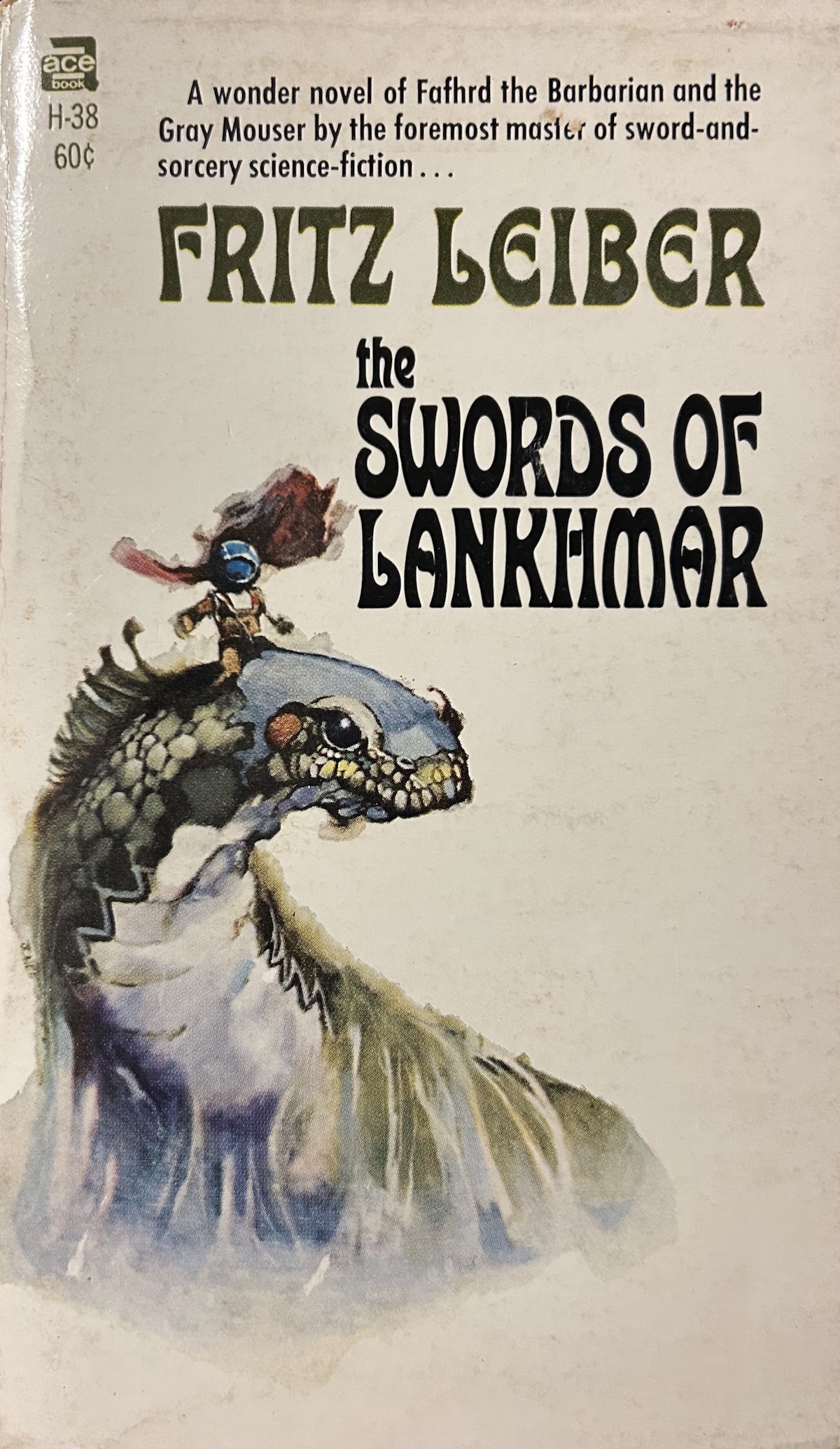
Powered by Dreamwidth Studios