A cartoon from an old (1927-vintage) issue of The New Yorker. It made me smile, even though it’s probably supposed to appeal to class and ethnic biases.
cartoon by O. Soglow (?) in The New Yorker issue for Sept 17, 1927
“Look, my dear friend Amaryllis Partington-Smith-Symythe-Vanderbilt-Smythington-Smyth–a banausic of foreign abstraction, decorating his shop-window with classical statuary! Très amusant!”
“Wasn’t your dad a fruit-peddler named Rabinowicz?”
Wild dreams last night, part of which seemed to take place in cat heaven. I was in the house where I grew up and we were looking frantically for my daughter’s cat, Clarkus Maximus.
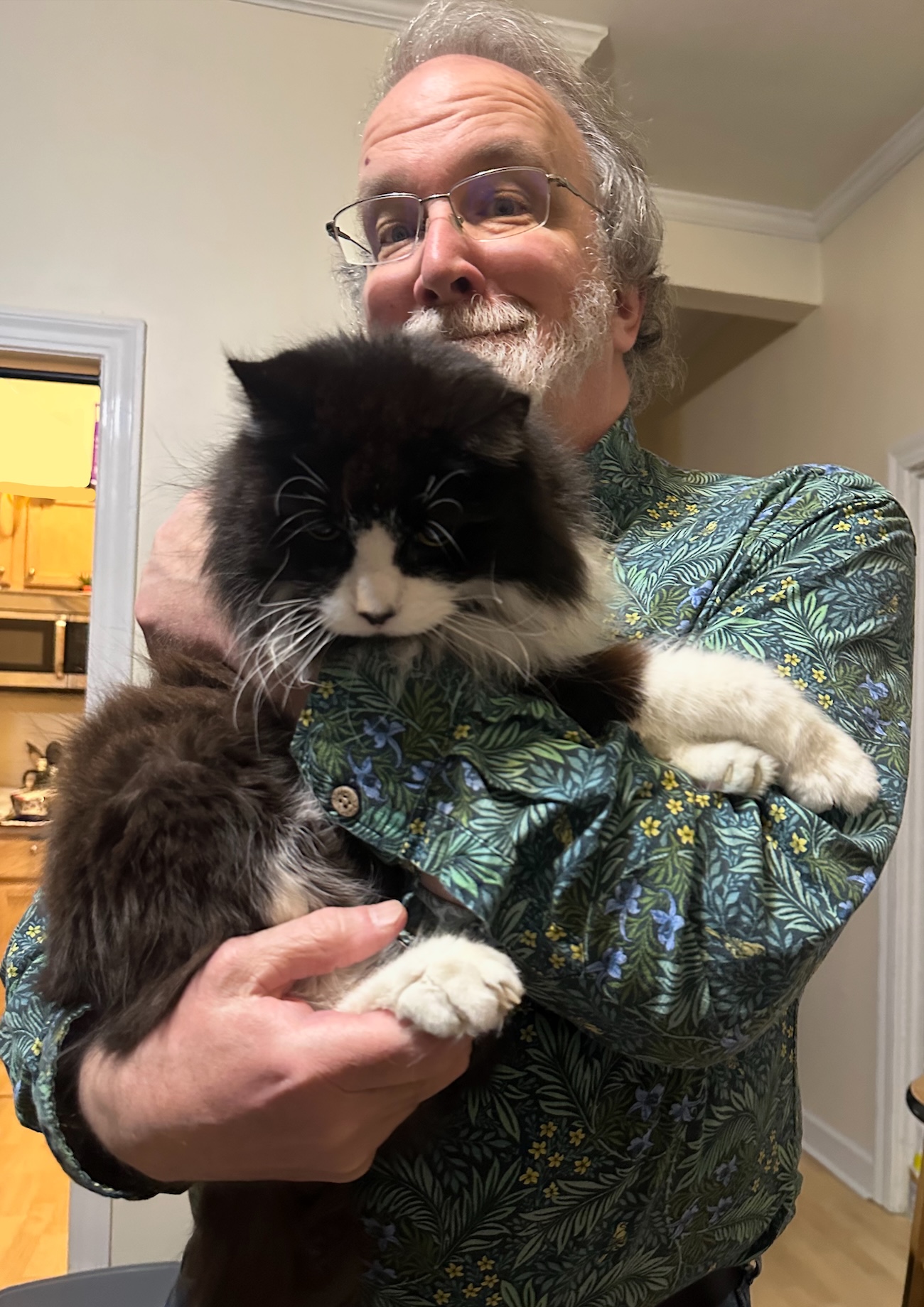
The clarkiest of Clarks, in the arms of the oversigned. (April 2025)
We found him, safe inside in the house, but then I went out through the side door and was amazed. Where the house next door and the backyard should have been was a great, sunny plain like the African savanna, speckled with all sorts of cats, including some I used to know like Fritz the Cat Leiber Pfundstein Enge. It was especially great to see him again.
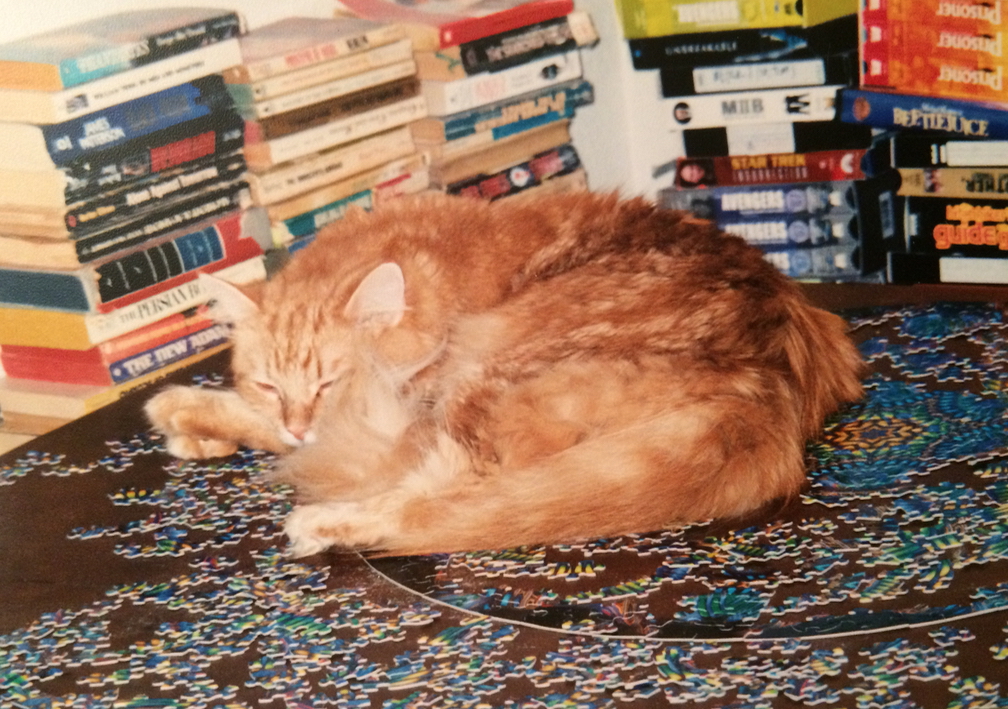
Fritz, puzzling over something. (some time in the early 2000s)
Presiding over it all was a giant, peaceful lion. I could tell by the expression on his face that he didn’t like me being there, and my dreams turned to a different and darker theme.
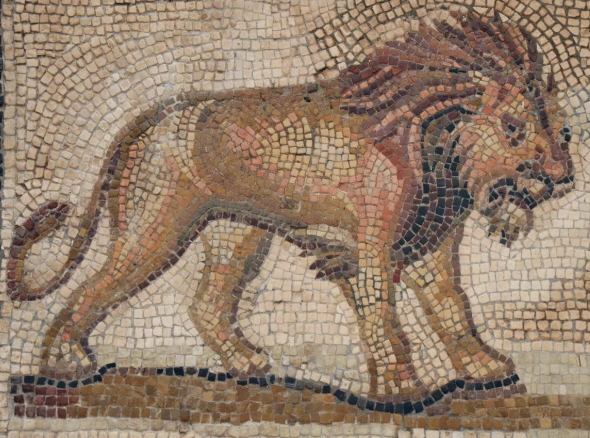
Roman-era mosaic of a lion, currently in the Archaeological Museum in Seville.
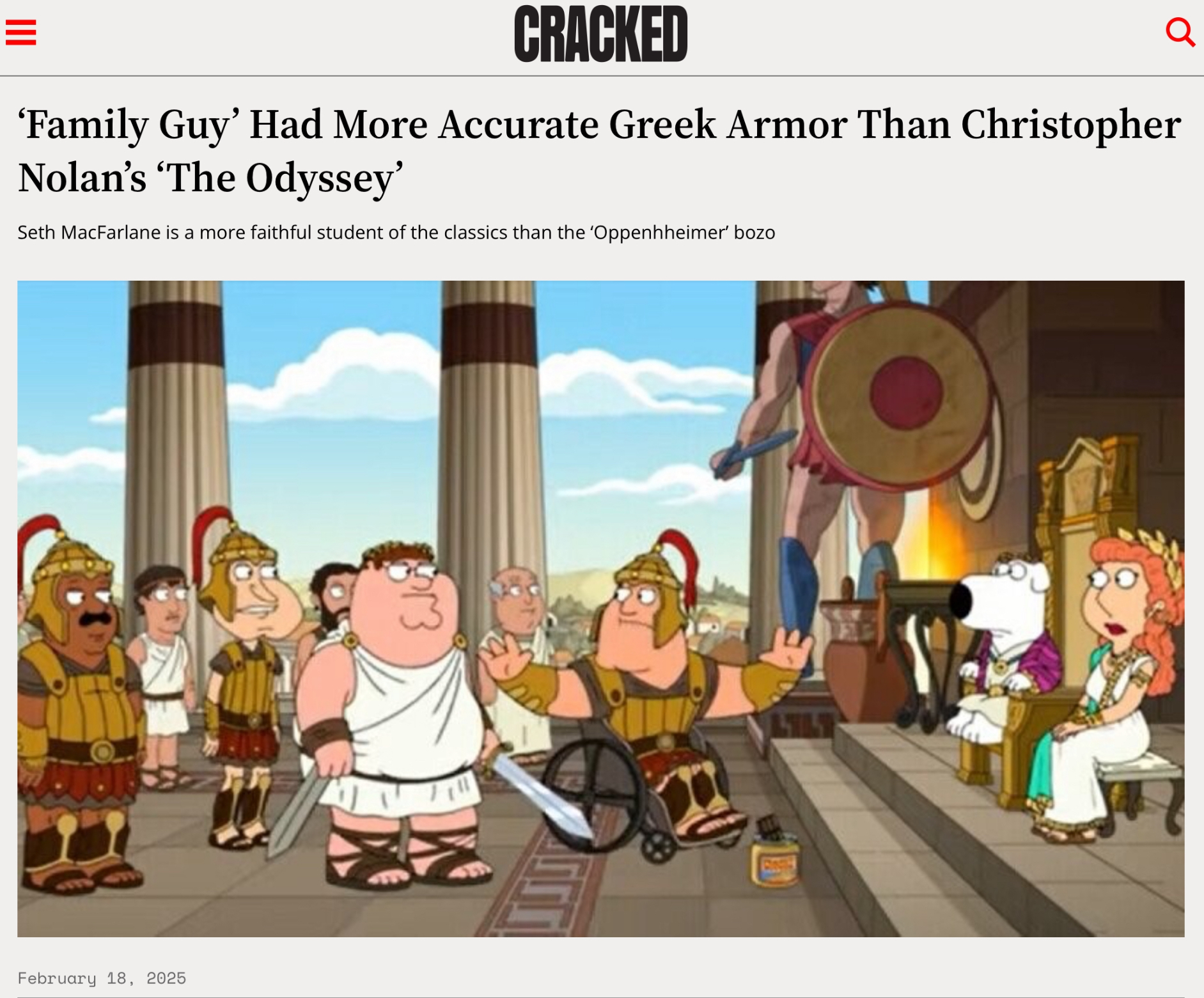
Saw the article below on Bluesky and felt the irritation that almost always accrues when scrolling through social media. But this irritation was really specific. Demanding a historically accurate version of a myth is like trying to find the zip code of Ásgarð. It misconceives the whole enterprise of storytelling. It Must Be Stopped.
This got me thinking about maps in fantasy novels, because that was one way to avoid useful work.
Maps are really not as necessary for fantasy novels as people sometimes pretend, although I sympathize with readers who want to know how you get from the Lantern Waste to Ettinsmoor, etc. As a rather shifty storyteller, I’d prefer not to be pinned down if I can avoid it. (I always cite Melville on this point: “It is not down on any map. True places never are.”)
But I really resist the modern tendency to make fantasy maps follow modern standards of cartography and geology. That’s like insisting that the Fellowship of the Ring should have taken public transit from Rivendell to Mordor.
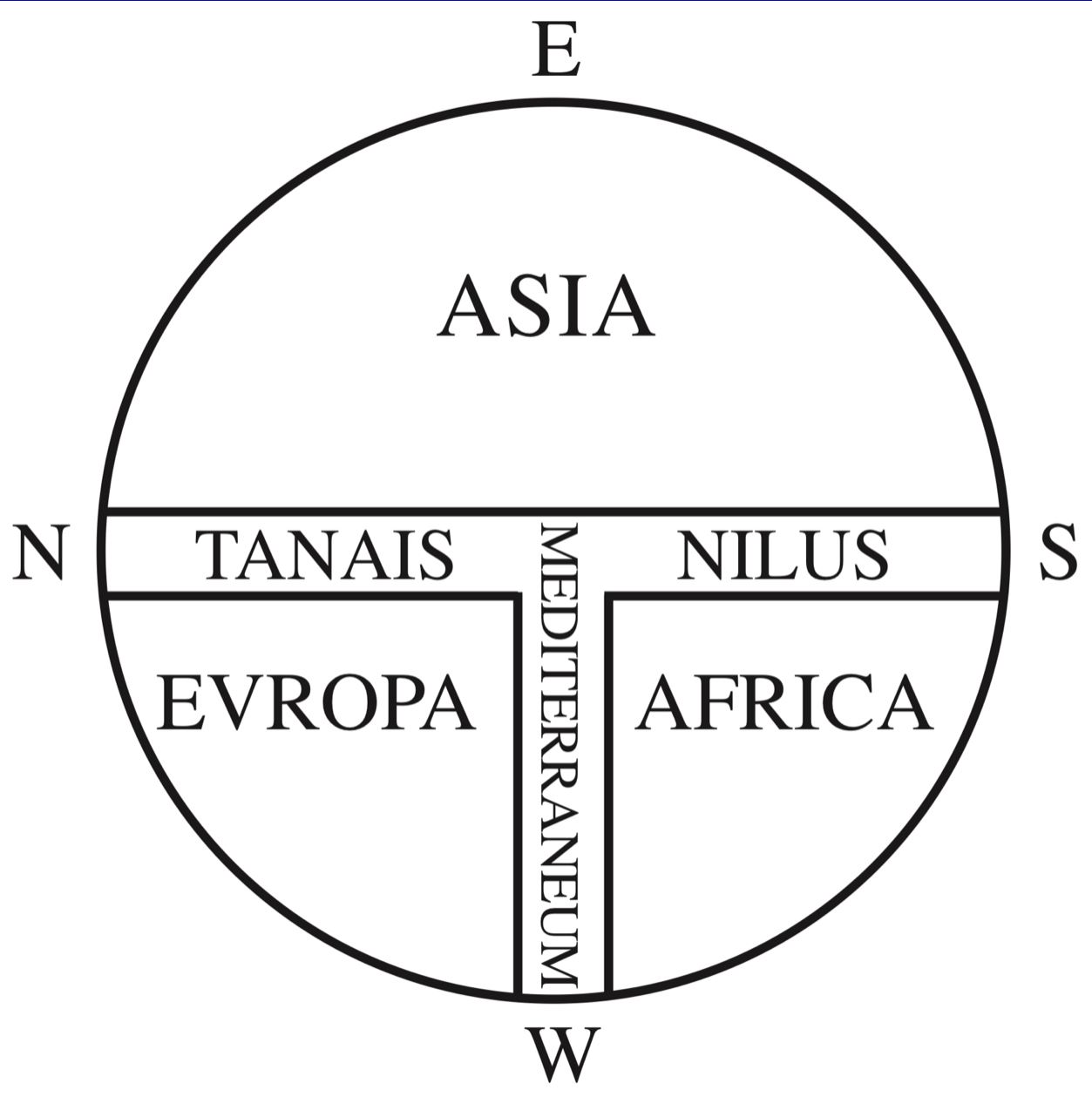
Conventions of maps vary from culture to culture, and they often don’t look familiar to us at all. In this context I often have occasion to think of this medieval model:
Plus, there’s no reason to suppose that a fantasy world was formed along scientific principles. Imposing contemporary standards of geology onto fantasy worlds makes fantasy into a subgenre of science fiction, whereas the reverse is obviously true.
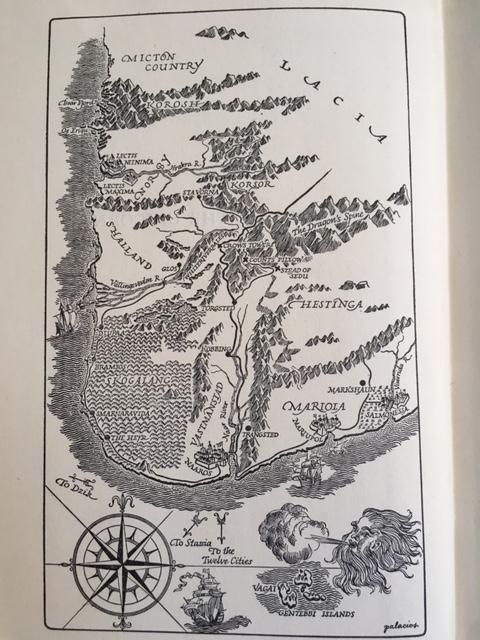
If people want to write a kind of mundane fantasy with low or no magic, that can obviously be done and has been done with great success. Pratt’s The Well of the Unicorn is a celebrated example. (Magic exists in the world of the book, but it reads like a historical novel for an imaginary world.)
Rafael Palacios’ map for Pratt’s The Well of the Unicorn “Are mountains really distributed like that on a real landscape? How big are those ships, really? Are we supposed to believe there’s really a giant disembodied head blowing up a gale over that sea?”
This isn’t an obligation built into the genre, though. Like everything in an imaginary world, maps, the type of maps, or even the mappability of the world should be a deliberate choice on the part of the worldmaker, not something just thrown in because that’s the way it’s done, or to satisfy specious notions of accuracy.
Let us close with a hymn from the sacred texts.
“What’s the good of Mercator’s North Poles and Equators, Tropics, Zones, and Meridian Lines?” So the Bellman would cry: and the crew would reply “They are merely conventional signs!” —Lewis Carroll, The Hunting of the Snark
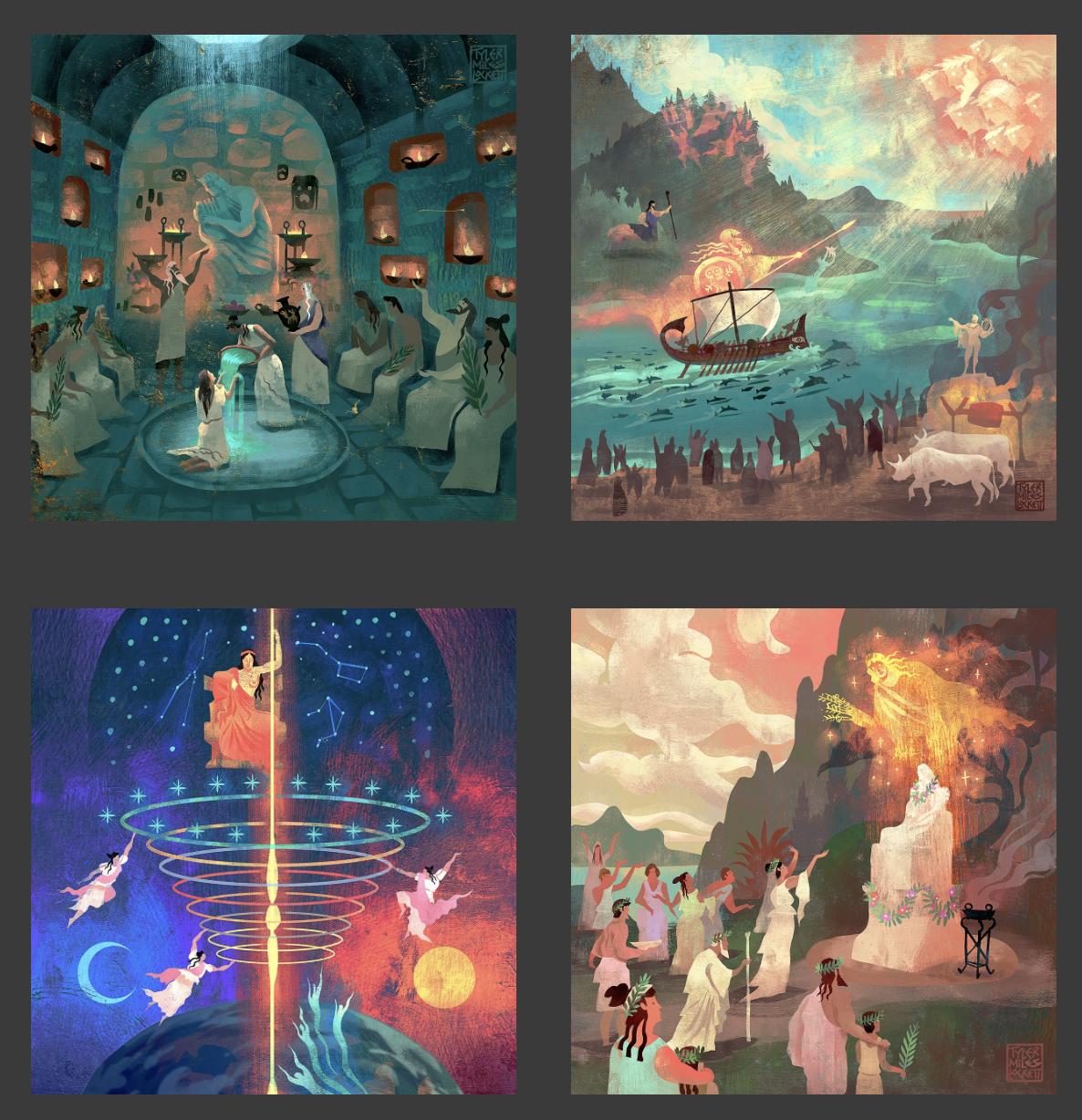
I’ve been looking forward to John Wiswell‘s Wearing the Lion since I heard about it, and even more so now that I’ve seen more work by the illustrator, Tyler Miles Lockett. Bold, colorful, imaginative stuff.
![[personal profile]](https://www.dreamwidth.org/img/silk/identity/user.png)