One of the long-lost pleasures of vinyl that I’m recently recovering is going through stacks of used LPs at record stores. These are thinner on the ground than they were in the 20th C, but when I find one I almost always come away with something great.
I don’t remember being crazy about Orff’s Carmina Catulli, but it is the most famous setting of Catullus’ verse, which I’m teaching again next semester in my Upper Latin class.
There’s some Latin in Prokofiev’s Alexander Nevsky, too: the villainous Crusaders mysteriously intone some sinister-sounding Latin phrases that don’t turn out to mean much. (Peregrinus expectavi pedes meos in cymbalis: “I, a pilgrim, awaited my feet in the cymbals”.) This cantata early went into my mental soundtracks, and a couple scenes in Morlock stories are choreographed to different sections.
There’s no Latin or Greek in the Mahler, unless you count the symphony’s nickname, but that’s okay. I’m not usually crazy about Mahler’s vocal music.
Also: Past-Me did Present-Me a solid by ordering a bunch of books that arrived today, just in time for a weekend when I’ll have very little time for reading. I fall upon the thorns of life; I shrug.
I reread more than I read. This has certain bad effects; e.g., the towering stacks of TBR books that constantly threaten to topple over and crush me, which are always growing taller, more numerous, and (if I’m not misreading their expressions) more angry.
I’d like to say rereading has compensating benefits, e.g. a deeper understanding of the texts I obsessively reread. But often my rereads just make me more confused.
Take Beowulf, a text that would be on my always-reread list even if I didn’t teach it twice a year.
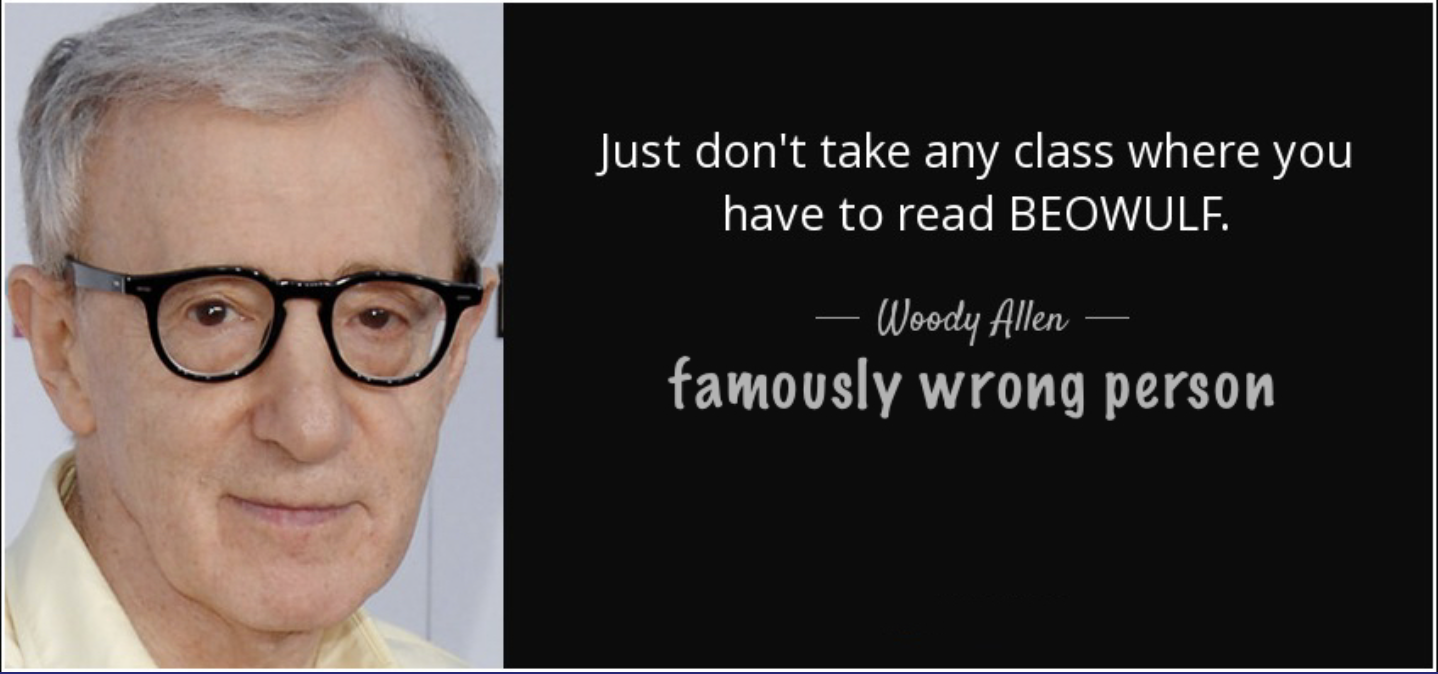
Woody Allen was one of my heroes as a kid, but this line from Annie Hall should’ve been my first warning that there was something wrong with him.
Beowulf is already a hero when he lies down in Heorot, King Hrothgar’s famous mead-hall, to await the arrival of Grendel, the manslaying monster. Beowulf has come with his Geatish pals to Denmark specifically so that he can defeat Grendel. He discusses in advance his plans to engage in hand-to-hand combat with the monster, putting aside weapons and armor.
So: why doesn’t he wait by the door?
Beowulf may want to draw Grendel into the hall, not warn him off from the door. But that doesn’t explain what happens next. I’m not trying to roast Beowulf here, by the way, just trying to wrap my head around the scene.
Grendel bursts in, slamming the door of the hall open. He’s come to kill and eat, as he has so many times before.
Beowulf does nothing.
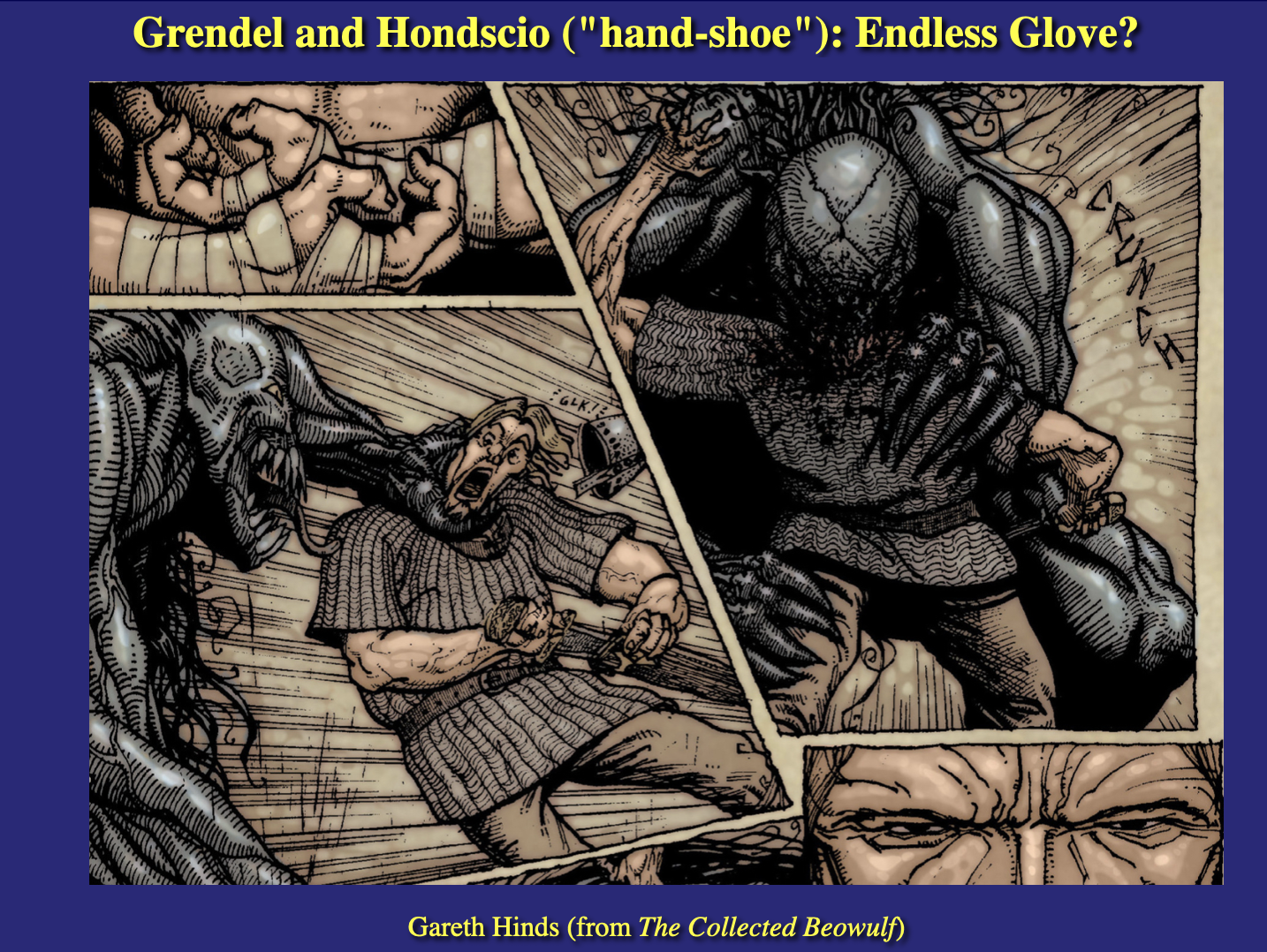
Grendel goes to one of Beowulf’s band of Geatish warriors, a guy (we will later learn) named Hondsciō (“glove”; compare modern German Handschuh “hand-shoe; glove”).
Beowulf does nothing.
Grendel kills Hondsciō and rips him to pieces.
Beowulf does nothing.
Grendel goes to where Beowulf is lying.
Beowulf does nothing.
Grendel grabs Beowulf, and then the fight is on. It’s WWE Raw Is War.
The (surviving) Geats leap up from where they’re lying and try to attack the monster but their swords have no effect. The Grendelkin seem to be immune to ordinary weapons.
Grendel soon realizes he’s out of his depth and tries to flee, but Beowulf won’t let go. Finally Beowulf rips Grendel’s arm off (hand, arm, shoulder), dealing him a mortal wound. Grendel flees back to his underwater lair to die.
The question that constantly bedevils me when rereading this passage is: why does Beowulf wait so long to start doing what he came there to do?
So far, my answer to this question (spoilers: I cannot really answer this question) comes in multiple parts.
The first part is geographical, and hinges on the design of these medieval Germanic halls like Heorot. They’re long buildings with a peaked roof, and a firepit running down the middle.
image above: a reconstructed Viking-era meadhall at Trelleborg in Sweden. image below: artist’s conception of such a hall’s interior from Gudmundson, Den islandske Bolig i Fristats-Tiden (1894)
After the feast, the tables etc would be stacked away (or used as beds?) and the henchmen would sleep in the hall by the firepit.
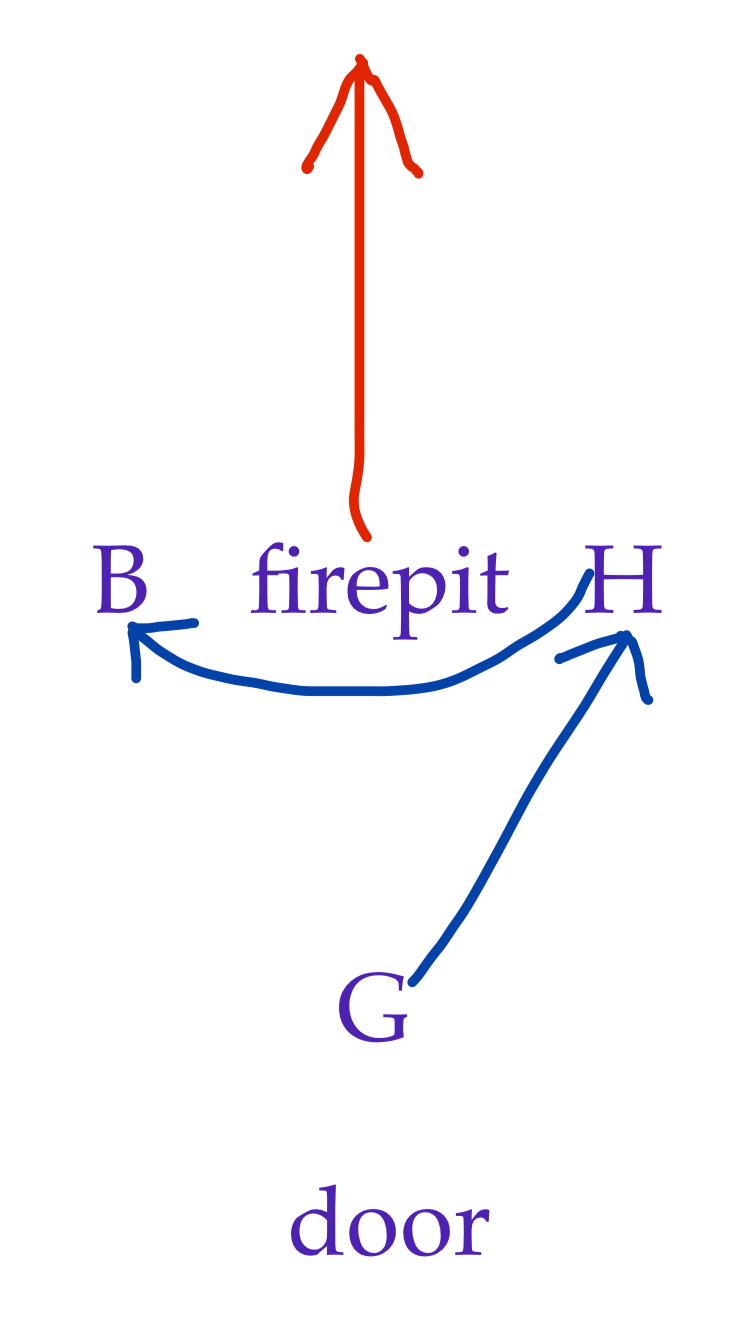
So the Geats come to Heorot, make a big deal about it being occupied again. (Grendel has been attacking it at night for twelve years, and people had given up sleeping there, lest they wake up dead.) The Geats lie down as if to sleep on either side of the firepit. Maybe Hondscio is on one side of the firepit and Beowulf is on the other. Grendel, like Buridan’s donkey, could go in one direction or the other. Unlike Buridan’s donkey, he’s not going to starve to death while making a decision. He launches himself against Hondscio, and then turns to the guy on the other side, who is Beowulf.
Professionally drawn graphic by a professional graphic-drawing guy.
Okay. But this still doesn’t explain why Beowulf takes so long to act. He’s not asleep and he’s not scared (according to the poet). It’s almost as if this is a turn-based game, like chess, and Beowulf has sacrificed a pawn to put the opposing player in an untenable position. That seems to conflict with the magnanimous nature of the hero as the poet represents him, though.
A bookish sort of explanation: Hondsciō’s death is necessary because it prefigures Grendel’s own death. In reparation for the loss of Hondsciō, Grendel loses his hand (along with his arm and shoulder), suffering a fatal wound.
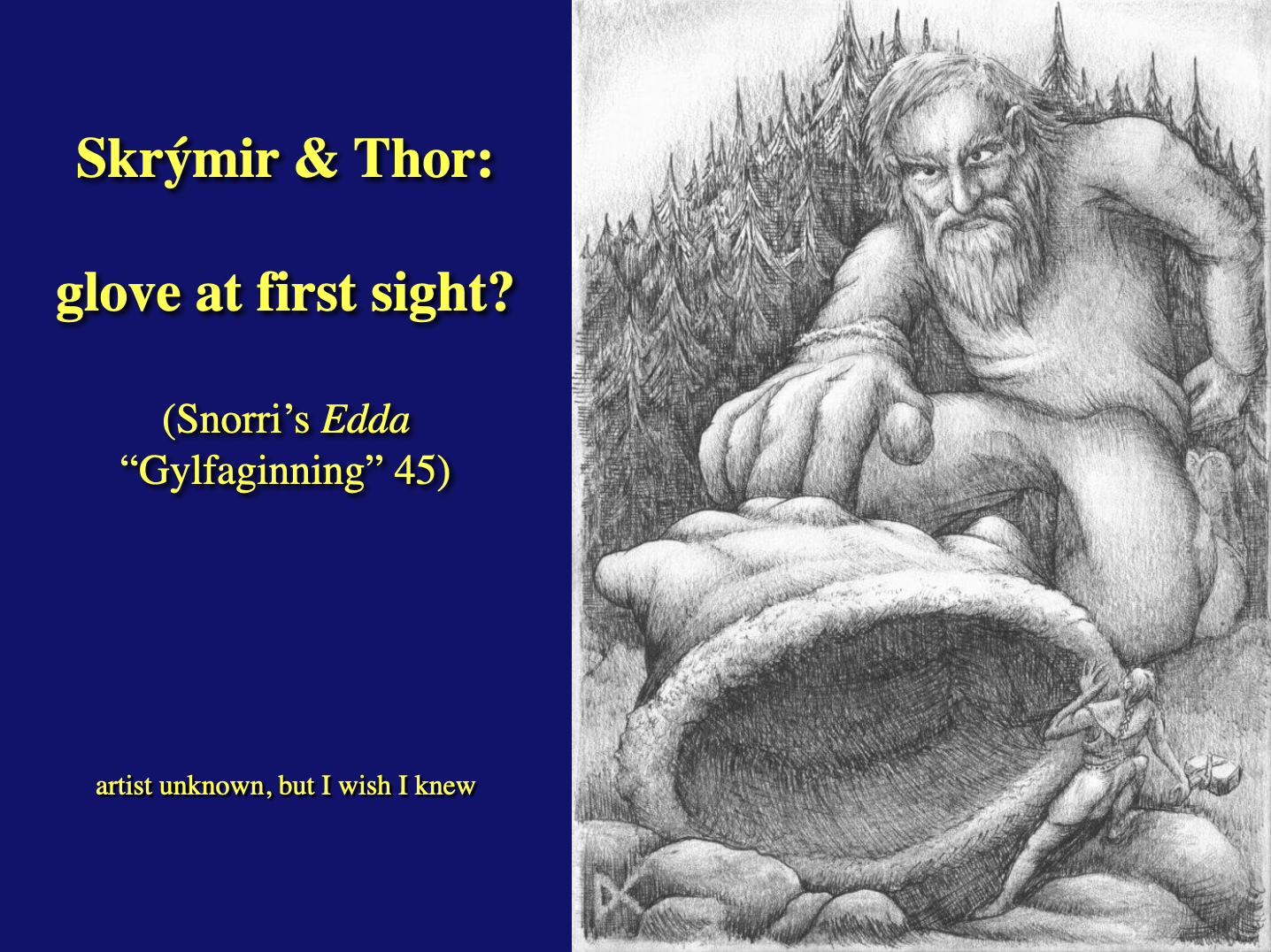
A slide from my Norse myth class.
If this seems too academic and tweedy a reading for so savage a poem, I should add that Beowulf himself makes the connection when he’s retelling the tale to his uncle and king, Higelac, back in Geatland (line 2069b-2100). He talks about the hond-rǣs hæleða (“the hand-battle of heroes”) and goes on to describe the death of Hondciō, naming him for the first time in the poem. He mentions for the first time a weird glove (glōf) made of dragon-hide that Grendel had. Beowulf seems to describe Grendel’s habit of putting dead men into the glove. Which is really weird, does not clarify the situation, but does remind me of another mythological situation, where Thor and friends find themselves in a giant’s glove.
Beowulf concludes this part of his humblebrag by mentioning how Grendel’s right hand (swīðre… hand) remained behind in Heorot.
That line from hand to hand connects a lot of dots in the narrative. And maybe that’s enough. Beowulf describes Hondsciō as fey (“doomed”; fǣgum), and maybe that’s enough.
But maybe it’s not. It still doesn’t give a motivation for Beowulf’s odd stillness until he himself is attacked.
I wonder if the answer isn’t hidden inside Grendel’s identity. The Beowulf-poet famously or infamously grafts the Grendelkin onto the family tree of Adam and Eve, tracing their line of descent from Cain the murderer. But the Beowulf-poet is Christian, and this story probably pre-existed the arrival of Christianity in northwest Europe. So what was the pre-Christian identity of Grendel and his mother?
I think they were the restless dead, a perennial affliction in these Nordic stories. (Think of the Barrow Wights from The Lord of the Rings.) Glám, Grendel’s analogue in Grettir’s Saga (chs. 33-35), is one of the walking dead. And Grendel is repeatedly described as a ghost (ellengǣst “bold ghost”, 86a; se grimma gǣst “the cruel ghost”, 102a; wergan gāstes “accursed ghost” 133a).
But Beowulf kills Grendel. Killing someone who’s already dead seems like a definitional impossibility. But it is something that comes up a lot in these stories, and the answer is frequently some kind of mutilation, a practice known as “arm-pitting” (Greek μασχαλισμός). It’s precisely this kind of thing that Beowulf inflicts on Grendel.
But (not to beat a dead horse or monster here) why does it take Beowulf so long to act?
This is where I came in and this is where I go out, I guess, asking the same question. The only answer I can come up with is personal and has to do with nightmares. I don’t know if you’ve ever been attacked by a ghost or a sinister shadow in a dream. It used to happen to me pretty frequently, back when I was able to get a decent night’s sleep. (Deep sleep is a luxury old people have to learn how to do without. If you wonder why the old people in your life are increasingly crazy, that might be one of the reasons.)
When the ghost is coming for you in the dark, it seems to get the first move. You may see it; you may know it’s coming for you. But you can’t do anything about it. There’s a whole branch of magic in Morlock’s world devoted to stuff you can do in these situations. (See “A Stranger Comes to Town” for some practical applications.)
It may be that in the Ur-myth of Beowulf, he was in that nightmare state, watching the ghost approach and unable to stop it.
That’s not the the answer; as is common in myth and storytelling, there isn’t just one answer. But that’s the best I’ve got from this most recent reread.
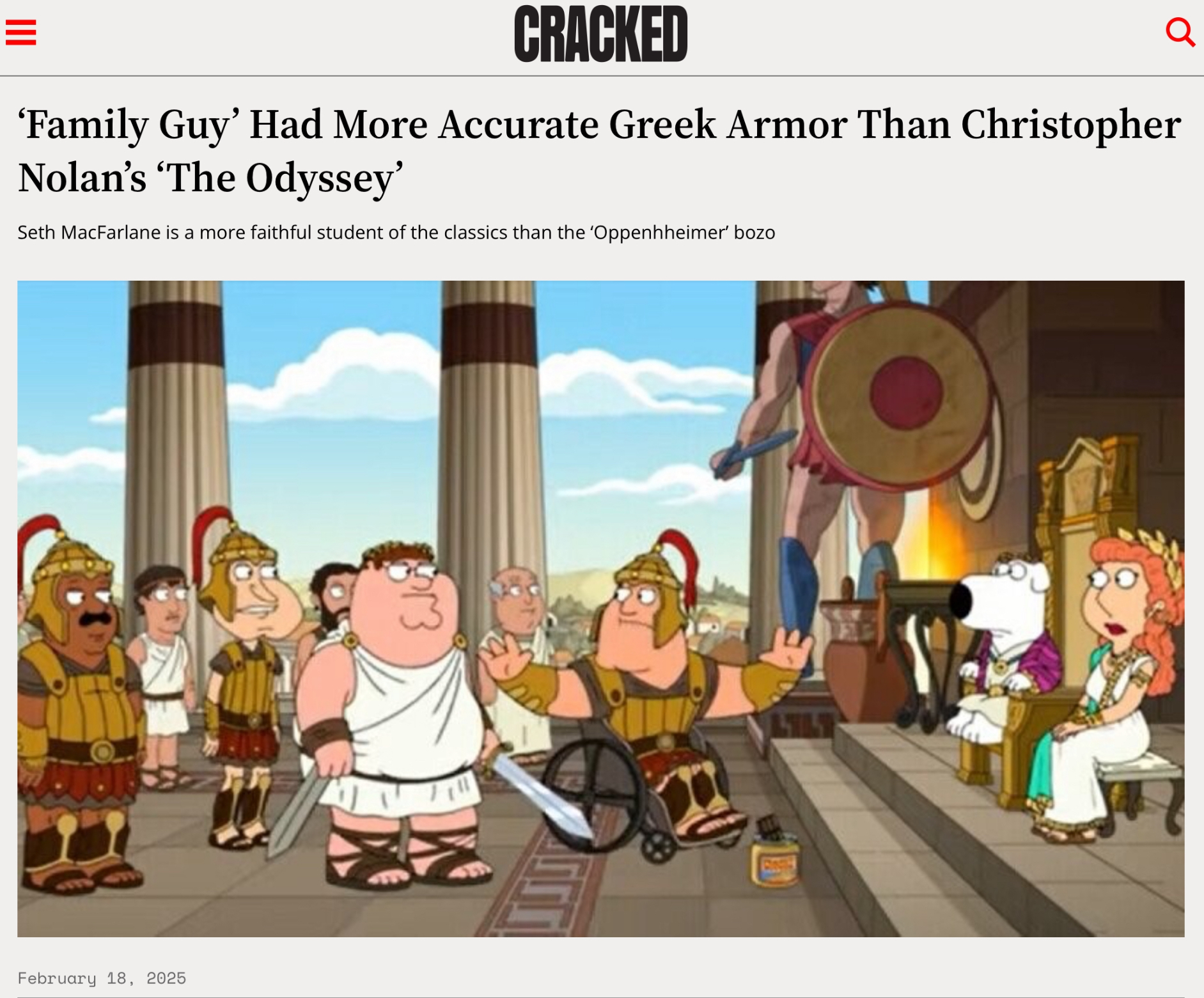
Saw the article below on Bluesky and felt the irritation that almost always accrues when scrolling through social media. But this irritation was really specific. Demanding a historically accurate version of a myth is like trying to find the zip code of Ásgarð. It misconceives the whole enterprise of storytelling. It Must Be Stopped.
This got me thinking about maps in fantasy novels, because that was one way to avoid useful work.
Maps are really not as necessary for fantasy novels as people sometimes pretend, although I sympathize with readers who want to know how you get from the Lantern Waste to Ettinsmoor, etc. As a rather shifty storyteller, I’d prefer not to be pinned down if I can avoid it. (I always cite Melville on this point: “It is not down on any map. True places never are.”)
But I really resist the modern tendency to make fantasy maps follow modern standards of cartography and geology. That’s like insisting that the Fellowship of the Ring should have taken public transit from Rivendell to Mordor.
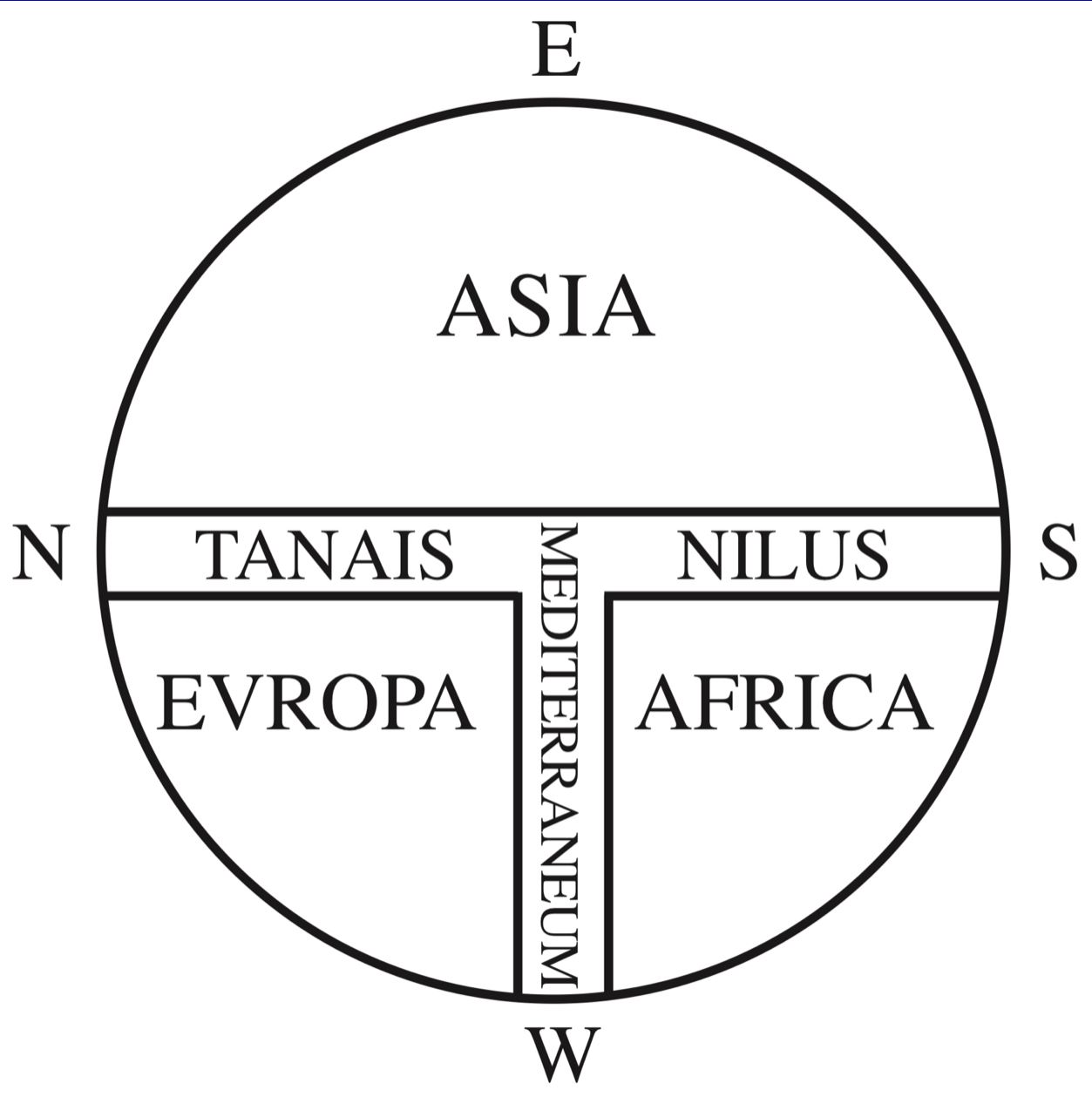
Conventions of maps vary from culture to culture, and they often don’t look familiar to us at all. In this context I often have occasion to think of this medieval model:
Plus, there’s no reason to suppose that a fantasy world was formed along scientific principles. Imposing contemporary standards of geology onto fantasy worlds makes fantasy into a subgenre of science fiction, whereas the reverse is obviously true.
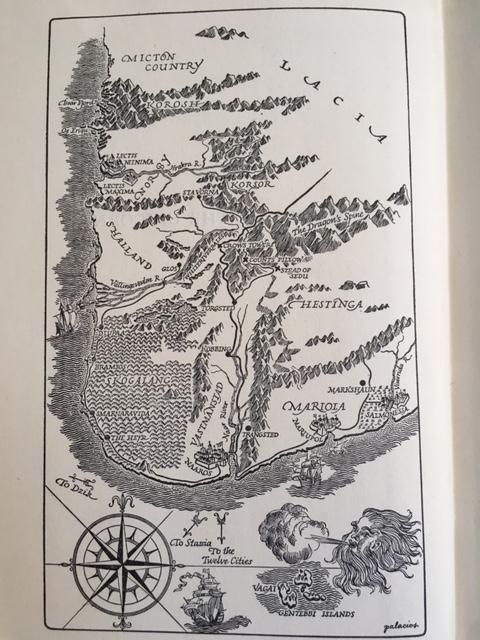
If people want to write a kind of mundane fantasy with low or no magic, that can obviously be done and has been done with great success. Pratt’s The Well of the Unicorn is a celebrated example. (Magic exists in the world of the book, but it reads like a historical novel for an imaginary world.)
Rafael Palacios’ map for Pratt’s The Well of the Unicorn “Are mountains really distributed like that on a real landscape? How big are those ships, really? Are we supposed to believe there’s really a giant disembodied head blowing up a gale over that sea?”
This isn’t an obligation built into the genre, though. Like everything in an imaginary world, maps, the type of maps, or even the mappability of the world should be a deliberate choice on the part of the worldmaker, not something just thrown in because that’s the way it’s done, or to satisfy specious notions of accuracy.
Let us close with a hymn from the sacred texts.
“What’s the good of Mercator’s North Poles and Equators, Tropics, Zones, and Meridian Lines?” So the Bellman would cry: and the crew would reply “They are merely conventional signs!” —Lewis Carroll, The Hunting of the Snark
![[personal profile]](https://www.dreamwidth.org/img/silk/identity/user.png)