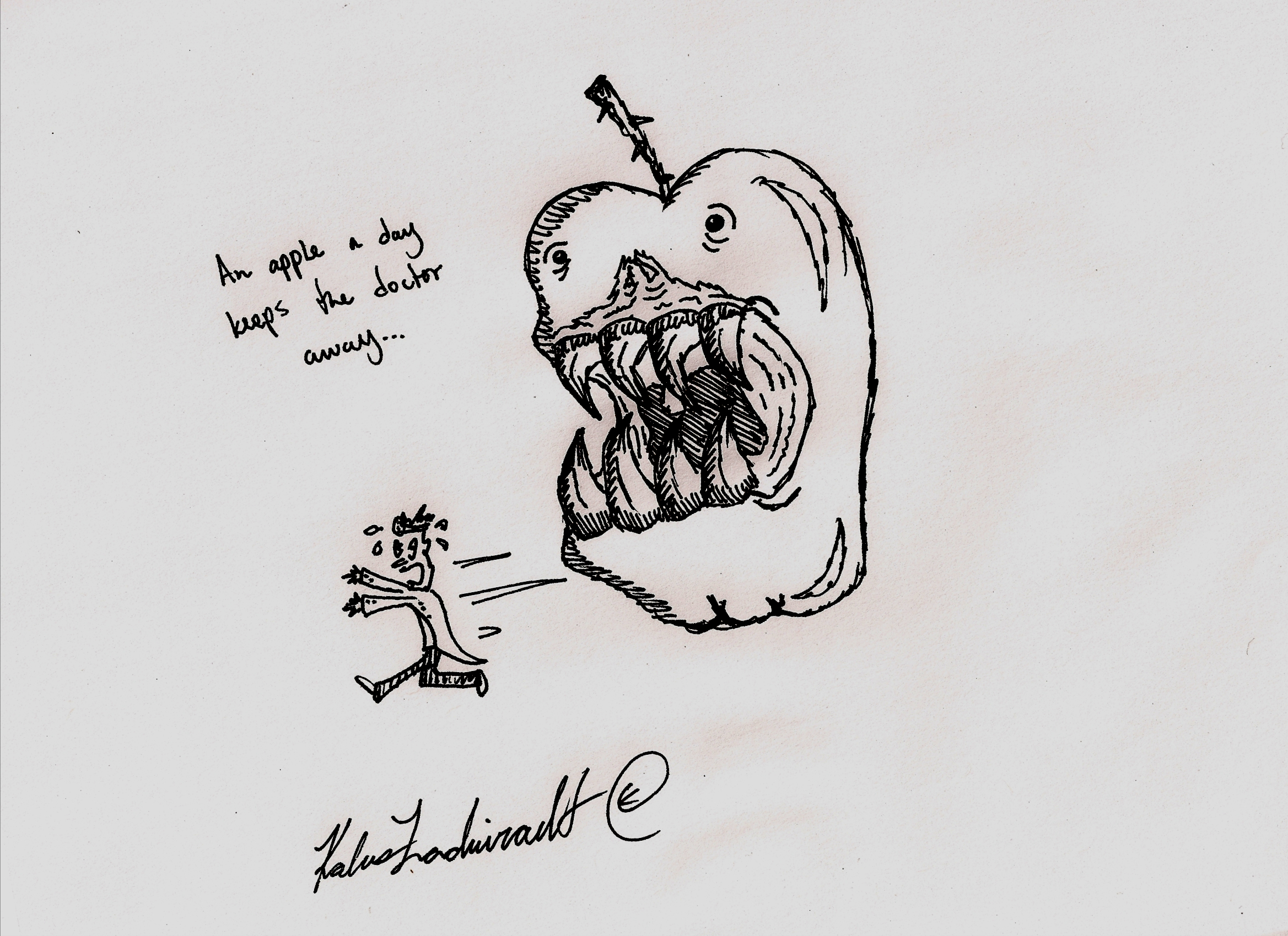
The new macOS (27) makes it much harder to turn off “Apple Intelligence”. I’ve been willing to string along with Apple so far, in spite of everything, and I will miss it. But forced feeding of slop is not something I’m going to pay for. So: what’s next?
What’s next is a LOT, which is why I’ve been reluctant to get started. But the very first thing I need is a list of things I’ll need so that I can have the same toolset for open-source devices that I have for Apple devices. I guess that’s what this is.
A. Hardware
Primus: a Linux destop.
I’ll just get a dumb Windows machine and then install Ubuntu, unless Asus or somebody ships a desktop with Ubuntu. This is a mere shopping problem.
Secundus: a Linux laptop or tablet.
See above.
Tertius: an open source phone.
There are Linux phones, I believe, but there are also other mobile OSs. See an example (Graphene) at the URL below. Again, largely a shopping problem. (Which is not nothing, but see further below.)
Hardware is actually the easy part. I’ve become extremely attached to some software designed for Apple devices. Pages, for instance, for writing; Keynote for slideshows; Protagoras and Bellerophon for reading/interpreting Latin and Greek; PDF Expert for reading PDFs, especially in dead languages; etc.
LibreOffice is what I’ll end up using to replace my current word-processors and slideshow programs. I’m unenthused about that. But it’ll work. And I figure there are PDF readers for Linux, although I’ve never had occasion to look for them.
There simply may not be any equivalents for Protagoras and Bellerophon. But Heslin (designer of Diogenes) does provide Linux versions of his software, so maybe that’ll do. There are supposed to be ways you can set up your own instantiation of the Perseus Project, too. A summer project, maybe. (Or a retirement project, depending on how long this process takes.)
C. Cloud Storage
This, I think, is going to be the worst. The original slogan for iCloud was “It just works”, but at first it really didn’t. Now, damn it, it does, with nary a slip between devices. I’m going to have to find some substitute for it, or go back to the dark ages of the 20th century, when glitchy computers ate whole manuscripts without even belching.
The trouble is that most of the cloud services (Google, Dropbox, etc) are pure evil these days. Leaving iCloud for them would be leaping from the frying pan into the fire.
But: there may be options I don’t know about. Looking for those will be step one.
Also: there may be a way to go on using iCloud with Ubuntu devices, even though iCloud doesn’t officially support Linux distributions.
ANYWAY….
This is a long road and I’m just taking the first steps on it. By the time I finish, the A.I. bubble probably will have burst and the situation will be different when that’s happened. But this is a change worth making for several reasons, obligatory slop just being the most urgent or emergent of them.
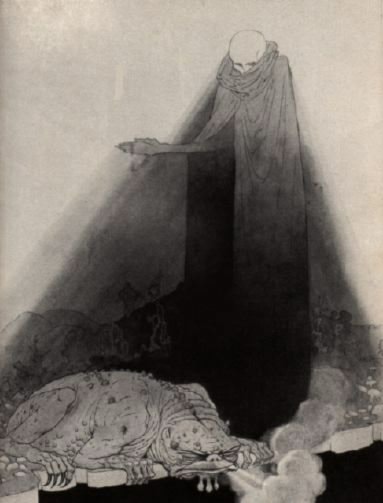
In ancient days in the little kingdoms at the edge of the world, a seeker came before the prophet Imbaun, who said unto him, “As you go your way athwart the world, doing sometimes good and sometimes evil, avoid spelling any word with two or more contiguous Xs. For it shall make you seem a mere knob or dickhead.”
And the seeker said, “But I’m proteinmaxxing so I can looksmaxx my maxximaxxmaxx—”
Imbaun said sadly, “It is too late for this one.”
The seeker turned and saw the god Mung making the sign of Mung, pointing toward the end, and afterwards saw nothing, for he had nothingmaxxed.
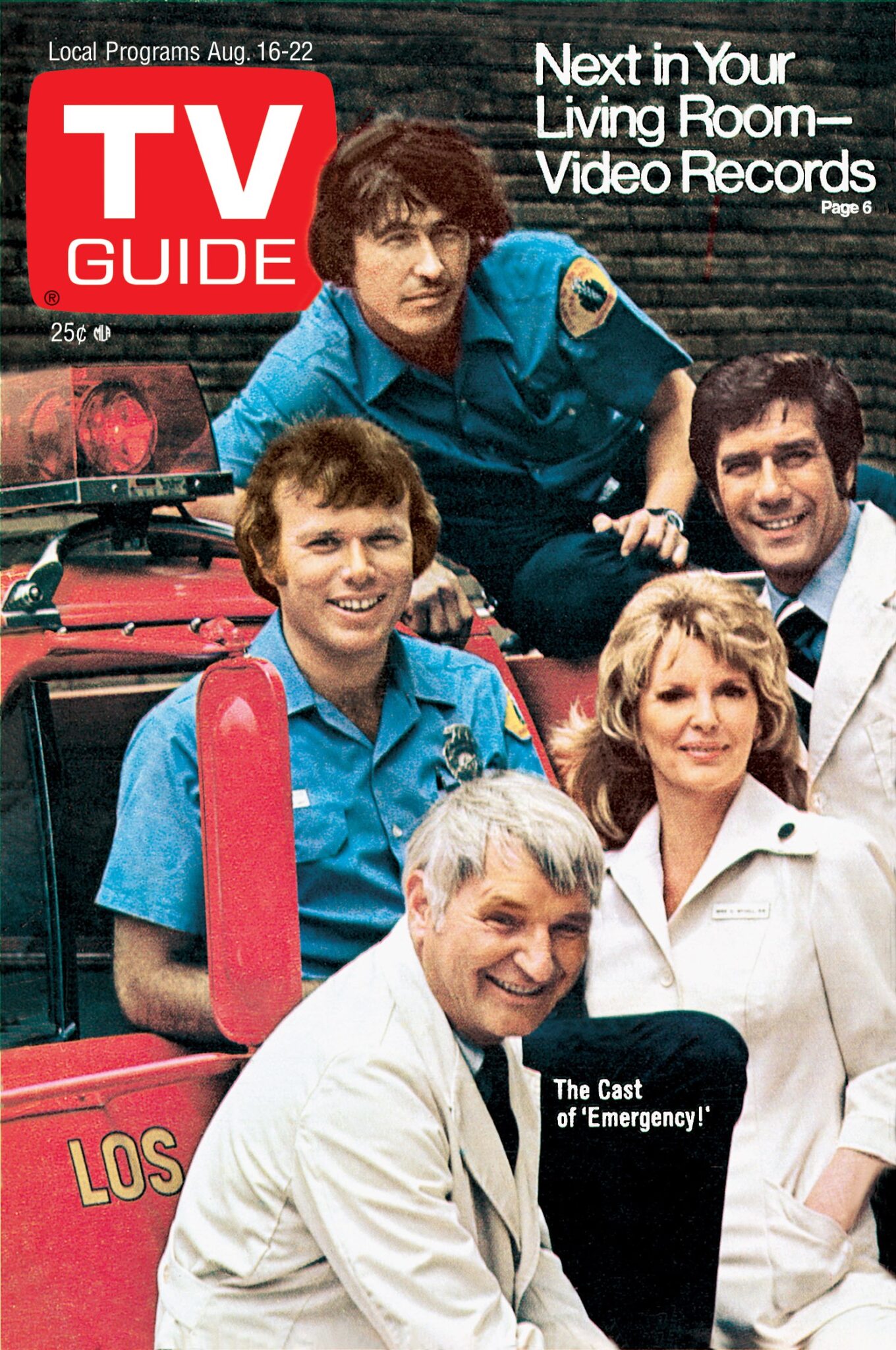
I was recently thinking about Randolph Mantooth (omnia mutantur; nihil interit), which naturally made me think of EMERGENCY! (1972-1979),
which made me think of Julie London, because I’m wired that way,
which made me think of how her ex-husband, Jack Webb (a man of unsuspected depths), hired both her and her husband Bobby Troup for the show, which makes me think of this scene from PERRY MASON: SPACE LAWYER, where Perry (Raymond Burr) elicits a confession from Buzzie (Bobby Troup) in heptalk. It is one of the greatest things ever.
Martha Vickers plays Buzzie’s bored hipster mate, who at no point seems to understand what’s happening in the scene. The actress died of esophageal cancer a dozen years later, which lends a macabre element to all the cigarette smoke drifting through this scene.
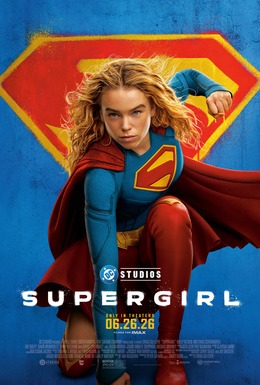
I finally saw Supergirl (2026), now that it’s on various streaming platforms.
(I rarely go to theaters anymore, a habit I developed even before the COVID lockdown. It’s an aversion to audiences who don’t know how to go to a movie rather than to any virus.)
The movie was pretty good, on balance, but had some pacing problems. Some spoilers for the movie and the comic book that provided some of the story follow below.
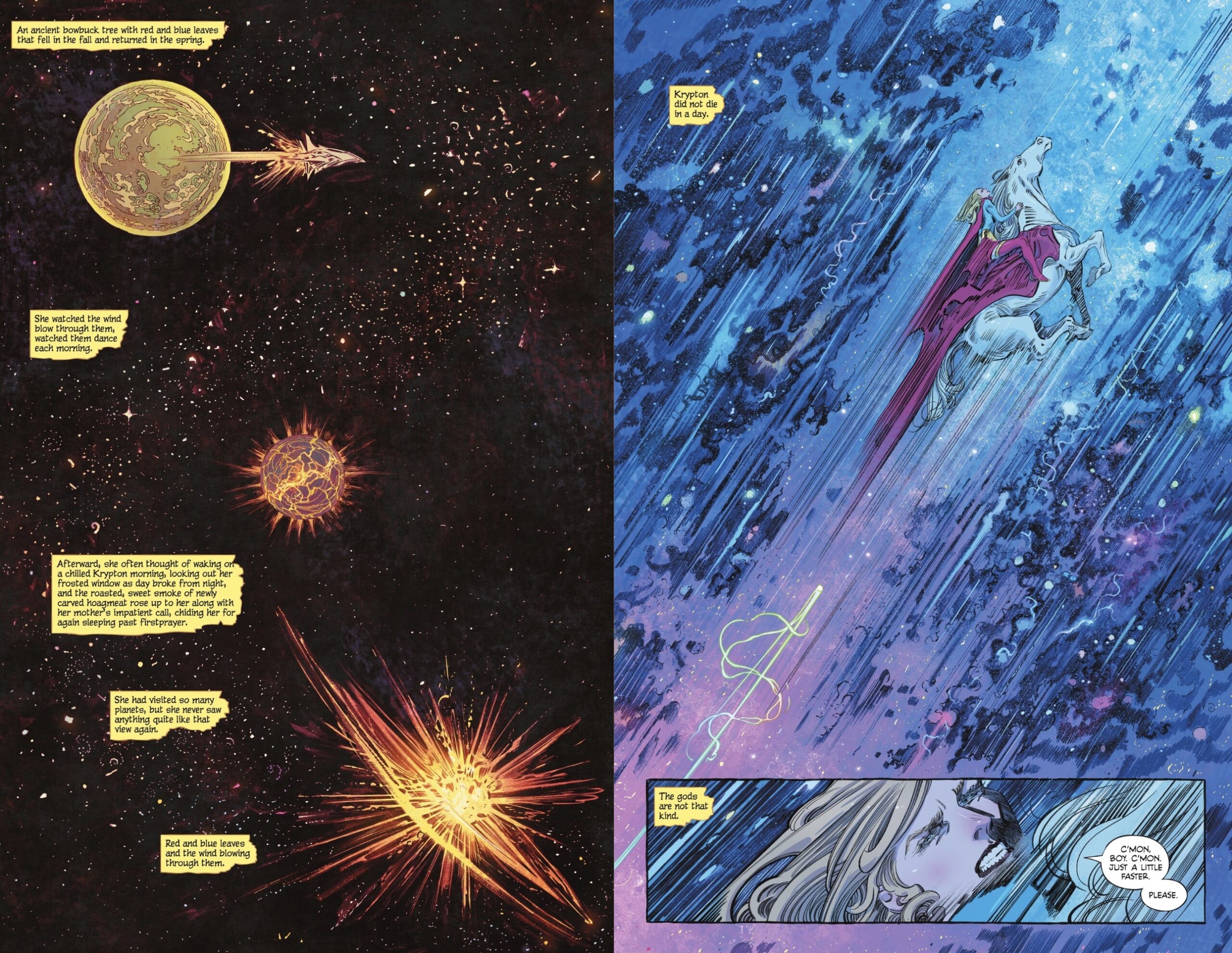
One of the great things about the source material (Woman of Tomorrow by King, Evely, & Lopes) was its wildy phantasmagoric storytelling.
“Krypton did not die in a day. The gods are not that kind.”
There’s only a certain amount of that that can fit into a movie of reasonable length (which this is—less than 2 hours). And, somehow, Evely&Lopes’ art has more impact than the splendiferous CGI that we’ve become used to in comic-book movies and now is somewhat overfamiliar, like wallpaper you’ve seen so often that you hardly see it anymore.
The plot of the comic book is sufficiently complicated that I don’t feel as if I can explain its intricacies. In fact, and in spite of King’s overly wordy script, I don’t think I even understand some of them. (That’s not a slam: impact, not understanding, is what’s important in art, and the book lands with a lot of impact.) But the plot obviously needed to be trimmed down to fit into a movie-sized movie.
The filmakers (scenarist Ana Nogueira and director Craig Gillespie) do a good job of that here, stripping the story down to its essentials: Ruthye’s quest for vengeance and Supergirl’s semi-accidental involvement in that, when the pirate who murdered Ruthye’s family also steals Supergirl’s spaceship and shoots her dog with a poison arrow. (Spoilers: Krypto will be okay.)
There are a lot of fight scenes in this movie, and fight scenes in superhero movies can be a bore. You know what I mean: CGI puppet vs. CGI puppet in a knockdown, dragout battle for the stakes of who cares. In contrast, the fight scenes in Supergirl are mostly pretty strong, showing our hero fighting hand-to-hand (in spite of red sunlight, poison, kryptonite, and other super-obstacles) for human stakes that are always alive and present onscreen.
Milly Alcock shines in these scenes and, in fact, in every scene. She, and Krypto (a CGI puppet, but an unusually charming one) are the best additions to the DCU since Gunn’s Peacemaker (2022-2025).
One of the many changes from Woman of Tomorrow: Comet the Superhorse does not, I am sorry to say, appear in the movie. Instead we get Jason Momoa as Lobo. I find the Wolverine/Lobo type of antihero somewhat boring (in sharp contrast to Comet, who is one of the weirder and more interesting creations of DC’s Silver Age), but Jason Momoa is always a likable screen presence and the character played a role in the plot without hijacking it. (He’s after a different space pirate than our heroes are.)
“Look, Enge, if that is your real name: since there’s all this great stuff in the movie, why are you damning it with faint praise? ‘Pretty good’? We know what that means.”
The movie is really worth watching, and maybe even rewatching. But (arrrgh and damnation) it has its problems, and if I were to sum those up in one word I’d say it’s all the damn moping.
Moping has been a problem with superheroes onscreen ever since their modern era began with X-Men (2000). You’ve heard this one before: “Oh, I can walk through walls and run so fast that time reverses itself, but why can’t I just be like Regular Folk™?”
Supergirl has more reason to mope than most: her planet died before she was born; her parents and everyone she knows died of kryptonite poisoning when she was a child. I’m not saying that her moping is unmotivated. But sadness by itself doesn’t make for drama. Drama (Greek δρᾶμα) literally means “action”—not necessarily in the form of car-chases or CGI punchfests, but it the sense of doing something. Moping isn’t doing something.
A chunk of the movie is given over to Supergirl’s origin story, and I think this was also a mistake. Origin stories in general are overrated, in general, and Supergirl’s origin story in particular is overcomplicated and undramatic.
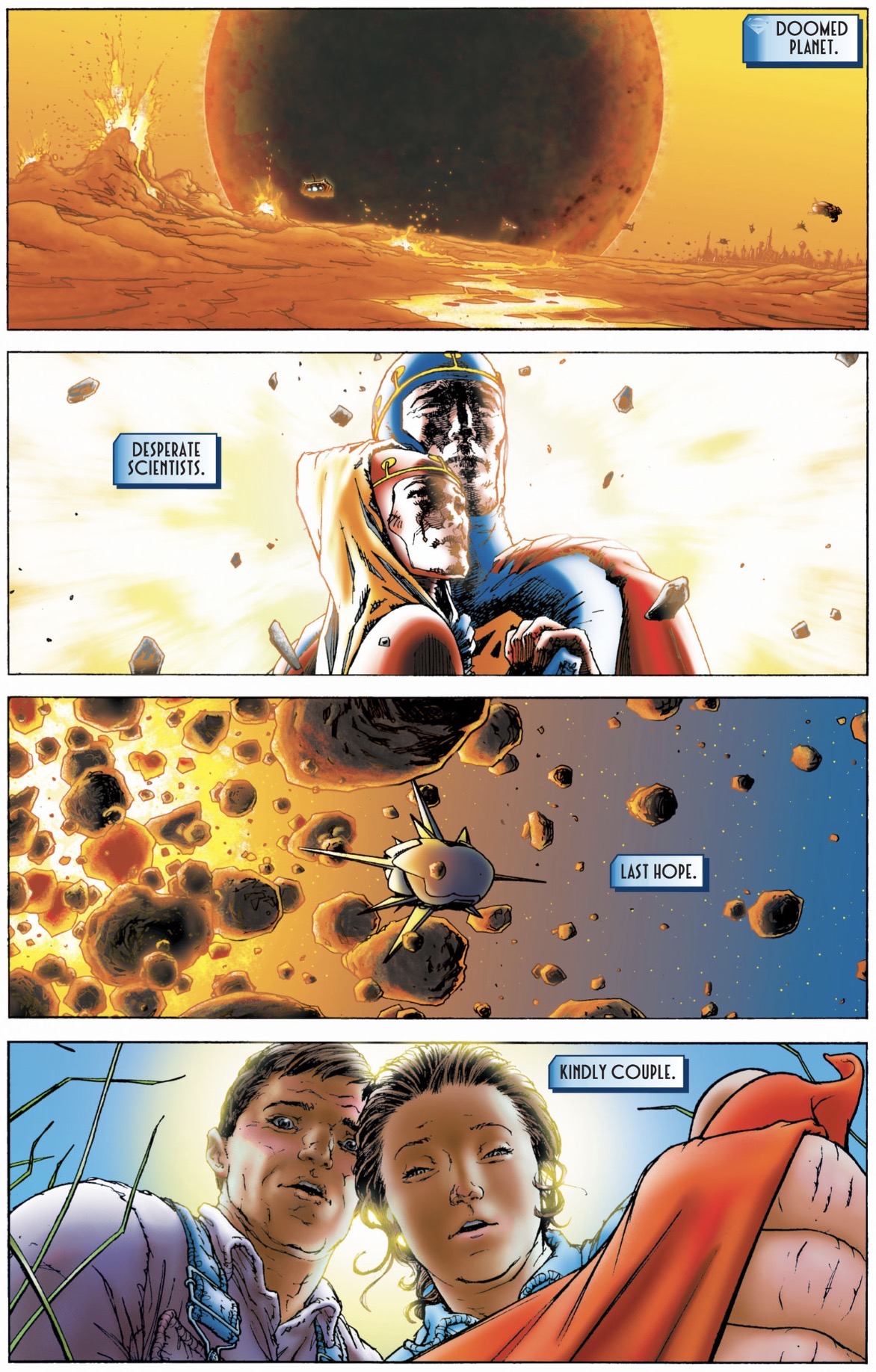
Consider the catastrophic clarity of Superman’s origin, which can be (and has been) summed up in a single page:
From episode 1 of Morrison & Quitely’s All-Star Superman
Supergirl’s origin story begins with the death of Krypton also, but involves the temporary survival of one of Krypton’s cties, Argo, which is then destroyed in a seperate but related and much more slow-motion disaster. Through this circuitous narrative path, Supergirl arrives on Earth as a teenager, some time after Clark has already grown up and become Superman.
In a book this sort of story can work, especially in Woman of Tomorrow, where it appears as a leitmotif of grief in Kara’s internal monologue while she’s struggling with superheroic tasks. But it’s cumbersome and slow-moving material onscreen, and the best screen version of Supergirl (the CBS/WB series) skipped past it to focus on Kara’s present-tense story.
The moping doesn’t last forever, and these passages of the film almost justify themselves when Supergirl soars into the sunlight of decisive action.
At the end of both book and movie, the heroes capture and confront the villain, the space-pirate Krem of the Yellow Hills, just as you knew they would. In both book and movie, Supergirl convinces Ruthye to forego vengeance, so as to keep her heart and conscience free. And, in both book and movie, Krem is killed anyway, but the two versions have radically different routes to that end.
In the movie, Supergirl goes back and kills Krem. If the guilt of such a thing is a burden (as she claims), she’s willing to bear it. It’s a morally complicated but dramatically effective way to cut the Gordian knot of the plot conflict.
In the book it’s even more complicated. Krem is imprisoned for long years in the Phantom Zone. Apparently, in that place, he’s seen the error of his ways. In an epilogue set long after the end of the story proper, a still-youthful Supergirl visits a now-aged Ruthye for a reunion with the repentant brigand. As the aged ex-brigand is on his knees, thanking them for his opportunity to change his ways, and begging pardon for his crimes, the aged Ruth kills him without explanation and without mercy.
The creators don’t say what they are saying with this harsh, discordant ending. The message may be that mercy, on some occasions, is a greater burden to carry in your heart than revenge. In any case, the conclusion reminded me of Aeneas killing Turnus right at the end of Vergil’s Aeneid.
The epilogue of the movie is more explicitly comforting. Supergirl shows up at Clark’s apartment in Metropolis, having made peace with her past and ready to face her future.
Time and the tides of popular culture are fighting against the new DCU. People are getting weary of superhero movies and the popular reaction to Supergirl, in particular, was poisoned by trollish, gynophobic men. This movie wasn’t the kind of out-of-the-ballpark hit that the DCU really needed at this moment.
But: it’s worth watching, and maybe even rewatching. That’s more than can be said of many a superhero movie, including some with much more impressive box-office numbers.
When I find out that a movie I like is based on a book, I frequently seek out the book. It’s not just that I like books better than movies (though a case could be made, I guess). There’s just likely to be stuff even in a fairly short book that there wasn’t space to include in a two-hour movie (or even a three-to-seven-hour movie, the current standard).
“More of what I like” is a pretty easy sell for me. The pattern was set when I read the novels that The Maltese Falcon (1941) and The Thin Man (1934) were based on. Huston’s movie is an enduring classic, but Hammett’s novel is even better, and the “Thin Man” movies, though fun, are pale shadows of Hammett’s last novel.
I’ve probably watched Mike Nichol’s The Graduate (1967) fifteen times, and usually when I see the credit “based on the novel by Charles Webb” I think, “Hey, I should read that.” Then I forget about all that when Anne Bancroft appears onscreen.
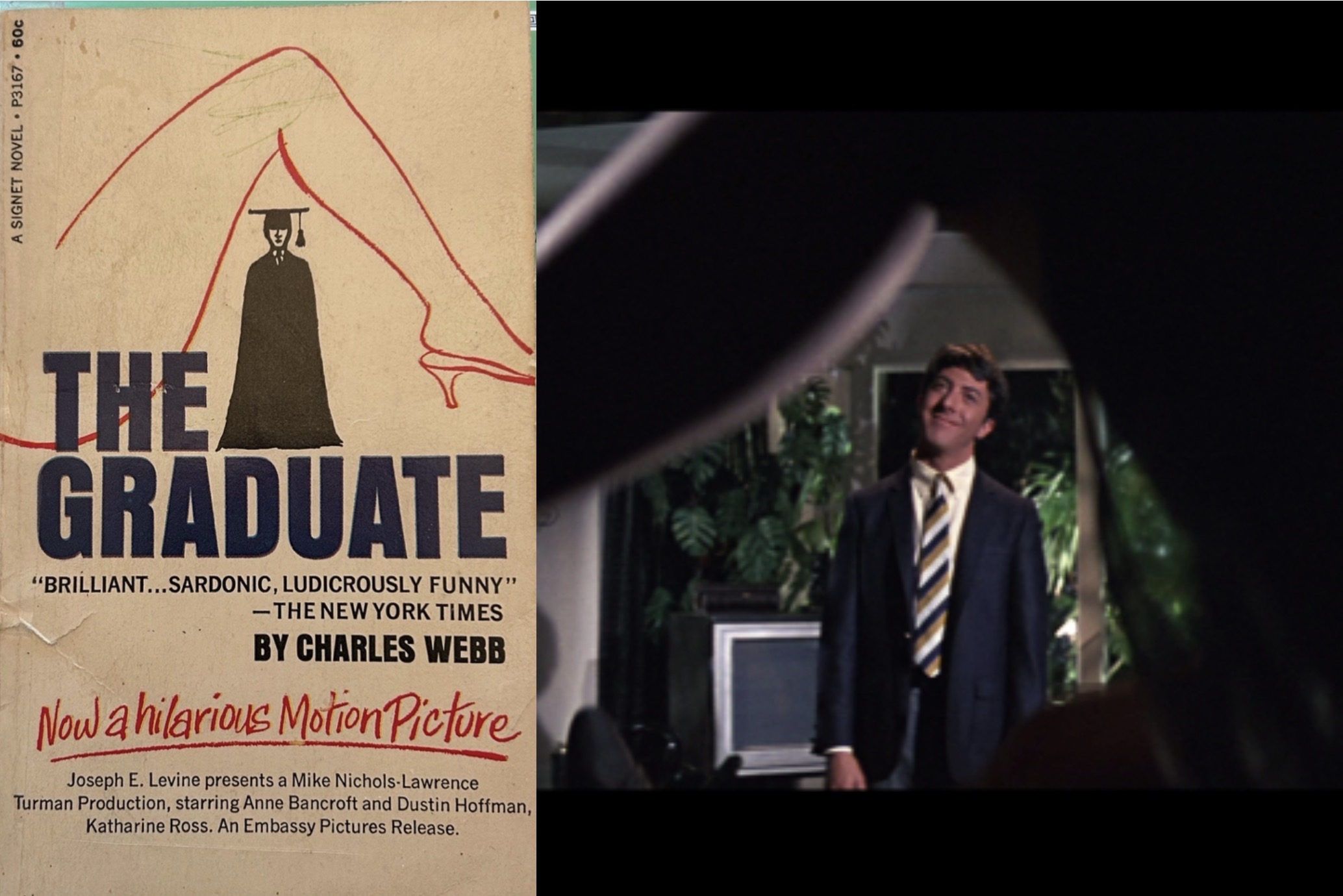
But over the weekend, D and I visited NeverMore Used Books in Toledo—a truly great bookstore. I ran across a paperback of Webb’s novel there and snapped it up. (Spoilers for the 63-year-old novel and the 59-year-old film follow, if you’re worried about that.)
I was wondering if the paperback’s cover inspired Nichols’ daring shot, but this cover image only seems to appear in movie tie-in versions, so it’s probably the other way around.
Webb’s novel is a quick read but, by and large, an unnecessary one. It has a lot of good stuff in it, but almost all of that good stuff was lifted by the crafty screenwriter Buck Henry and put into the screenplay, frequently sharpened and made more effective. (The script is co-credited by Calder Willingham, as mandated by the Writer’s Guild, but apparently it was Henry’s version that was shot after Willingham’s script was discarded; so says Mr. Wikipedia.)
The story common to book and movie:
Benjamin Braddock, an award-winning scholar and track star, comes home to California after graduating from college with no idea of what to do with the rest of his life. At a family party celebrating his return, he is buttonholed by Mrs. Robinson, who is married to the law-partner of Benjamin’s father and is a longtime family friend. (Sort of! More on this below.) She wants Benjamin to give her a ride home, and he churlishly agrees.
It turns out that what she really wants to do is seduce Benjamin (although she denies this in a brilliant conversational gambit that sets Benjamin back on his heels). Eventually, even Benjamin (not the brightest bulb on Broadway, no matter how many academic honors he piled up back east) figures out what’s going on; despite his original shock, he falls in with her suggestion and they begin an affair routinely conducted at a local hotel.
Benjamin has qualms and tries to break the affair off, but in the end he can’t bring himself to do it. In the gilded wilderness of his upper-class life, his trysts with Mrs. Robinson are (as he tells her) “the only thing I have to look forward to.”
There’s a fly in this existential ointment, though: Elaine Robinson. She’s the Robinsons’ daughter, a couple years younger than Benjamin, and the Braddocks and Mr. Robinson (at least) would like these two crazy kids to get together. Mrs Robinson (for reasons that are implied but not stated) is against this plan, as is Benjamin. For him, anyway, dating mother and daughter simultaneously would make the already-weird situation unbearably weird.
When a date with Elaine is more or less forced on the weak-willed Benjamin, he resolves to take her on the worst date ever, being a clinically insensitive jerk (his only evident talent, tales of collegiate glory notwithstanding) and landing eventually in a strip club. Elaine is humiliated and starts to cry. Benjamin is touched for the first time in the story with something like human sympathy, and tries to make it up to her. The date ends on a positive note and they agree to get together the next day.
That’s not to be, though. Mrs. Robinson intervenes. Benjamin tells Elaine of his affair with her mother, to forestall Mrs. Robinson doing so, and Elaine kicks him out of her house, eventually going back to Berkeley for college and a life that doesn’t include Benjamin.
After giving the matter some weeks of mopey thought, Benjamin decides to marry Elaine. He leaves his parents’ house, stalks Elaine at Berkeley, and (despite her doubts and the explicit interference of everyone he knows) succeeds in running off with her, away from her planned marriage with a cartoon of Joe College. They run away together, climb onto a passing bus, and ride off to a future as empty as Benjamin’s imagination.
At this point you’re probably saying, “Enge, if that is your real name, you seem to have wandered off task. You were going to sum up the story common to book and movie, not summarize the entirety of one or the other.”
That’s the thing, though. The detailed summary above applies both to the book and the movie. Nichols’ movie is one of the most faithful screen adaptations I’ve ever seen. On the rare occasions the movie differs from the book, the movie’s version is usually better.
Take, for instance, Benjamin’s first attempt to end the affair with Mrs. Robinson.
In the book, Benjamin writes her a Dear Jane letter. Hilariously, he addresses her as “Mrs. Robinson” in the letter, as he always does in every context. (Her first name never appears in the book or movie; in a little-known sequel published more than 40 years after the original novel, the character’s first name is given as “Glenda”.) Later on, they end back up together, without any clear transition.
In the movie, breakup and reunion are compressed into a single, highly effective scene that highlights Benjamin’s rootlessness and propensity to drift. We also get, courtesy of Anne Bancroft’s acting ability, a glimpse of the alienation and loneliness that are at the core of Mrs. Robinson’s character.
Similarly: in both the book and the movie, Benjamin and Elaine are enjoying their date so much that, instead of going home, they decide to go have a drink somewhere. At Elaine’s suggestion, they go to the nearby Taft Hotel. Benjamin is not crazy about this idea, and he has a good reason. However, he can’t say what it is: the Taft is where Benjamin and Elaine’s mother have been carrying on their affair. So they go, and a bunch of people recognize Benjamin, addressing him as “Mr. Gladstone” (the nom de la nuit that he uses when registering at the hotel). He retreats in confusion, and Elaine patiently elicits from him the fact that he’s been having an affair with “a married woman”—although Benjamin lies like a rug about it, saying that Elaine doesn’t know the woman and that she has a son (not a daughter).
It’s pretty funny (and then poignant) in the book—a turning point where Benjamin is confronted with his own lies and takes a belated and halting step toward honesty.
But the movie is even better, sharpening the ironic edge of the scene by having a series of people (Buck Henry as a desk clerk, Mike Farrell as a bellhop, Buddy Douglas as yet another bellhop) say in quick succession, “Good evening, Mr Gladstone!” to an increasingly dismayed Benjamin. (Dustin Hoffman is always brilliant, but never better than he is here.) Most of that stuff is there in the book, but without the ratcheting up of tension with each exchange, until they flee into the night. It’s like the scene in the book is the first draft of the script.
One element of the book that’s missing in the movie is a trip Benjamin takes after returning home. He tells his parents that he’s “going north” and doesn’t know when he’ll return: “Maybe in five years; maybe in ten years.” He’s going to spend his life among “real people” whom he expects to be different than the unreal people his affluent upbringing has stranded him among.
Three weeks later, he’s back home. He hitchhiked a lot, met many people, and helped fight a wildfire. But the “real people” he met were dull; the people who picked him up he dismisses as “queers”; fire-fighting, too, was apparently a snoozefest. None of this is in direct narration; we get in in fragments from Benjamin’s surly responses to his parents’ concerned questions.
At this point, my simmering impatience with Benjamin’s character began to boil over. He’s incredibly joyless. He gets to sleep with a beautiful older woman, somehow persuades said woman’s beautiful daughter to run off with him, leads in all respects a charmed life, and it’s nothing to him, to hear him tell it.
But that joylessness began to remind me of some people I’d known, and then I realized something: this kid is suffering from undiagnosed, untreated depression. (I am not, of course, That Kind of Doctor, but Benjamin is a fictional character and I have some expertise dealing with them.) At that point, I found I could sympathize with him, though at no point did I identify with him.
There’s one interesting bit from the book that didn’t make it into the movie. When Benjamin is writing his ill-fated “Dear Jane” letter to Mrs. Robinson, Benjamin’s father walks in on him. Benjamin tries to brush his father off, as usual, but his father won’t be brushed. He says he noticed Ben’s discomfort when the Robinsons visited earlier and asks if it’s because of Mrs. Robinson.
This bolt from the blue catches Benjamin’s hard-to-catch interest, and Mr. Braddock expands on his remark. “Ben, I’ve known that woman for twenty years and I still don’t know her. … There’s something about her that makes anybody feel uncomfortable. … But she’s—she’s really not much of a person. She never makes any effort socially or any other way. … But she’s not honest, Ben. … I think she’s devious.”
This could be read a few different ways. One is that it’s a straight-up attempt by the writer to villainize this character. I’m disinclined to accept that, though, partly because this passage made me more sympathetic to her, and because it underscored some similarities between Benjamin and Mrs. Robinson that Ben’s father may or may not have been aware of. I wonder, too, if Mrs. Robinson had an affair with Mr. Braddock at some earlier date, or tried to initiate one, and that’s part of Mr. Braddock’s distaste for his partner’s wife.
If it seems like I’m damning the novel with faint praise, I’m really not. If you have a favorite line from the movie, chances are it’s present in the novel. It can be very funny, reminding me sometimes of Amis’ Lucky Jim. There are some beginner’s mistakes, but on the whole I’d say this was a promising first novel, except that the writer’s promise seems to have been mostly unfulfilled.
A problem common to the book and the movie is Elaine Robinson. If you accept that every story must include an attractive young woman whose job it is to be the Hero’s Girlfriend, maybe there is no problem. But if we want to think of Elaine as a person rather than a trope, the story doesn’t give us much to work with.
We may infer that Elaine is disenchanted with the shallow and materialistic lifestyle of her parents, and that she doesn’t want to find herself a clone of her mother in twenty years. The book doesn’t say anything about that, but there is a significant exchange between Elaine and her mother as the younger woman is fleeing her marriage to Joe College. Mrs. Robinson grabs her daughter and says, “It’s too late!” Elaine shakes loose and says, “Not for me!”
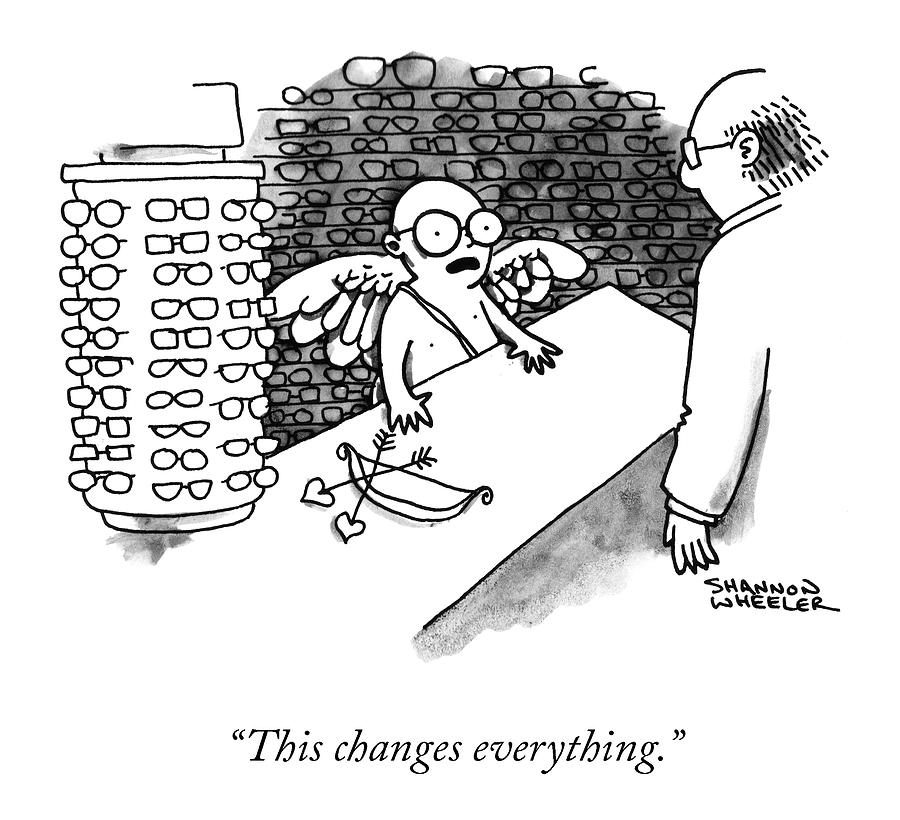
In the book, Elaine simply goes with Benjamin away from the abortive marriage, almost as voiceless as Lavinia in the Aeneid. We have to infer that there is some vibe between them that they both feel and can’t or don’t have to articulate. I guess that’s a thing that happens sometimes: Cupid, if not blind, is at least a little nearsighted. Still, this is another area where the movie has a leg up, as it were, on the book.
I’ve been hearing about Lawrence Block’s crime fiction since forever, but I finally got around to reading some. Now I wish I’d done it decades ago.
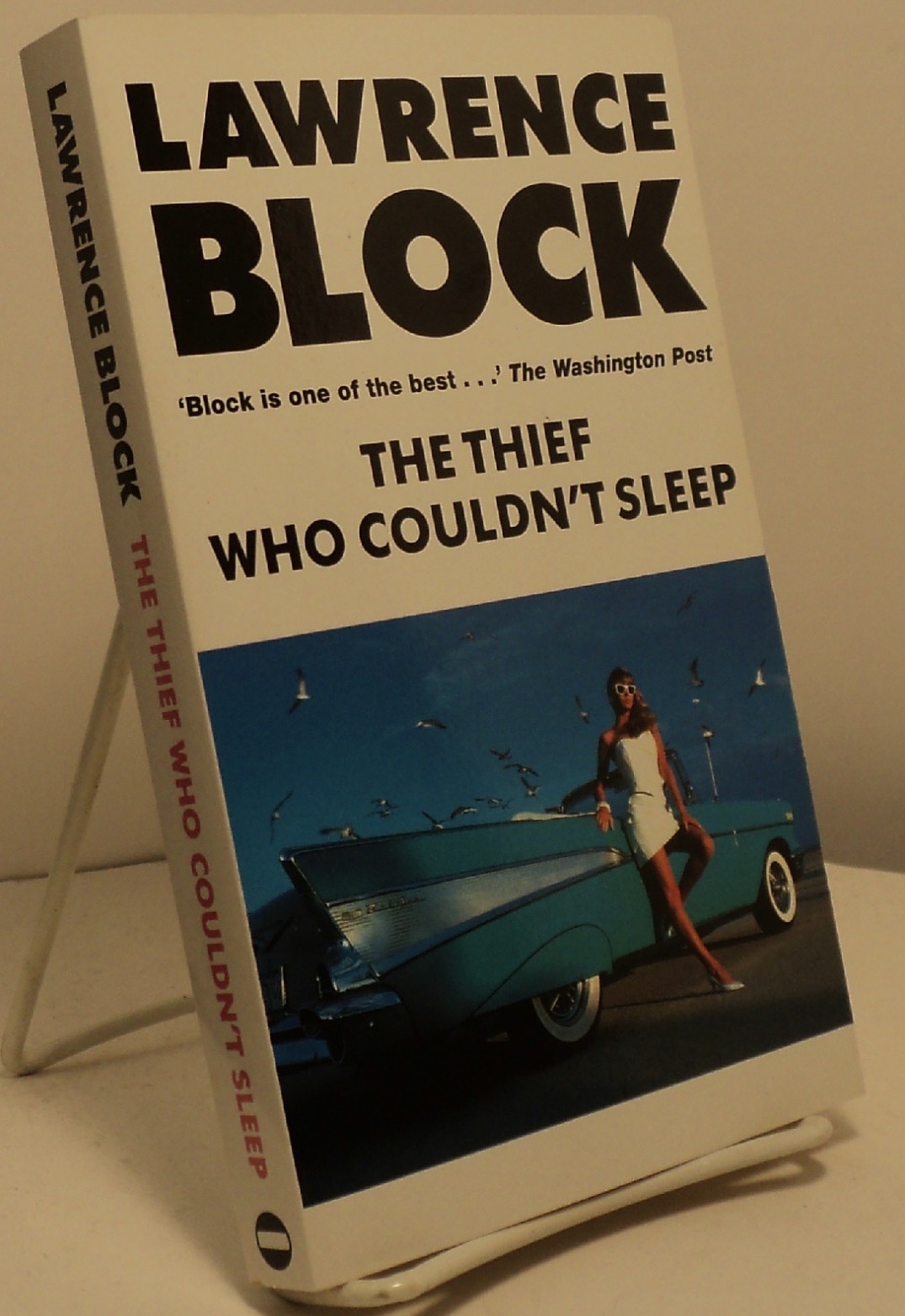
Block’s The Thief Who Couldn’t Sleep (in the No Exit Books edition, circa 1970). This isn’t my copy, but is the edition I read.
This first thing of his I read was The Thief Who Couldn’t Sleep. I didn’t believe in the hero, Evan Tanner (who suffered a traumatic brain injury in the Korean War and consequently never sleeps, but suffers no apparent ill effects from this) or the crazy adventures he got into in and beyond Europe in the frosty depths of the Cold War. But it was a fast-moving and fun adventure, and all the sex in it is friendly and consensual (not always the case in these things).
The weakest and dullest part of the book was the very end, where our unlikely hero becomes an operative for an even more unlikely super-secret spy agency. But that’s forgiveable as a set-up for the ensuing series (which carried on for a dozen or so volumes).
I’m currently working on the first novel in another long-running series by Block, Burglars Can’t Be Choosers, and his collected stories (under the title Enough Rope). I can recommend both on the so-far-so-good principle.
I was reading Dougan’s commentary on Cicero’s Tusculan Disputations, which is a perfectly normal thing to do, and at one point (ad 1.49.118) he suggested that the English word clever is derived from deliver.
“Interesting, if true,” I thought, and consulted my go-to authorities, the tyrant OED and the democratical AHD.
It looks like Dougan was wrong about this. The OED calls clever a word “of uncertain origin” and glances uncertainly at a list of possible Germanic cognates, but it doesn’t so much as mention Dougan’s theory. The AHD more confidently derives clever from an o-grade of PIE *gleubh– “to tear apart, cleave”, making it akin to cleave, clove (both the past tense of the verb, and as in the cleavable chunk of garlic), and glyph.
Like you, probably, I instantly thought: The clever cleaver clove the clover in the cleft! In this useful and beautiful sentence, all the different words (except for the articles and the preposition) derive from the same Indo-European root, or so I hoped.
But what about clover? It doesn’t seem impossible that it also derives from *gleubh-, since the plant notoriously divides into multiple leaves—usually three (hence the genus name trefoil or Trifolium), but four if you’re lucky. The dictionaries don’t support this etymology, but dictionaries don’t know everything.
Still, if you wanted to operate under the authority of the dictionary, you could change the sentence to The clever cleaver clove the glyph in the cleft! This is equally useful, if slightly less beautiful.
I watched these two movies last night back-to-back and found that, oddly, they had a lot in common—although maybe the main thing they had in common was the guy watching them. Both involve solitary characters who face off against monsters. In this, they reminded me of sword-and-sorcery—a subject never far from my mind—even though neither quite qualifies as S&S; the one lacks sorcery, the other swords.
Above left: Zatoichi (Shintaro Katsu) is seen under the arms of a swordsman he’s just killed. Above right: Kristen Stewart fiddles with the fastenings of an ugly and uncomfortable dress.
There are no spoilers for Zatoichi movies; if you’ve seen one, you know how this one worked out. Spoilers for Personal Shopper will be inevitable, though, especially when discussing the movie’s ambiguous ending. If all you want to know is whether these movies are worth your time, I think they are. But de gustibus non disputandum, and all that.
Zatoichi’s Revenge is the 10th entry in the very long and justifiably popular movie series about a blind swordsman swordsman wandering through Japan in the Edo period.
If you’ve seen any of the previous nine, you know how this one goes. Zatoichi, a blind masseur with a taste for gambling, is also the best swordsman alive. How a blind man can do what Zatoichi does is never explained, but it seems to be a natural phenomenon, based on his heightened non-visual senses, not some kind of magical or pseud0-scientific gift (cf Luke Skywalker or Daredevil). Zatoichi wanders into a given town and becomes involved with the people there. Some good people are being oppressed by thugs. Zatoichi ends up in conflict with the thugs and disposes of them with his sword. Then Zatoichi hits the road again, like Shane, or Paladin from Have Gun—Will Travel.
Why watch what is essentially the same story ten times or more? (The film series has 26 entries, and was followed by a television series, and there have been remakes and retakes since these ended.)
I guess maybe it’s not for everyone. It’s for me, though, maybe because I grew up in the Dark Age of television and consequently have a high tolerance for repetition in episodic storytelling. Also, I early grew to like the main character, as played by Shintaro Katsu. He’s a humble and kindly man, with a fondness for sunshine and rice-balls, who simply happens to be a deadlier swordsman than anyone else. Then, too, the writers/directors know how to vary the formula with a variety of incidents, and each episode has new characters (broadly but vividly drawn) who evoke new interest.
In this outing, Zatoichi returns after many years to the town where he learned the art of massage. But his master has been murdered and the old man’s daughter has been forced into a house of prostitution by the local yakuza boss. In the course of finding this out, Zatoichi comes to know a dice-thrower, Denroku, who works for the yakuza and the dice-thrower’s prepubescent daughter, Tsuru, who has already caught the eye of the boss. Denroku (whose name means “the weasel”) is an agreeable if crooked guy who, when the time comes to rescue his daughter and the other women forced into sex-work by the boss, rises to the level of heroism. Zatoichi gets revenge on the samurai who murdered his master (and others besides), dispatches countless interchangeable bad guys in long, well-choreographed fight scenes, and in the end goes his melancholy way alone as you knew he would.
Why does no one shoot Zatoichi with a gun (a technology not unknown in the period)? This actually happens in one of the earlier films (Zatoichi’s Flashing Sword—shades of Lin Carter). But in general, it just never comes up. Arrows the hero can deal with as lightly as he does the swords of his enemies, but I guess the filmmakers didn’t have the moxie to claim Zatoichi could pluck bullets out of midair.
Personal Shopper, in contrast, is a standalone film, and by no means one made according to a formula; it was rarely clear to me what was going to happen before it happened. In fact, by the end, it wasn’t clear to me what was happening at all, which sounds like a criticism but is not, really. There’s a deliberate ambiguity in the final scenes which increases rather than decreases their power.
I probably would have watched this movie years ago if it were not for the incredible dullness of the title, which doesn’t even hint at the true subject of the movie. It’s true that the main character is a personal shopper for a woman who is some kind of unclearly defined bigwig, and can’t herself be seen picking out her own dresses etc. But calling the movie Personal Shopper is like giving The Maltese Falcon a title along the lines of Some People Who Meet in San Francisco: accurate, but not true to the work.
What is the true subject of the movie? Death, and what (if anything) comes after it.
Maureen (Kristin Stewart) is an American woman living in Paris, paying her bills by working as a personal shopper to a somewhat horrible woman of enviable wealth and privilege. But her real interest is in developing her talent as a medium, which she shared with her late twin brother. Her brother died three months earlier, and they had a deal that whichever one died first would come back to give a sign to the other. Maureen hasn’t felt that promised contact and she’s getting discouraged. But a series of enigmatic text messages start appearing on her phone that either come from someone with supernatural ability, or someone who has stalked her with deadly obsession.
The plot takes an even darker turn when the woman Maureen works for is brutally murdered and there are indications that Maureen herself is involved.
The movie gives unambiguous signs of supernatural activity, which I’m reluctant to talk about because I think the director (Olivier Assayas) handled them very deftly indeed, and I’m fairly sure this magic would fall apart if handled roughly with words. But the movie is not Turn of The Screw II; the supernatural world is real and sometimes visible in the world of the film.
The murderer is caught, toward the end of the movie, and it becomes clear that they were the one sending texts to Maureen and implicating her in the murder of her employer.
What is not clear is whether Maureen herself survives the film. Before the murderer is caught, we see her waiting for them in a hotel room, and the door to the room opens as that scene ends. Later, the film’s closing scenes show Maureen going on a journey, which is a venerable symbol for death. (See Tolkien’s “Leaf by Niggle”, and it wasn’t new then.) In the place where she arrives, she starts to receive signals from a spirit who, if I’m reading the signals right, is Maureen herself.
What does this mean? Is Maureen dead, and only coming to realize it? Or is the spirit world just a Rorschach blot that shows you only the contents of your own mind?
No answers here or in the movie, which ends exactly there.
Both the director and the lead actor received some acclaim for this movie, and deserved it, in my view. It’s one to watch and rewatch.
As for Zatoichi’s Revenge, I don’t have to rewatch that. I’ll just watch the next movie in the series, which will be practically the same thing.
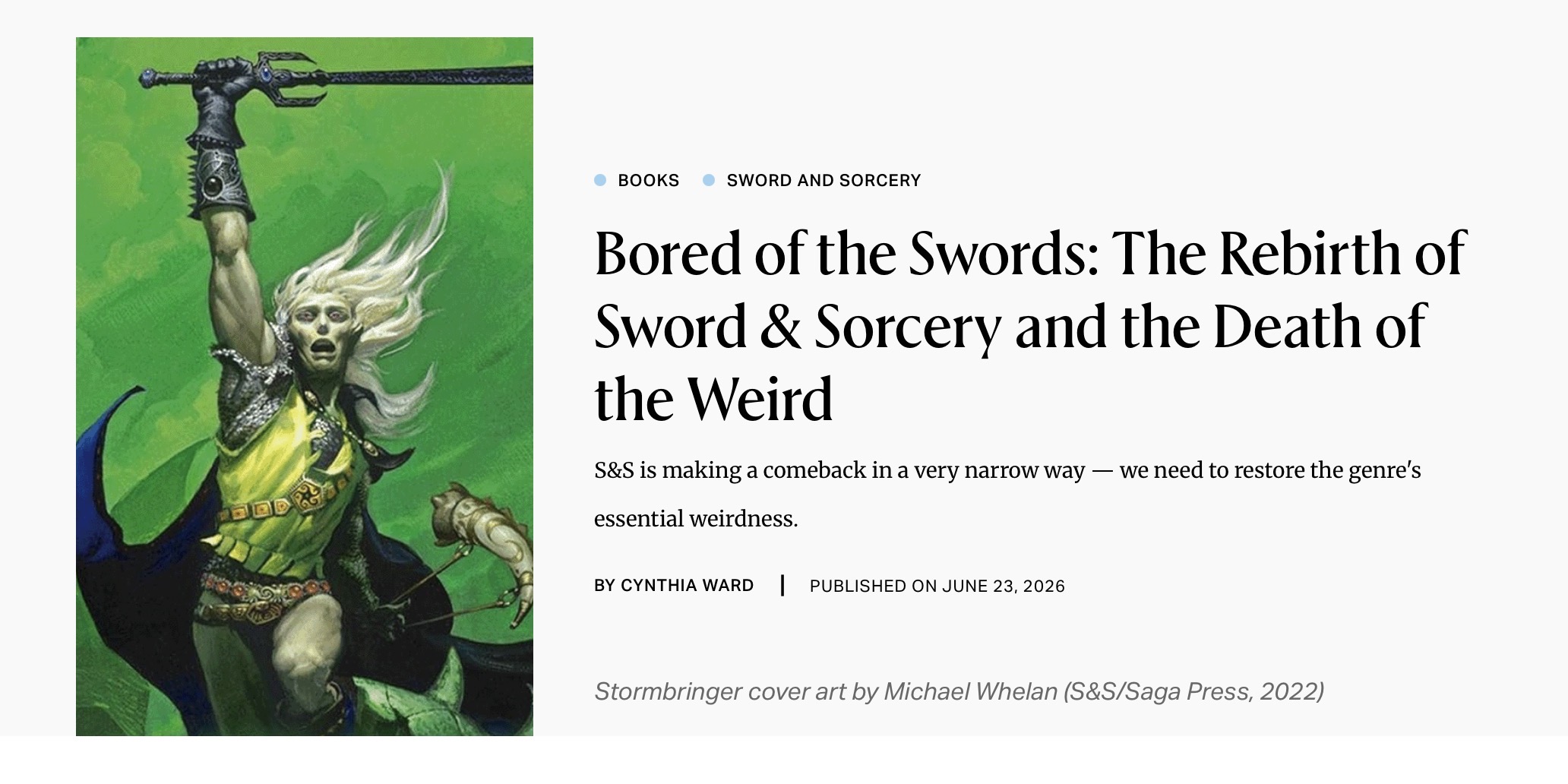
It’s natural not to name names in a general broadside like this, but I also think that it may be a mistake; one is as likely to wound friend as foe. However, since I’ve been writing for decades about an alcoholic wizard suffering from scoliosis, I’ll assume I’m not among the intended targets.
Screenshot
Appeals to weirdness fall friendly on my ear, anyway. Speaking as a reader, if imaginative fiction isn’t weird I’m unlikely to be interested in it. What’s the point? If the only weird thing about your story of an elf going through a midlife crisis is that it’s an elf going through a midlife crisis, you might as well de-elf that character and see if that story needs to be told at all.
Sameness has been a potential problem with S&S from the beginning, emerging as it did from the commercial magazine market before WWII, swarming with archetypes, tropes, and imitations. To the eye of love, there is an enormous difference between The Shadow, The Man of Bronze, and The Spider (personally, I’m a fan of The Spider, and Norvell Page generally), but a reasonable person might reasonably remark, “These guys are all the same!”
They are and they aren’t. But someone seeking strangeness is as likely to find it in the variety of events and characters that the heroes encounter as in the heroes themselves. That’s where the heroic pulpsters of yesteryear really brought the weird, and it’s one place where would-be heirs to pulp traditions should be bringing it.
More diversity in characters in heroes and characters is important, too, but (a.) I would distinguish that from weirdness of subject matter, and (b.) I think that some in the modern S&S renaissance are already on the case (e.g. New Edge Sword and Sorcery and Old Moon). Charles Saunders, Jessica Amanda Salmonson, and Samuel Delany are as important to the rising generation of S&S writers as REH, C.L. Moore, and Fritz Leiber. Anyway, that’s what I hear when I put my ear to the ground.
Re novellas and novelettes: these houses are already working on projects at longer lengths, and I wouldn’t be suprised if other S&S-inclined small publishers are, too. But it’s the nature of the short fiction market that there are always going to be more spaces for shorter stories than there are for longer stories. And longer stories aren’t necessarily weirder stories; arguably, they allow for a different, more slow-burn type of weird. But very short can be very weird. I cite R.A. Lafferty, and anyone reading this can probably think of other examples.
Re sameness: in conversations about sword-and-sorcery online there is the memetic sameness that bedevils all online conversations. Instead of making arguments, people wave tropes like flags: “Barbarian!”, “Big Snek!”, “Thews and More Thews!”. What this represents about what people actually think is moot.
All genre fiction—maybe all storytelling—exists in tension between two contradictory desires: the desire for something that’s the same (“I want something like Star Wars!”) and something that’s different (“This is boring—it’s just like Star Wars!”). (The academically minded might want to have a look at Umberto Eco’s “Interpreting Serials”, which talks some about this.)
That this tension exists is not a problem. The problem happens when it’s resolved—when lovers of the barbarian-warrior get their wish of 100% barbarian-warrior content and die of barboredom in the midst of barbundance.
I guess if the weird gets so weird that there’s no sameness anymore, no connection to the genre as the reader understands it, that this might also be a problem. However, in my experience, weirdness is harder to invoke than sameness, so I’d recommend always erring on the side of weirder.
It’s natural not to name names in a general broadside like this, but I also think that not doing so may be a mistake; one is as likely to wound friend as foe. However, since I’ve been writing for decades about an alcoholic wizard suffering from scoliosis, I’ll assume I’m not among the intended targets.
Screenshot
Appeals to weirdness fall friendly on my ear, anyway. Speaking as a reader, if imaginative fiction isn’t weird I’m unlikely to be interested in it. What’s the point? If the only weird thing about your story of an elf going through a midlife crisis is that it’s an elf going through a midlife crisis, you might as well de-elf that character and see if that story needs to be told at all.
Sameness has been a potential problem with S&S from the beginning, emerging as it did from the commercial magazine market before WWII, swarming with archetypes, tropes, and imitations. To the eye of love, there is an enormous difference between The Shadow, The Man of Bronze, and The Spider (personally, I’m a fan of The Spider, and Norvell Page generally), but a reasonable person might reasonably remark, “These guys are all the same!”
They are and they aren’t. But someone seeking strangeness is as likely to find it in the variety of events and characters that the heroes encounter as in the heroes themselves. That’s where the heroic pulpsters of yesteryear really brought the weird, and it’s one place where would-be heirs to pulp traditions should be bringing it.
More diversity in characters in heroes and characters is important, too, but (a.) I would distinguish that from weirdness of subject matter, and (b.) I think that some in the modern S&S renaissance are already on the case (e.g. New Edge Sword and Sorcery and Old Moon). Charles Saunders, Jessica Amanda Salmonson, and Samuel Delany are as important to the rising generation of S&S writers as REH, C.L. Moore, and Fritz Leiber. Anyway, that’s what I hear when I put my ear to the ground.
Re novellas and novelettes: these houses are already working on projects at longer lengths, and I wouldn’t be suprised if other S&S-inclined small publishers are, too. But it’s the nature of the short fiction market that there are always going to be more spaces for shorter stories than there are for longer stories. And longer stories aren’t necessarily weirder stories; arguably, they allow for a different, more slow-burn type of weird. But very short can be very weird. I cite R.A. Lafferty, and anyone reading this can probably think of other examples.
Re sameness: in conversations about sword-and-sorcery online there is the memetic sameness that bedevils all online conversations. Instead of making arguments, people wave tropes like flags: “Barbarian!”, “Big Snek!”, “Thews and More Thews!”. What this represents about what people actually think is moot.
All genre fiction—maybe all storytelling—exists in tension between two contradictory desires: the desire for something that’s the same (“I want something like Star Wars!”) and something that’s different (“This is boring—it’s just like Star Wars!”). (The academically minded might want to have a look at Umberto Eco’s “Interpreting Serials”, which talks some about this.)
That this tension exists is not a problem. The problem happens when it’s resolved—when lovers of the barbarian-warrior get their wish of 100% barbarian-warrior content and die of barboredom in the midst of barbundance.
I guess if the weird gets so weird that there’s no sameness anymore, no connection to the genre as the reader understands it, that this might also be a problem. However, in my experience, weirdness is harder to invoke than sameness, so I’d recommend always erring on the side of weirder.
I was reading Cicero’s Tusculan Disputations, which is a perfectly normal thing to do, and he quoted a line from Ennius, to make some point he thought needed making:
egregie cordatus homo, catus Aelius Sextus
“Why is he calling Aelius Sextus a cat?” I wondered.
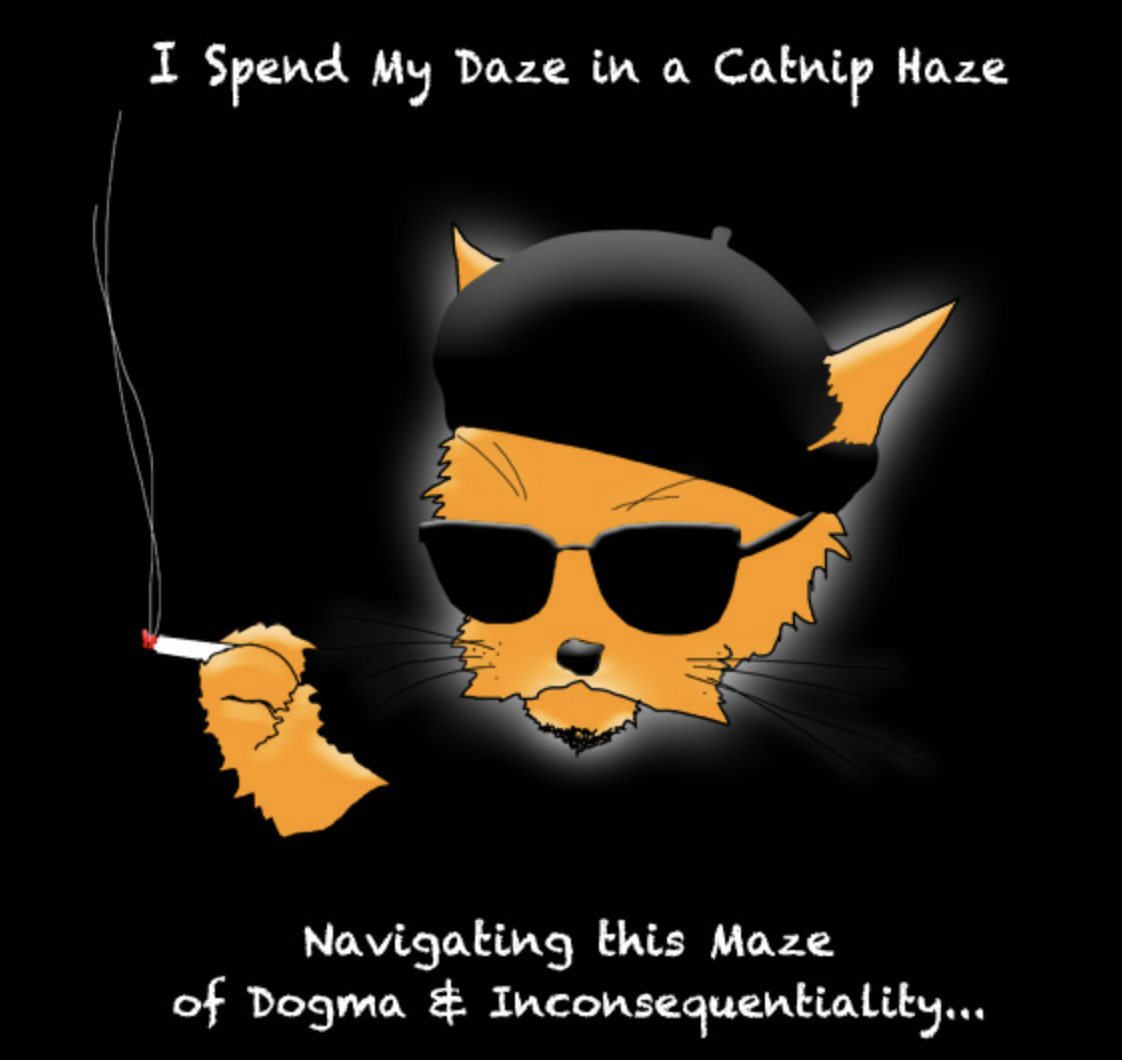
Image of beatnik cat by Doug Amey; I’m not sure if he wrote the accompanying doggerel.
It turns out he’s not; catus is also an adjective in Latin meaning “sharp, shrill” and by extension “acute, intelligent, sly”, probably the intended meaning here.
So the catlike Aelius disappears in a fuzzy puff of philologic and we’re left with something like this:
“the outstandingly wise (literally: hearted) man, wily Aelius Sextus”
Since the slyness of cats is proverbial, and because they can make shrill noises, I was left wondering if the Latin noun catus (“cat”) was derived from the adjective catus (“sharp, shrill, sly”).
The answer, frustratingly, is not clear. A word for cat that looks like catus is widespread in Germanic and Romance languages, and even migrates into Byzantine Greek, but its ultimate origins are unclear. (So says the tyrant OED and the democratical AHD.) The Latin word catus (sometimes cattus) is post-classical, first appearing in the commentaries of Servius (approx 400 C.E.) and Palladius (maybe 300s, maybe 400s C.E.). (So says Forcellini.) That’s late enough that it could be a loanword from a Germanic language.
Still, catulus/catula (“puppy; the young of several species”) is quite ancient, going back to Plautus, which is about as far as surviving Latin literature goes. Michiel de Vaan notes some cognates for catulus in other Indo-European languages, but doubts that the word can be put back to an Indo-European origin. But maybe the noun was derived from the adjective, because of the shriller, whinier sounds that little critters make.
It seems to me that catus (“cat”) may have been Vulgar Latin, submerged in the classical period but emerging in later Latin, as many a common word did. Or catus (“cat”) may have been a back-formation in later Latin to fill a lexical gap. The -ulus in catulus is a diminutive; it’s logical to assume that catus would be the word for the adult animal. Language doesn’t have to be logical, as we know, but this is a kind of process that adds words to languages (e.g. orientate from orientation—even though orient is just standing there, waiting to be used).
Either way, I suspect later Latin was patient zero, transmitting catus in various forms to various languages who had contact with it, which was a lot of languages.
The music below has been running through my mind as I typed all this, so I see no reason why it shouldn’t also run through yours.
Still reading Lucian, and came across a great new-to-me Greek verb: ὠρύομαι (oh-ROO-o-mai). It means (and sounds like) “to howl” (as a wolf or dog).
It comes up in conversation between Hermes, who is conducting a party of ghosts to the underworld, and Menippus, the recently dead Cynic (“Doglike”) philosopher. Hermes has been describing how the world above is mourning or celebrating the deaths of Menippus’ fellow travellers, and he goes on to (sort of) put Menippus in his place.
I’ve been reading a lot of Lucian lately, for reasons that are difficult to explain; maybe I’ll write something about that when I figure it out. But I am finding that he reads better in Greek than he does in English. In a good translation, the words flow by so readily and the content seems so thin that it’s easy to miss his point. In wading through the text in the original language (by no means the second language that is easiest for me), I am forced to slow down and ask, “Wait a second! What does he mean by that?” And in that moment of confusion I’m closer to getting his point than I ever am when sailing through an English version of the same work.
But when he starts throwing crocodiles around, I get confused in any language.
The crocodiles and other baffling entities crop up early in Lucian’s Dialogues of the Dead, which I’ve been reading in Hayes & Nimis’ useful (and free) edition. (Those unwilling to wrestle with the Greek can find English versions online by the Fowlers and by Macleod.)
One of these dialogues has the ghost of Diogenes (the first and weirdest of Cynic philosophers) buttonholing Polydeuces (a.k.a. Pollux) as he is preparing to leave the land of the dead for the land of the living.
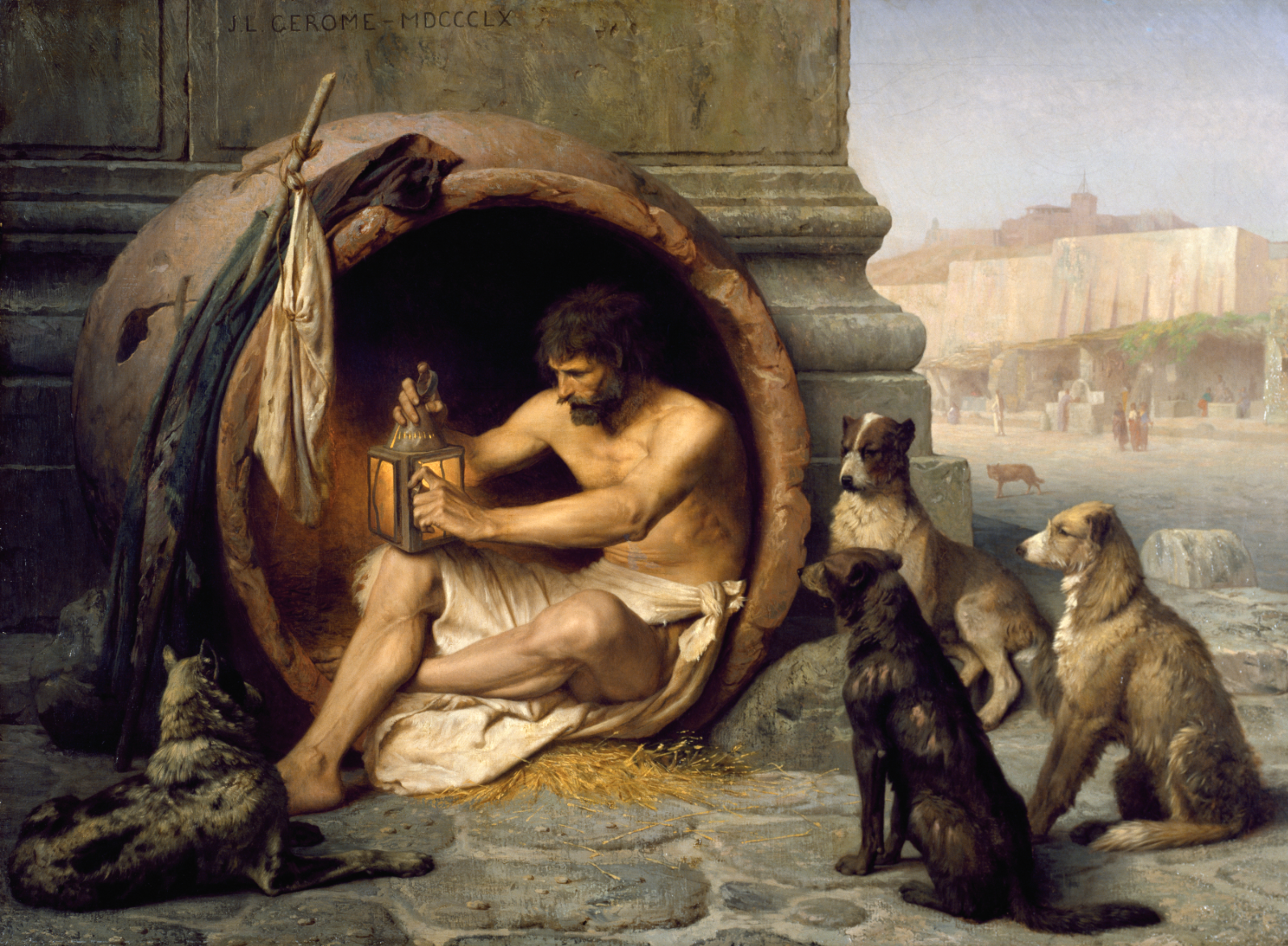
Gérôme’s painting of Diogenes the Cynic (a.k.a. “doglike”) and some actual dogs
Polydeuces had been immortal, but he surrendered half his immortality to his twin brother Castor, who was mortal. According to the plea bargain they struck with the Fates, these guys spend half their time in the Underworld and half on Olympus. I like the version where they travelled together (because if you give up immortality for your twin it seems only fair that you get to spend some time with him, and also because we see them travel together as the constellation Gemini).
DIOGENES: Do you mind if I also send a message to those philosophers?
POLYDEUCES: Go ahead; no problem at all.
DIOGENES: The whole thing is: tell them to stop acting like clowns, snarling at each other about The All, and putting horns on each other, and making crocodiles, and teaching the mind to ask such pointless questions.
The natural question that arises from this is: WTF? The beginning and the end are clear enough, but how do horns and crocodiles come into it?
At first I thought that the horns referred to cuckoldry. I’m sure Lucian would have enjoyed and employed the image of philosophers cuckolding each other, but the linguistic evidence seems to be against it.
[Cuckolds were fancifully said to wear horns on the brow.] to give horns to, to graft, plant horns on: to cuckold.
The origin of this, which appears in so many European languages, and, seemingly, even in late Greek in the phrase κέρατα ποιεῖν τινί (Artemidorus, Oneirocritica II. 12) is referred by Dunger (Germania XXIX. 59) to the practice formerly prevalent of planting or engrafting the spurs of a castrated cock on the root of the excised comb, where they grew and became horns, sometimes of several inches long. He shows that German hahnreh or hahnrei ‘cuckold’, originally meant ‘capon’.
Putting aside the disturbing image of castrated roosters sporting grafted horns (maybe to reappear as basilisks in some future Morlock story), I’m wondering: how late is that Greek? Artemidorus writes his Oneirocritica (“Dream Interpretation”) in the 2nd century C.E., and so is roughly contemporary to Lucian. But I was disappointed to find, when I consulted Pack’s edition of Oneirocritica, that the passage in Artemidorus that refers to horns is an interpolation by a later, probably medieval hand. Probably the expression got loaned into medieval Greek from some Germanic language.
Anyway, it turns out that what Diogenes is complaining about (and what Lucian mocks in many of his dialogues) are the paradoxes which philosophers liked to employ in their philosophical standup routines.
You can find, as I did, a number of places online that talk about these paradoxes. But it turns out that the Fowlers’ translation has a handy appendix of allusions, including a note on these paradoxes, which they call “Puzzles”. (One of those Fowlers is the guy who wrote The King’s English, an entertaining and irritating book on the English language that a lot of people took far too seriously, but don’t hold that against him. Although I kind of do.)
The Horns. If you have not lost a thing, you still have it ? Certainly. Have you lost your horns ? No. Then you are horned.
The Crocodile. A child is caught by a crocodile ; the father asks him to give it back. I will, says the crocodile, on condition that you tell me correctly whether I shall do so or not. The dilemma is obvious.
—Fowler & Fowler, appendix to vol.4 of their Works of Lucian of Samosata, p.223f
The source of these paradoxes is probably Chrysippus, successor to Cleanthes as the head of the Stoic school. Chrysippus’ books did not survive the wreck of antiquity, but a lot of writing about them did, and Diogenes Laertius (not to be confused with the more famous Cynic philosopher; DL wrote a century or so after Lucian) tags Chrysippus as the author of these paradoxes. (Those interested can find the quotes in DL’s biography of Chrysippus or in Von Arnim’s Stoica Veterum Fragmenta.)
But, for the crocodiles, there’s a better (or at least earlier) authority than DL: Lucian himself. In one of his weirder dialogues, Πρᾶσις Βιῶν (“Lifestyles for Sale”), Zeus holds an auction at which a variety of philosophers are for sale, which allows Lucian to mock their philosophies one by one. When it’s Stoicism’s turn, Chrysippus steps forward and baffles the would-be buyer with a bucket of cryptic conundrums including the wily crocodile.
Whether Chrysippus fairly gets the blame or not, the Stoics in general were fond of paradoxes and grammatical quibbling, to an extent that even bothered some Stoics, e.g. my personal favorite Seneca. A century before Lucian set pen to paper, Seneca wrote to his friend Lucilius:
Multum illis temporis verborum cavillatio eripuit, captiosae disputationes quae acumen irritum exercent. Nectimus nodos et ambiguam significationem verbis illigamus ac deinde dissolvimus: tantum nobis vacat? iam vivere, iam mori scimus?
—Seneca, Epistula 45.5
“Quibbling stole a lot of time from those philosophers—tricky debates which occupy the intellect pointlessly. We weave knots, and bind double-sided meanings to words, and afterwards we untie them. Do we really have so much free time on our hands? Do we already know how to live and how to die?”
No doubt the paradoctors could have said a word or two in their own defense (e.g. that exercising the intellect is never pointless). But there seems to have been a general feeling that this kind of wisecracking made philosophers seem less than wise.
Very general. Lucian is echoing and amplifying a moral critique of abstract philosophy that goes back long before Seneca or even Plato. Why should we worry about gazing at the stars when it won’t keep up from falling into holes here on Earth?
The Regular Guy who asks this kind of question doesn’t really want an answer. Lucian is pretending to be this Regular Guy, even though no one could be more irregular than Lucian. For instance, he wrote in Classical Greek, but he didn’t speak it. Greek had undergone a lot of changes since Socrates gulped down his hemlock. When Lucian’s contemporaries read him they must have felt something like the disorientation that modern readers have when they encounter Eddison’s The Worm Ouroboros. Why should a man in the 20th Century write as if he were living in the 17th? Regular Guys don’t do things like that.
Henderson’s drawing of the titular worm from the first edition of Eddison’s The Worm Ouroboros
Getting back to Lucian, let’s have another look at that sneaky (not snaky) crocodile, who starts to look a little like Epimenides.
No one knows what Epimenides looked like, so I snerged this image from a poster for Lyle, Lyle, Crocodile (2022).
There are effectively two scenarios possible in the Crocodile Paradox. In scenario A, the hopeful parent says, “You’re going to give my kid back!” “Nope,” replies the crocodile, and eats the kid. In scenario B, the despairing parent says, “You’re not going to give my kid back.” “Right!” says the greedy crocodile… in which case, the crocodile has to give the kid back, in which case the parent was wrong, so the crocodile keeps the kid, in which case the parent is right, so the crocodile has to give the kid back, etc. etc. repitend etc.
This is, in fact, a variant of the Liar Paradox, which creates an undecidable dilemma.
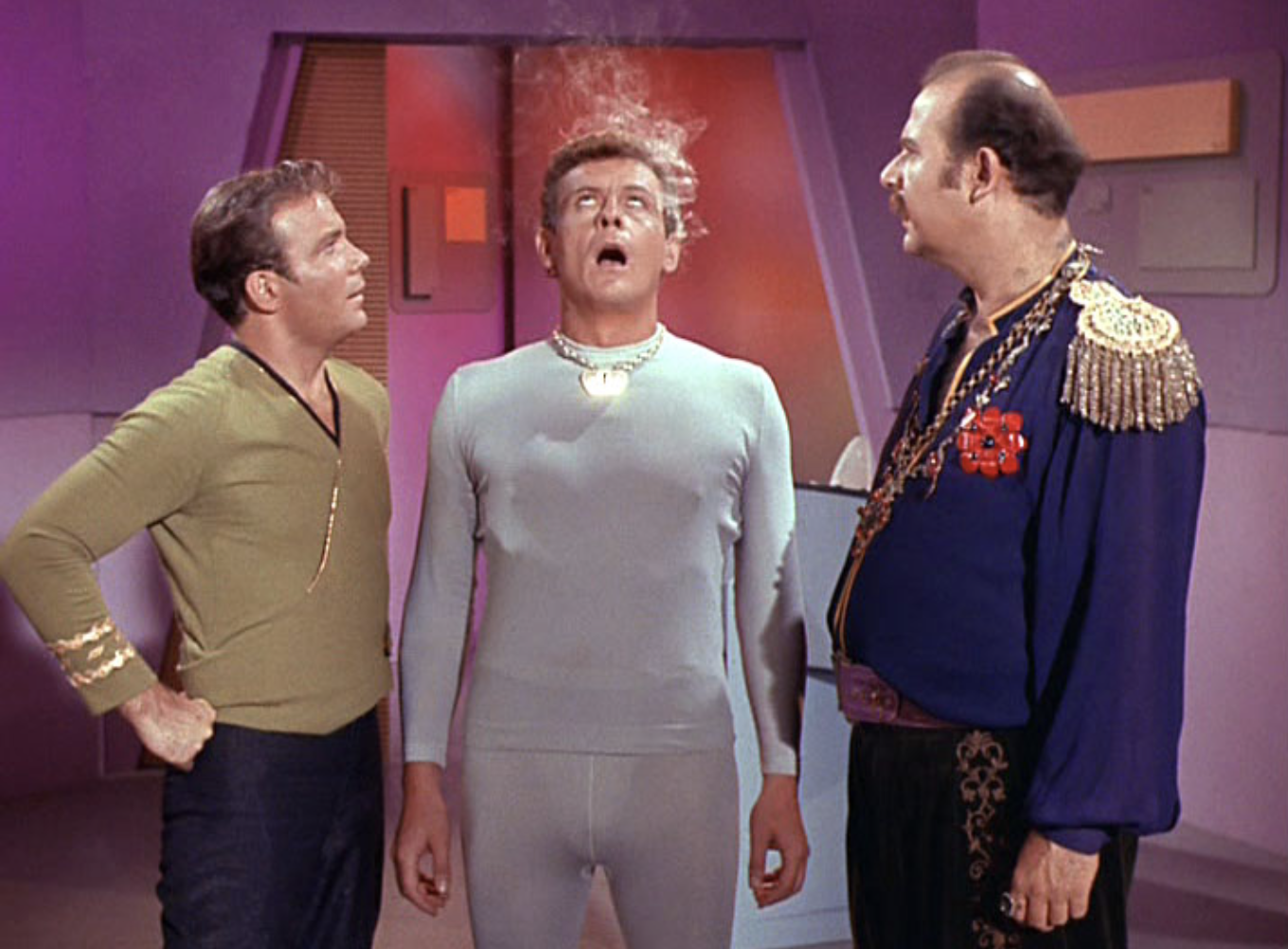
Well, so what? What difference does it make, unless you’re on deadline for submitting a Star Trek script in which the crew of the Enterprise must defeat a computer with logic? (I’m sort of on strike against Star Trek lately, since its current owners are fascists trying to destroy American democracy. But that’s not Star Trek‘s fault.)
Norman uncoordinated by the Liar Paradox: a screenshot from “I, Mudd”
Well, there is something more going on here than a running gag on Star Trek. Mulling over the Liar Paradox led Kurt Gödel to formulate his incompleteness theorems. The short (probably too short) version of Gödel’s findings: you can’t create any kind of symbol system which excludes the Liar Paradox unless you limit the kind of statements that can be made in the system. No system of symbols can be both complete and consistent.
In a world where people use symbol systems to communicate with each other, and in which there are symbol systems (computer software) that some people say are intelligent, or about to become so, this is a finding with some significance. And Gödel found it by taking seriously these ἄπορα, these undecidable dilemmas, these paradoxes that Lucian insists (over and over again) should not be taken seriously.
So Lucian was just wrong?
Yes, without a doubt. He was very wrong and bad. And after I log off here I’m going to go back and read some more of his stuff. That’s the paradox in my feelings about Lucian (or one of them, anyway).
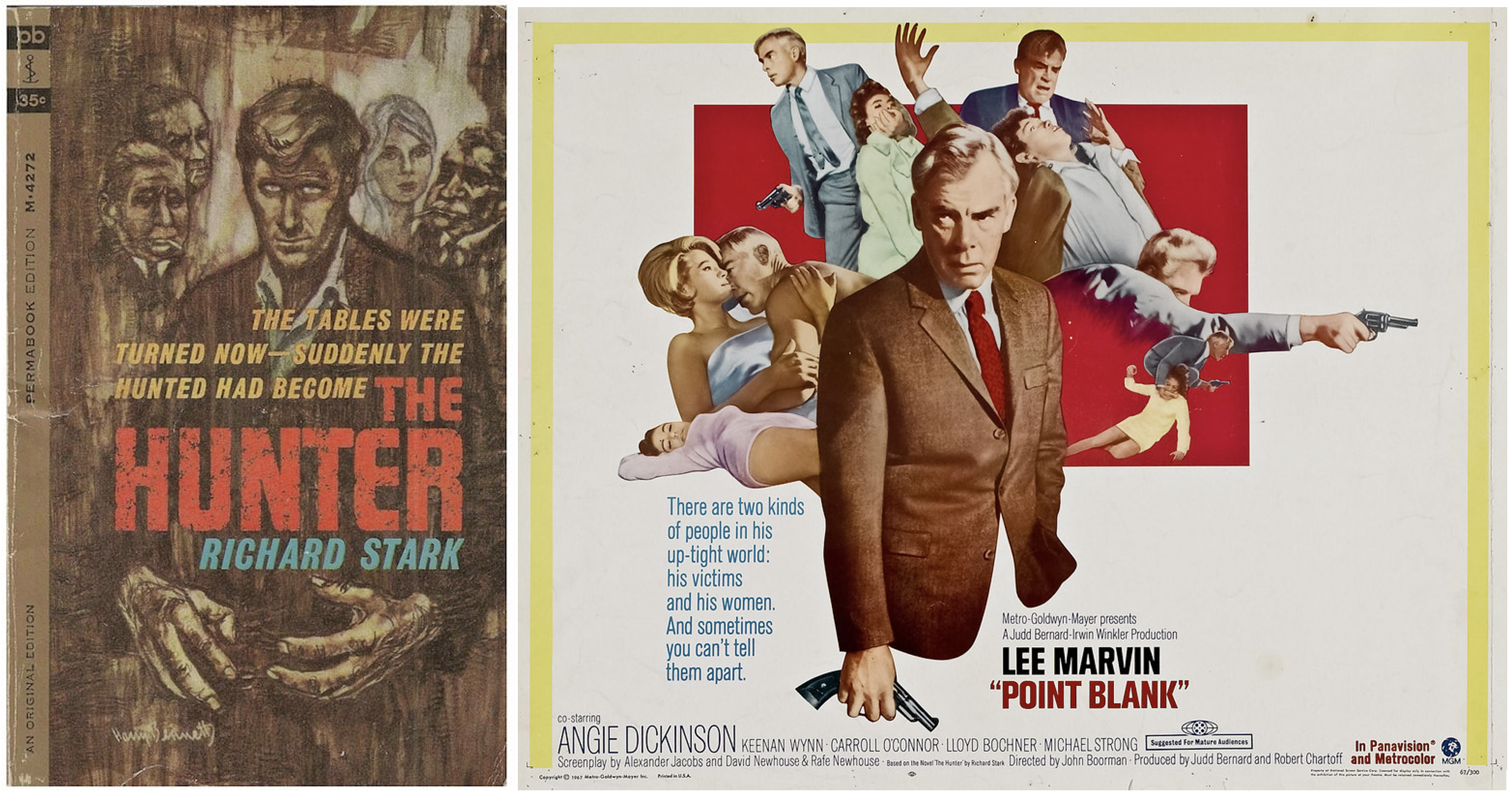
Left: the 1st edition of The Hunter by Westlake/”Stark” (1962); Harry Bennett was the artist. Note the deranged Lloyd-Bridges lookalike with the mutant hands: that’ll be Parker. Right: a poster for Boorman’s Point Blank (1967).
I recently rewatched John Boorman’s Point Blank, which caused me to reread the novel it was loosely based on, The Hunter by Donald Westlake (writing as Richard Stark). The Hunter is very low on my always-reread list, and would not be on it at all except that it’s the beginning of not one, not two, but three amazing series of crime novels by Westlake/”Stark”, who was one of the great genre writers of the 20th century.
The novel and the movie are very much the same story, except insofar as they are not at all the same story. If you’re only going to tackle one, I’d recommend sticking to Point Blank, which is a self-contained and evocative crime film, an early work by the visionary director who would later helm films like Deliverance (1973), Zardoz (1974), and Excalibur(1981). The Hunter, in contrast, is not great, but it contains the seeds of greatness.
Here’s the story, common to book and film, in its broadest outline: a guy (called Parker in the book, Walker in the movie) gets roped into a criminal conspiracy by a guy named Mal (short for Malcolm, but the fact that mal means “evil” in French is probably not a coincidence). The crime goes off without a hitch, but in the aftermath Mal persuades Lynne, the hero’s wife, to betray him. The hero is shot and left for dead; Mal and Lynne go off together with all the money.
Mal needs all the money because he owes a sizable debt to a criminal organization calling itself the Outfit. Using the money from the heist, he buys his way back into the Outfit and everything is rosy.
Except the hero is not dead. He comes back for vengeance on his ex-partner and his treacherous wife, and he wants the money he’s owed from the heist. And, in a way, he gets all of these things.
This, to my mind, is the outline of a ripping yarn, so why do I damn The Hunter with faint praise?
Three reasons, really. One is the inexperience of the author. It feels weird to say that, because “Stark”/Westlake had been writing paperback originals for three years when The Hunter appeared, but most of that work was porn; there are some greasy traces of porny writing in this novel, especially when the narrator describes the reaction of women to seeing Parker. Plus, work in porn didn’t really give Starklake the opportunity to tell this kind of story. Starklake is clearly feeling his way sometimes, throwing out ideas and not following them up. Parker spends a page or two telling an executive of the Outfit how he could make the Outfit suffer if he wanted to. In this book, it’s just conversational filler, but it becomes a major element in a later, better book in the series (volume 3, The Outfit). The heist that leads Mal to betray Parker is an unlikely one, involving nineteen premeditated murders within a page or two. A level-headed, experienced criminal like Parker would be unlikely to be involved in such a high risk, low-payoff kind of proposition. Etc.
Then there are some problematic attitudes specific to the era and genre: homophobia and misogyny. Even nowadays, weak men think they can establish their toughness by displaying bursts of homophobia, or performing cruelty against women. Not all detective/crime writers of the period resort to this stuff, but there’s some unpleasant gushes of it here.
Another lies in the character of Parker himself. Westlake can’t decide if his character is an avenging angel come back from the dead to get back at the people who wronged him—the Count of Monte Cristo in a windbreaker—or a professional criminal demanding his fair share of the take. Or maybe it’s more like this: Parker starts out as the first guy, and turns out to be more like the second guy. And it’s that second guy who will appear in the twenty-some volumes to follow.
It’s those roughly two-dozen sequels that really justify The Hunter‘s place on my always-reread list. As Westlake gets a clearer idea of Parker as a professional criminal, the books become better, more focused, and more interesting.
Point Blank is also a fairly early work in its creator’s career. Boorman had directed some TV and some documentaries in the UK, but only one fictional film, a not-really-successful vehicle for the Dave Clark Five. But, based on solid reviews and Lee Marvin’s personal confidence, Boorman got to make Point Blank pretty much the way he wanted it, and it mostly works. It helps that Marvin is the perfect actor to play Walker/Parker.
In The Hunter, Parker’s connection to Mal is strictly professional. In Point Blank, the connection between the hero and the traitor is deeply personal. Mal and Walker are old friends; Walker brings Mal home after a reunion of some kind. The trio develop into almost a Jules et Jim throuple. That makes the betrayal, when it comes, all the more brutal.
Why Walker survives being shot at point blank range is never established in the movie, but that’s not a problem, I feel, because we see him do it. The movie doesn’t take time explaining things that don’t need explanation. (In contrast, in The Hunter, Parker is shot at six times; only one of the bullet connects and that one is caught by his belt buckle. Maybe it’s a kind of thing that could happen, but it seems rather corny and unlikely to me.)
The double betrayal that’s rocked Walker’s world puts him into an existential funk. He’s intent on getting back at the people who destroyed his life, but he doesn’t seem to have an obvious idea how to do that. Walker’s wife, Lynne, is equally disoriented; she and Mal have parted ways by the time Walker catches up with her; she’s terrified of Walker’s vengeance, sick of life, but scared of death. In the end, after the damage is done, Walker finds that he’s been used as a weapon in a power struggle over control of the Outfit. He’s gotten what he thought he wanted: revenge on Lynne and Mal, and payment of his share from the heist. But it’s not clear if he wants any of that stuff now that he’s got it; we don’t even know if he picks up the money at the end of the movie. Walker is silent, alienated, alone in the dark.
This is not quite a ripping yarn. It’s more of an existential nightmare in which the characters struggle through a landscape where love, loyalty, and even material success are void of meaning or value. But, unlike a lot of movies from the 60s with existential themes, Point Blank manages to tell a coherent story. Fine work from Boorman, who would go on to do even better in the future.
As, of course, would Westlake. His next novel in the Parker series was another problematic effort, but after that the series would develop into some of the best crime fiction written by an American.
And the series had two spinoffs. One of Parker’s occasional partners in crime is a suave ladies’ man and professional actor named Alan Grofield. Starklake wrote four novels in which Grofield is the main character, all of which are entertaining and the last of which (Lemons Never Lie) is at least as good as any of the Parker novels.
After writing about Parker for nine years, Westlake spun 180º and started writing crime novels that are almost parodies of the Parker books. The first and greatest of these is The Hot Rock (1970), a deadpan, utterly hilarious novel about a heist that goes wrong, then wronger, then even wronger until, somehow, its wrongness becomes brilliantly right. (It was also made into a pretty good movie, but William Goldman’s script couldn’t quite contain all the Wodehousian twists and turns of the novel, and Robert Redford was miscast as the rumpled antihero—and anti-Parker—Dortmunder, who is at the center of the story.)
I might write more about the Parker series, and its spinoffs, on another occasion. But if you’ve never read them, and you’re into American crime fiction, you owe it to yourself to seek them out. Why waste time on my opinions when you could form your own?
I shouldn’t close without mentioning that The Hunter was also the basis of a great graphic novel by the late, lamented Darwyn Cooke. He went on to adapt three more of Starklake’s novels, and might have done more if not for his own untimely death.
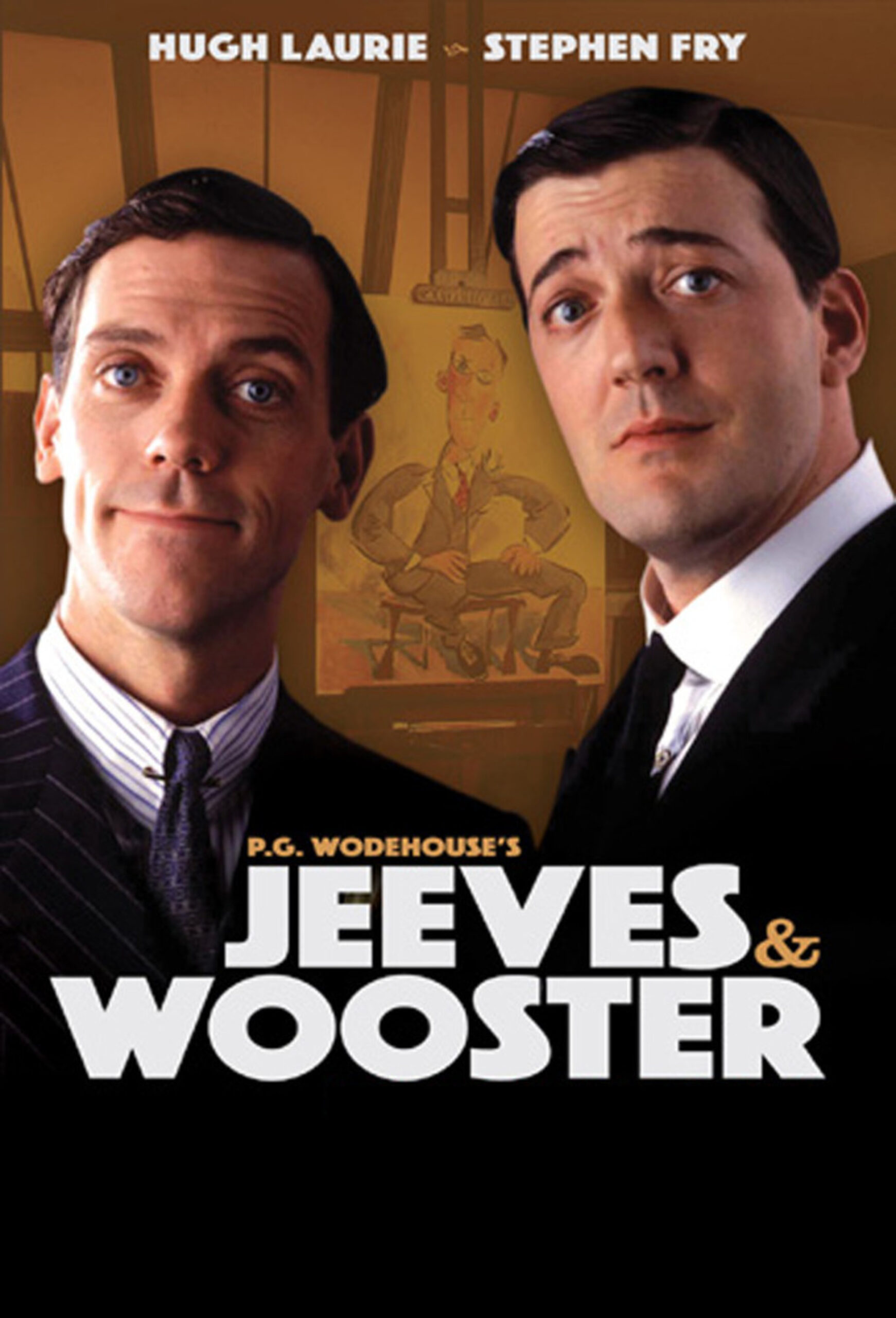
For escape, in the midst of the grading storm that always accompanies finals, I’m reading Innes’ England Under the Tudors (3rd ed; 1911). It scratches a longstanding itch to sort out the reigns and events of the pre-Liz Tudors, and is a dryly fun read. I realized the other night that it’s because the narrative voice reminds me of Jeeves, as played by Stephen Fry.
Innes, an older contemporary of Wodehouse, must have been exactly the kind of agreeable old pedant that PGW admired and rebelled against.
But he’s no dusty old buffoon. He’s a sharp observer of character and writes with a democratic contempt for tyrants. Here I was, reading about the English Reformation, worlds away from the dangers of the 21st C, when Innes smacks me between the eyes with this (about Henry VIII’s Treasons Act):
“An irresistible instrument of tyranny was created, justified of course by the usual argument that without such powers it was not possible to deal adequately with the abnormal dangers of the situation. It need only be remarked that where there is practically no check on the abuse of such powers save the scrupulosity of the persons in whom they are vested, the risk of flagrant injustice becomes almost incalculable.”
It turns out that the past is relevant to the present. Much of my life has been devoted to sustaining this truth, but it still surprises me sometimes.
Maudet is fired by his manager after losing a series of fights. He convinces his girlfriend that they have to sell all their belongings to get money to live on. Then he ditches his girlfriend without splitting the take with her and takes a job as secretary/bodyguard for an amoral millionaire, the titular Ferchaux, who has to flee France for a place where they love amoral millionaires, i.e. the United States. Even in the U.S.A. Ferchaux isn’t 100% welcome, so they empty one of Ferchaux’s caches of money in NYC and go on the road.
I didn’t love any of these characters, but the movie maintained its interest until it stops in its tracks, literally and figuratively, in the outskirts of New Orleans. For reasons never explained, Ferchaux, who had planned on travelling to Caracas in Venezuela (a place our current president finds difficult to pronounce, but easy to bomb), instead halts in Louisiana and settles in a decaying manse. He eventually dies there, but the movie predeceases him, becoming an increasingly tedious exercise in watching Maudet become bored and frustrated. There’s a burst of violence at the end which doesn’t redeem the foregoing tedium.
I may be missing something here. The movie is based on a book by Georges Simenon, and I have to admit that I’ve never really wrapped my head around the way he tells a story (or, as I see it, fails to do so).
Melville I tend to like, especially his masterpiece, Army of Shadows (1969), which tells the story of the French Resistance in the same unglamorous, antiheroic style as his crime movies. This one didn’t make me like him any less, even though I can’t really recommend it. The first half or so was fairly absorbing, and there were some interesting turns by Stefania Andrelli as an amoral hitchhiker and Michèle Mercier as an exotic dancer with a heart of gold.
I render this as: “He <Epicurus> calls him <Democritus> a mollusk and an illiterate and a cheat and a whore.”
Democritus, as described by Epicurus
I’m pretty confident about everything but the last word. Sex words in ancient languages are somewhat difficult to translate because the dictionaries have traditionally been prissy on these dangerous subjects. LSJ squirmingly defines πόρνος as “catamite; sodomite”… as if same-sex activity between men weren’t widely acceptable in the ancient Greek world. The newish (2021) Cambridge Greek Dictionary does better, defining πόρνος as “male prostitute; rent boy.”
That male sticks in my craw, though. (Don’t go sticking things in my craw.) I think there’s a widespread presumption among modern English speakers that terms about sex-workers are feminine by default, so that the term whore would misgender the Greek word (and atomist philosopher).
But rent boy, though contemptuous, is light-hearted, whereas whore seems like an angrier word, a closer match to the Greek. I could render πόρνος as male whore, but that would endorse the (incorrect) assumption that male sex-workers are some kind of anomaly.
I realize that I have just written more than 150 words about one word. If you have a philologist in your life, that won’t surprise you. If you don’t… well, count your blessings, I guess.
Some discussion of thews and thewbilation in the Sword and Sorcery Tavern on Discord made me curious about the etymology of thew.
I consulted my friend, the democratic AHD, and it hit me in the face with this.
Did not expect it to derive from a word meaning “habit; custom”. That seems a pretty abstract origin for such a fleshy word. But I guess you don’t develop thews in the modern sense without the habit of exercise. Or so I’m told by those who have them.
I like the word thewy, though, and I wish it would come into more general use.
“What do you want to be when you grow up?”
“Thewy.”
Orel’s Handbook of Germanic Etymology (my go-to resource in these matters) didn’t help any, so I slouched over to the tyrant OED. No further etymology was available, but there was a lot of historical stuff about the meandering usage of the word in modern English.
For instance, it used to refer to “physical good qualities, features, or personal endowments” generally.
The Turberville quotes made me wonder: how ripped was Helen? Homer is silent on this important subject; modern storytellers will have to ask and answer the question.