Some discussion of thews and thewbilation in the Sword and Sorcery Tavern on Discord made me curious about the etymology of thew.
I consulted my friend, the democratic AHD, and it hit me in the face with this.
Did not expect it to derive from a word meaning “habit; custom”. That seems a pretty abstract origin for such a fleshy word. But I guess you don’t develop thews in the modern sense without the habit of exercise. Or so I’m told by those who have them.
I like the word thewy, though, and I wish it would come into more general use.
“What do you want to be when you grow up?”
“Thewy.”
Orel’s Handbook of Germanic Etymology (my go-to resource in these matters) didn’t help any, so I slouched over to the tyrant OED. No further etymology was available, but there was a lot of historical stuff about the meandering usage of the word in modern English.
For instance, it used to refer to “physical good qualities, features, or personal endowments” generally.
The Turberville quotes made me wonder: how ripped was Helen? Homer is silent on this important subject; modern storytellers will have to ask and answer the question.
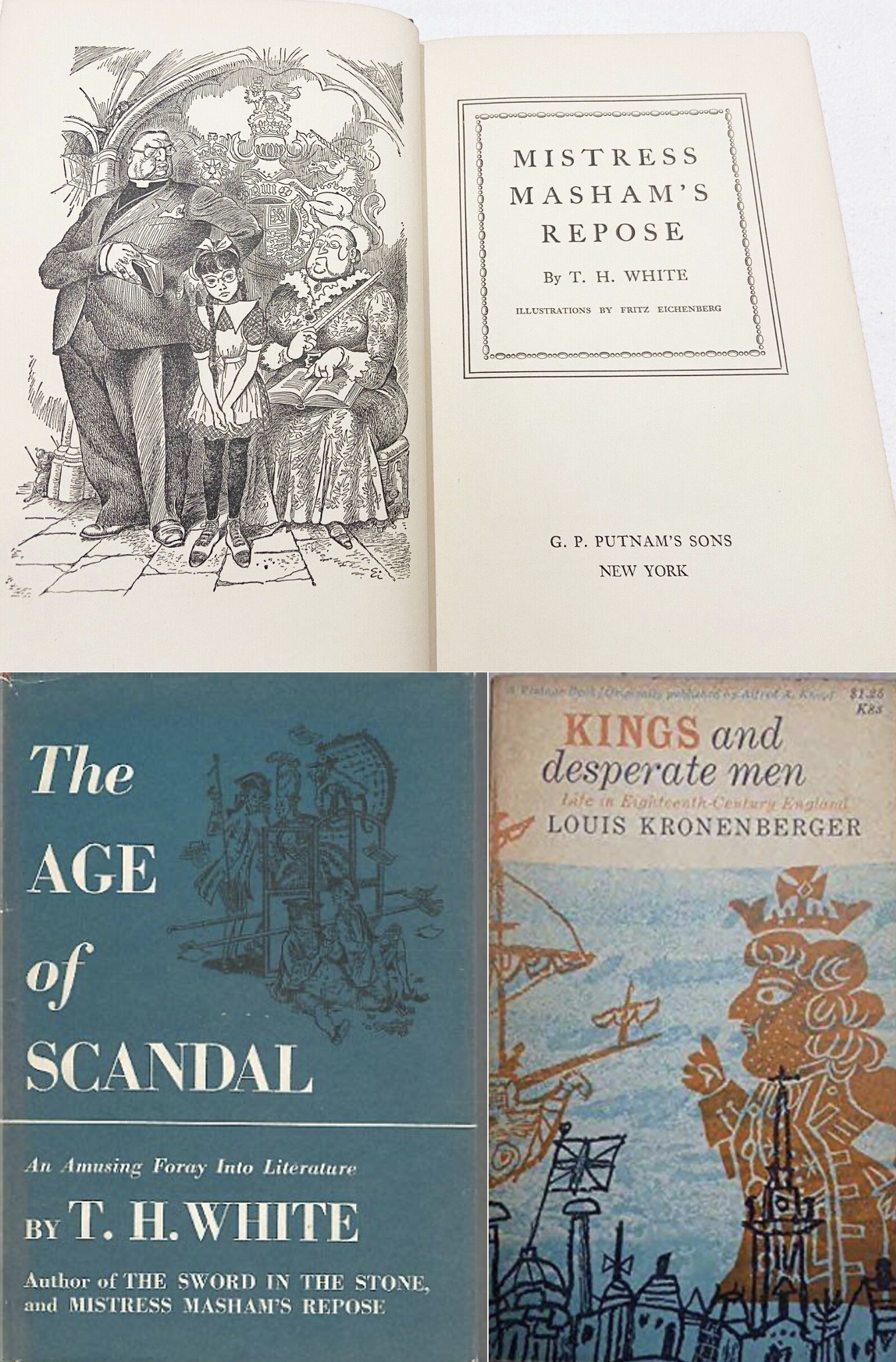
I came to T.H. White’s brilliant fantasy Mistress Masham’s Repose (Putnam, 1946): immediately after reading two much inferior (but not worthless) books. One was by White himself, The Age of Scandal (Putnam, 1950), a social history of the later 18th century; the other was by Louis Kronenberger, Kings and Desperate Men: Life in 18th Century England (1942, Knopf).
Three books; one blog post. We pass the savings on to you!
Kronenberger’s book has some merits, but I don’t really recommend it. He gives historical background which is useful for the novice in this zone of history (like me), but frequently he’s just winding you up with his opinions: about the characters of Sarah Churchill and the Duke of Marlborough, of the several King Georges, of Sir Robert Walpole, etc. etc. He’s like a guy who lives to call into a sports show and yammer on about what’s wrong with the pitching staff of the Twins (or whatever ball team is closest to or most irritating to you). It gets a bit tedious.
White’s social history is more lively, but is deformed by his general unhappiness, his political embitterment, and (my guess is) some sexual practice he was ashamed of. (The final chapter is on the Marquis de Sade, who is a little off-topic for the English 18th Century… unless he’s not, if you know what I mean. There’s a lot of discussion of caning and physical cruelty in the various chapters.) I also don’t admire many people and things that White admired: Toryism (of a venomously anti-democratic type), Horace Walpole, aristocrats and royalty in general, etc. De gustibus non disputandum, and all that. The book was interesting enough to finish but I was glad to reach the last page.
Both volumes would seem to be irrelevant for discussing a kids’ book which is set in post-WWII England… except that Mistress Masham’s Repose is not necessarily a kids’ book and it’s no more set in 20th-Century England than The Sword in the Stone was set in the historical Middle Ages. This is an imaginary England looking back at the 18th Century through the wrong end of a telescope and finding very tiny people there.
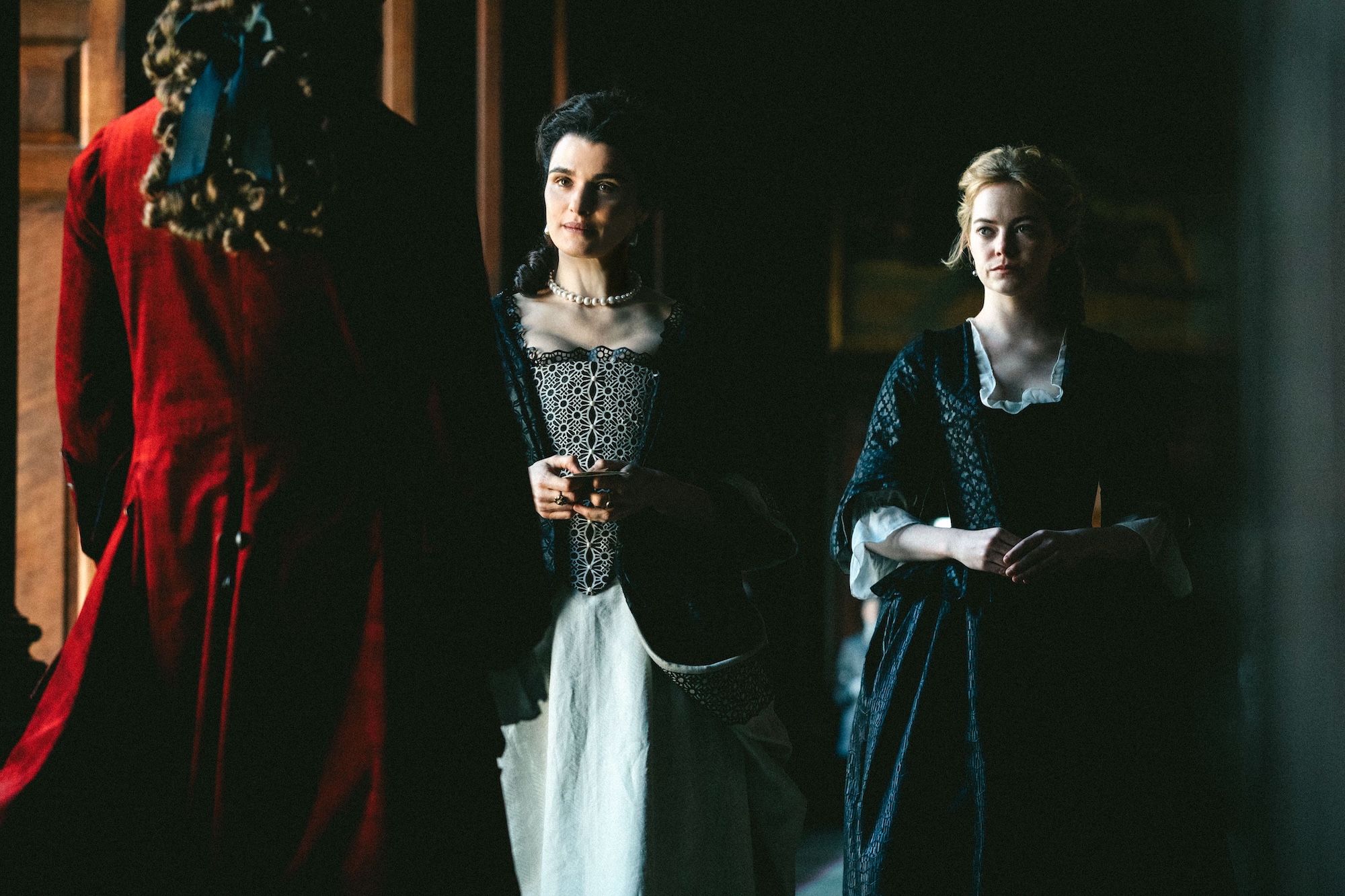
Mistress Masham, for instance, is not a character in Mistress Masham’s Repose. She was one of Queen Anne’s favorites—the younger one, played by Emma Stone in the Yorgos Lanthimos film.
“She may be a favorite, but I’m favoriter.” “I’m favoritest.”
So why put Mistress Masham’s name in the title? Candidly, I think it may have been a mistake, but there’s no doubt that White did it on purpose. He wanted the book to be awash with the 18th Century from the title page. (The title phrase also supplies the book’s last words, closing the ring of White’s composition.)
“What is this book about, though?” I seem to hear you say or scream.
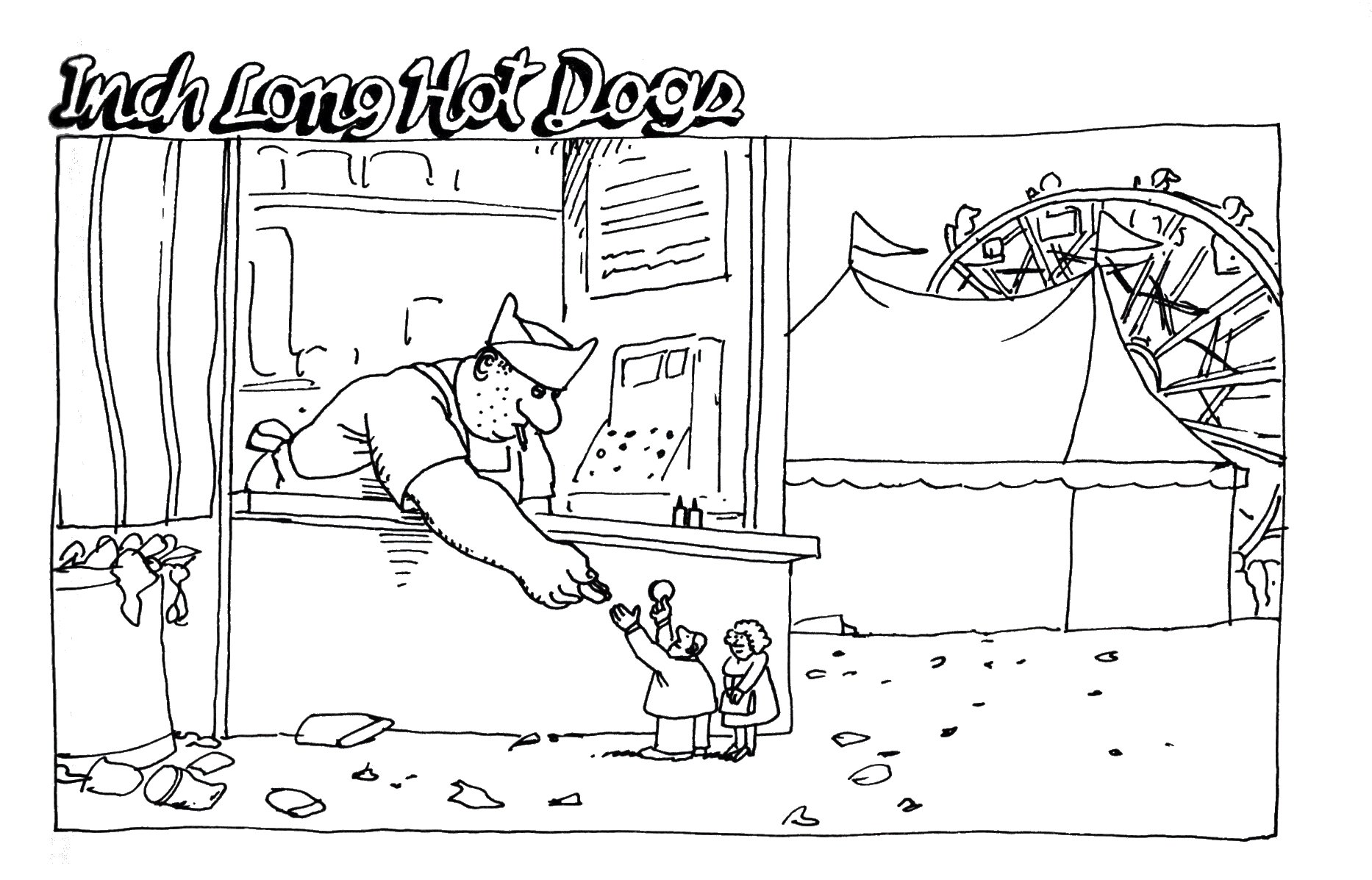
It’s about the big and the little. There’s a particular kind of humor that comes from sharp contrasts between big and little.
cartoon by B. Kliban
It’s all over the place in the firsttwo Ant-Man movies in the MCU.
Pez is mightier than the sword?
You see it in Vergil’s Georgics 4, also, where the poet talks about a beehive as if it were a mighty nation. Vergil doesn’t have the reputation of a hilarious writer but these passages always make me laugh. There are some echoes of it in my story “Evil Honey”, where Morlock is sent (against his will) into a diseased hive on a mission from the god of bees.
And this little-is-big stuff is the main theme in Mistress Masham’s Repose.
Principally, the story about a girl, Maria. You can see her above in Fritz Eichenberg’s vivid drawing, except that that’s not really her.
If I avoided reading this book on purpose for fifty years, and I did, it’s partly because I didn’t know or care who Mistress Masham was, and partly because I didn’t want to read about sad, passive, upper-class children wilting under the cruel ministrations of their caregivers.
That’s not what Maria is like at all, though. She is the last remnant of a ducal family; she’s a ten-year-old orphan who grows up on an untended, crumbling estate; she has vile caregivers as sinister as any who darken the pages of Roald Dahl. But Maria is no fainting lily; she’s a fireball. She makes things happen.
We meet her swaggering around the half-wild grounds of the estate, intent on trying some piracy. “She boarded the tree bole, brandishing her cutlass, and swarmed ashore with the battle cry of à Maria, her spectacles twinkling fiercely in the sun.”
She sets sail on her mighty craft (a punt) across the wild briny waves (a small lake on the estate), lands on terra incognita (a little island “about the size of a tennis court” called Mistress Masham’s Repose), and prepares to confront the savage natives.
There are no savage natives, really. It’s all a game. To Maria’s surprise, there do turn out to be natives, though. When she cuts her way through the brambly hedge that’s grown up around the edge of the island, she finds in its center a place with short, well-kept grass like a bowling green. Even stranger, she finds a baby. Stranger yet: the baby is small enough to fit into a hollowed-out walnut shell, acting as a crib. Strangest of all: the baby is alive.
With the help of her friend, a kindly but scatter-brained professor who hopes to make his fame and fortune with a fastidiously correct translation of Ambrose’s Hexameron (that’s how scatter-brained he is), Maria finds out that these minuscule strangers on her estate are Lilliputians. After Lemuel Gulliver (a historical person in this novel) was rescued from Lilliput, the ship captain who’d rescued him returned and kidnapped some of the little people with an eye to making money by showing them at fairs and elsewhere.
And he did, keeping them prisoner and giving them only enough to survive until, one fateful night, they escaped from him and fled into the nearby ducal estate of Malplaquet. They settled there and the colony lived in seclusion for centuries on the tiny island of Mistress Masham’s Repose.
Maria is small and vulnerable enough to be endangered by her guardians, the vicious Miss Brown and the hateful Vicar, Mr. Hater. White writes, “Both the Vicar and the governess were so repulsive that it is difficult to write about them fairly.” You can fill in the details yourself, or consult White’s text. It turns out that there would be enough money to tend to the estate and Maria, but the guardians are stealing it. If they can, they plan to do away with her and keep the money for themselves—and each one plans to do away with the other, and keep all the money for him/herself.
But the Lilliputians are small and vulnerable enough to be endangered by Maria. She can be greedy and arrogant within the scope of her abilities, and unless she learns to treat others with decency, she too might become a monster, like Mr. Hater and Miss Brown.
Maria develops the character to protect the Lilliputians from her protectors, and from herself. In turn, the Lilliputians look out for her as matters come to a head in a hilarious and action-filled finale.
Is this a book for children? Yes, I guess. It’s always been packaged that way; it’s addressed to a child; it has a child as its protagonist; after the child, the next most important characters are a bunch of Lilliputians.
But it’s pretty dark for a kids’ book. Apart from the psychological tortures that Miss Brown inflicts on Maria, ostensibly for her own good, the last third of the book involves a lot of physical cruelty to a child and hinges on a plot to murder a child. Books for kids don’t have to be all flowers and happy talk, but if you’re going to hand this to a kid (or read it to one) be prepared for some discussion of the Problem of Evil.
For me the funniest bits of the book were linguistic: the Professor wrestling with a difficult Latin word, while sitting on a stack of books that contains the answer; Gulliver’s lexicon for Lilliputian; the fact that the Lilliputians speak 18th C. English as a second language.
“The Campaign, Ma’am, which follow’d the Declaration, was exasperated by the old Bitterness of the Big-Endian Heresy—a Topick of Dissension, which I am happy to say we have since resolved by a Determination to break such Eggs as we are able to find in the Middle.”
But there’s also a lot of vivid characterization and wit, for those who can’t live by words alone.
Here’s the Professor:
He was a failure, but he did his best to hide it. One of his failings was that he could scarcely write, except in a twelfth-century hand, in Latin, with abbreviations. Another was that, although his cottage was crammed with books, he seldom had anything to eat. He could not tell from Adam, any more than Maria could, what the latest quotation of Imperial Chemicals was upon the Stock Exchange.
Here’s the Professor and Maria, talking about what to do with the Lilliputian Maria has captured.
“What would you do, Professor?”
“I would put her on the island, free, with love.”
“But not have People any more?”
“No more.”
“Professor,” she said, “I could help them, if I saw them sometimes. I could do things for them. I could dig.”
“No good. They must do their own digging.”
“I have nobody to love.”
He turned round and put on his spectacles.
“If they love you,” he said, “very well. You may love them. But do you think, Maria, that you can make them love you for yourself alone, by wrapping prisoners up in dirty handkerchiefs?”
Maria has to learn this lesson for herself, the hard way. She’s never been Big before, and she finds that intoxicating. She’s never had the power to hurt someone with her recklessness and greed. But when she learns how to control the power of her own Bigness, the love between her and her little people and the others in her life proves more powerful than the greed and cruelty of Miss Brown and Mr. Hater.
I’m not the sort of reviewer who assigns numbered ratings to books. My feeling is that qualitative experiences should not be made to lie down on the Procrustean bed of quantitative measurement. But I think this is one of T.H. White’s best books. I’d put it alongside The Sword in the Stone, and ahead of any of the sequels, which would make it one of the great fantasies of the 20th century. It is a little story about little people, but great in its littleness.
Reading some Middle English this afternoon, I came across the word lere, meaning “face”.
”That’s got to be where leer comes from,” I said, with the unwavering confidence of a folk etymologist, and then my confidence wavered a bit and I looked it up.
The democratic AHD says I’m right, deriving leer from OE hleor (≈ “side of face”, where the ear, which hears, is located), going back to PIE *kleu- “hear”.
Other cognates include listen, loud, the –laut in umlaut, Clio, the –cles in Heracles, and Greek κλέος “fame”
For various reasons I’ve had a couple different essays under my eyes this afternoon: “Epic Pooh” (Moorcock’s Titanic body-slam against Tolkien and other “high” fantasists) and Tolkien’s “On Fairy-Stories”.
All critical writing about fantasy needs to be taken with a pinch of salt. When the critics are themselves fantasists, you’d better have pounds of the stuff on hand. I’ve noted this before about Le Guin. She is, to my mind, the greatest stylist among modern fantasists. Her essay on style and fantasy, “From Elfland to Poughkeepsie”, is a must read. But, as I’ve argued elsewhere, she’s not infallible.
Clarke’s First Law is the relevant standard to apply here.
When a distinguished but elderly scientist states that something is possible, he is almost certainly right. When he states that something is impossible, he is very probably wrong.
Replace “scientist” with “critic”/“scholar”/‘artist”/“writer” and you’ve got it. (Also be aware that in the now-distant day when Clarke was writing, “he” could be used of people in general, regardless of their natural gender, because personhood was gendered masculine. I don’t endorse this position; I just report it.)
Moorcock’s discussion of Tolkien (and the style of much high fantasy) is worth reading, whether you agree with it or not.
The sort of prose most often identified with “high” fantasy is the prose of the nursery-room. It is a lullaby; it is meant to soothe and console. It is mouth-music. It is frequently enjoyed not for its tensions but for its lack of tensions. It coddles; it makes friends with you; it tells you comforting lies. It is soft.
He doesn’t like it.
And I guess I get that, especially given the date of Moorcock’s original essay, a time when bookstands were groaning under the weight of Tolkienian knockoffs. If Moorcock is less than fair to Tolkien, he’s certainly got the number of the Tolkienizers.
I would argue, though, that Tolkien himself has more than one string to his epic harp, and in particular when he’s writing about war (something that he, unlike most writers of heroic fantasy, experienced at its worst) we see him in a different mode.
Here’s Pippin in battle at the Black Gate of Mordor:
Like a storm <the orcs> broke upon the line of the men of Gondor, and beat upon helm and head, and arm and shield, as smiths hewing the hot bending iron. At Pippin’s side Beregond was stunned and overborne, and he fell; and the great troll-chief that smote him down bent over him, reaching out a clutching claw; for these fell creatures would bite the throats of those that they threw down.
Then Pippin stabbed upwards, and the written blade of Westernesse pierced through the hide and went deep into the vitals of the troll, and his black blood came gushing out. He toppled forward and came crashing down like a falling rock, burying those beneath him. Blackness and stench and crushing pain came upon Pippin, and his mind fell away into a great darkness.
’So it ends as I guessed it would,’ his thought said, even as it fluttered away; and it laughed a little within him ere it fled, almost gay it seemed to be casting off at last all doubt and care and fear.
Pippin isn’t actually dying; he just thinks he is. But it’s not a coincidence that Tolkien sends his most childlike characters (Pippin, Merry, Sam) into the most terrible places. Tolkien had been one of those children. As Tolkien remarks grimly and memorably, “By 1918 all but one of my close friends were dead.”
Moorcock is philosophically opposed to consolation, which for Tolkien is a major feature of fantastic storytelling. These are both legitimate points of view. But I would deny that Tolkien turns his eye away from grief and suffering and loss—the things people need consolation for.
Should people suffering from such things (and that’s everyone who lives, sooner or later) be offered any kind of consolation?
Absolutely not. Let them toughen up! Whatever it is, there’s worse coming.
Or maybe: No. It’s insolence and cowardice to babble chipper advice to someone suffering from terrible grief and pain.
Or maybe yes. If you think you can fairly offer it, if someone needs it, if it will do any damn good in a world without enough good in it, then maybe yes.
It’s not a question with just one correct answer. But as I get older, and fatter, and more corrupt, and as the world grows worse and worse, I have more and more sympathy for people who just want escape: for an hour, for longer, forever.
It’s not crazy for people who seek that kind of consolation to look for it in fantasy. And it’s not dishonest or corrupt for fantasists to try and offer it.
But with style, definitely. There’s a great line in Stan Freberg’s The United States States of America. A square general is asking a hipster fife player, “Do you want the war to end on a note of triumph or disaster?” And the fife player says, “Either way, man, just so it swings.”
That’s the only real rule for style. Either it works as verbal music or it doesn’t.
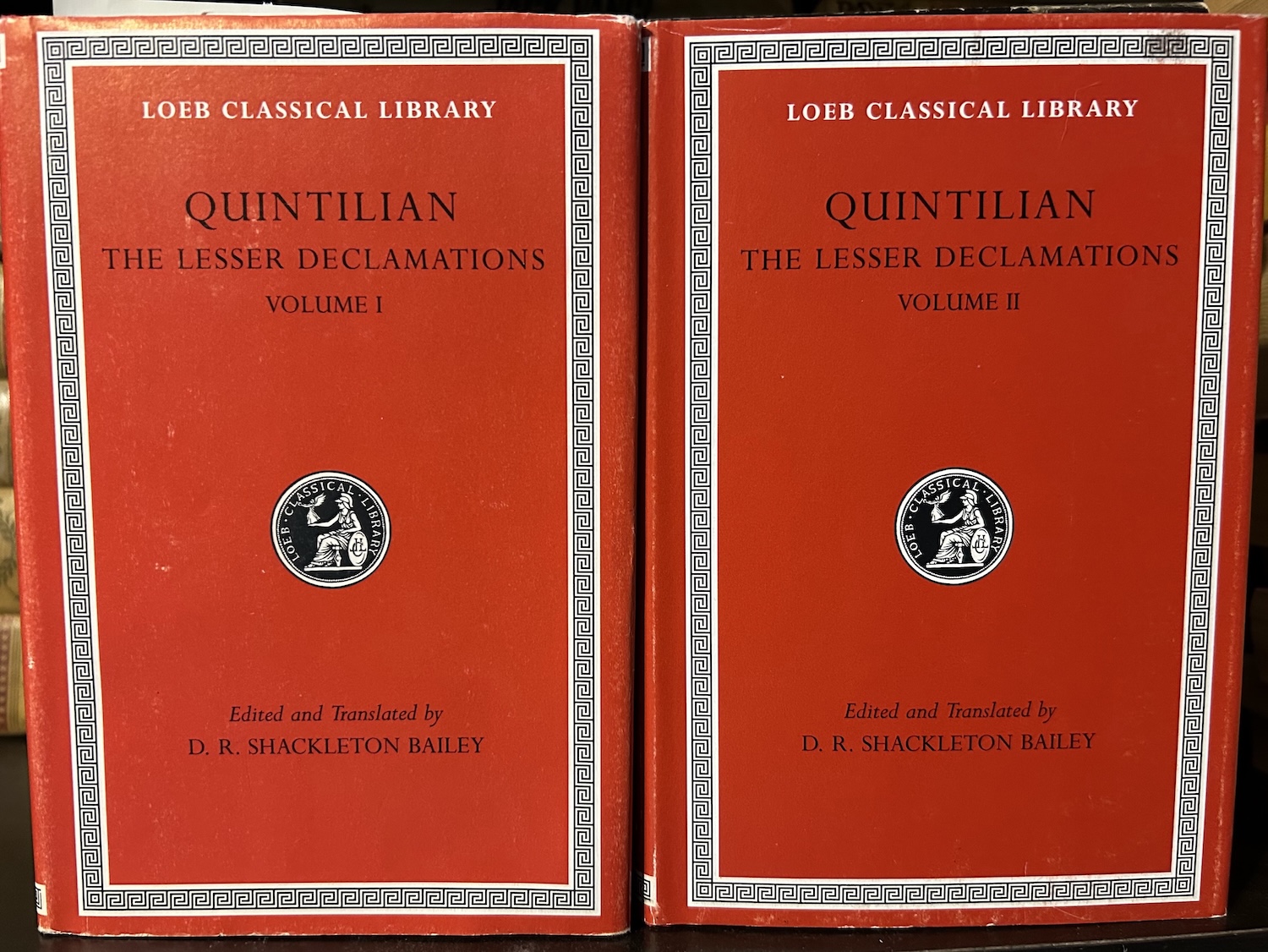
I’m reading the minor declamations of pseudo-Quintilian in Shackleton-Bailey’s great Loeb edition. The idea is to briefly escape the current political nightmare by immersing myself in the weird little stories of these controversiae.
It’s not going that well.
For example: take Decl. 272. The law in question is Qui publica consilia enuntiaverit, capite puniatur (“Someone who revealed the state’s plans should be punished by loss of citizenship or life”).
The messaging app Signal isn’t actually mentioned in the text, but it might as well be.
Then there’s Decl. 274. It’s a scenario where a tyrant is killed by a lightning bolt. Certainly a beautiful thought. One law says that a tyrant’s body should be tossed out of the city unburied. Another law says that people killed by lightning should be buried where they died. Which law prevails?
I figure I’m safe from the modern world here.
Then the anonymous lawyer starts saying stuff like this:
Exuit se tyrannus et erigit supra leges; ponendo extra illas se posuit. Hominem occidere non licet, tyrannum licet.
—Decl. 274.5
“The tyrant has stripped himself of and put himself above the laws; by putting them off, he has put himself beyond their protection. It’s unlawful to kill a person, but lawful to kill a tyrant.”
Hard to disagree with this.
But the argument raises a concern I’ve long had that the failure of a political system leads to unchecked civil violence. These guys who think they’re being so cunning in abrogating laws, ignoring courts, erasing the Constitution: they’re just setting themselves up for a lightning bolt.
If they were the only ones likely to get hurt, one might try to laugh it off. But failed states are usually a precondition for mass murder. In any case, civil violence tends to spread like a wildfire.
Maybe I should start reading horror fiction for escape. It’s bound to be more cheerful.
Here and there, though, the pseudonymous lawyer(s) come up with some really great lines.
From a case where a crime (attempted parricide) hinges on the intent of the accused:
Numquam mens exitu aestimanda est.
Decl. 281.2
“The intent of an action must never be reckoned from the outcome of the action.”
Later in the same case, the speaker is talking about something conceded under the threat of force:
non sunt enim preces ubi negandi libertas non est.
—Decl. 281.4
“Those aren’t ‘requests’ when there is no freedom to refuse.”
The best line I’ve come across yet is this beautiful but obscure phrase:
obicio tibi munus lucis.
—Decl. 282.2
“I offer you the gift of sunlight.”
Spoken by a father disowning his son, it seems to mean “Get out of my house.”
The subject matter is often depressing, e.g. a long series of cases about sexual assault, where the injured woman routinely gets to choose between the death of her rapist and marriage to her rapist. I guess, because Roman law didn’t always distinguish carefully between sexual seduction and sexual assault, this makes a certain amount of sense. A couple who were screwing around consensually could get married, and (since divorce by notification was the norm in the Roman world), it wouldn’t have to be forever. But this provision also summons nightmare scenarios where a woman is being chivvied by her relatives to marry that nice Mr. Moneybags Rapist for the good of the family. The legal cases in the declamations are always fictitious and frequently ridiculous; it’s impossible to say how many cases like this actually occurred. But one would be too many.
Whether the speeches are good or bad, depressing or uplifting, they’re soon over. The effect resembles what it used to be like to channel-surf through daytime television: glimpses of family dramas (cf soap operas), chunks of made-up history (cf the History Channel), stories of crime (cf the true crime broadcasts on Headline News), stories of unlikely awards (cf game shows), stories of wild adventure (cf movie channels).
The only thing missing are commercials, a loss which is definitely a net gain.
I reread more than I read. This has certain bad effects; e.g., the towering stacks of TBR books that constantly threaten to topple over and crush me, which are always growing taller, more numerous, and (if I’m not misreading their expressions) more angry.
I’d like to say rereading has compensating benefits, e.g. a deeper understanding of the texts I obsessively reread. But often my rereads just make me more confused.
Take Beowulf, a text that would be on my always-reread list even if I didn’t teach it twice a year.
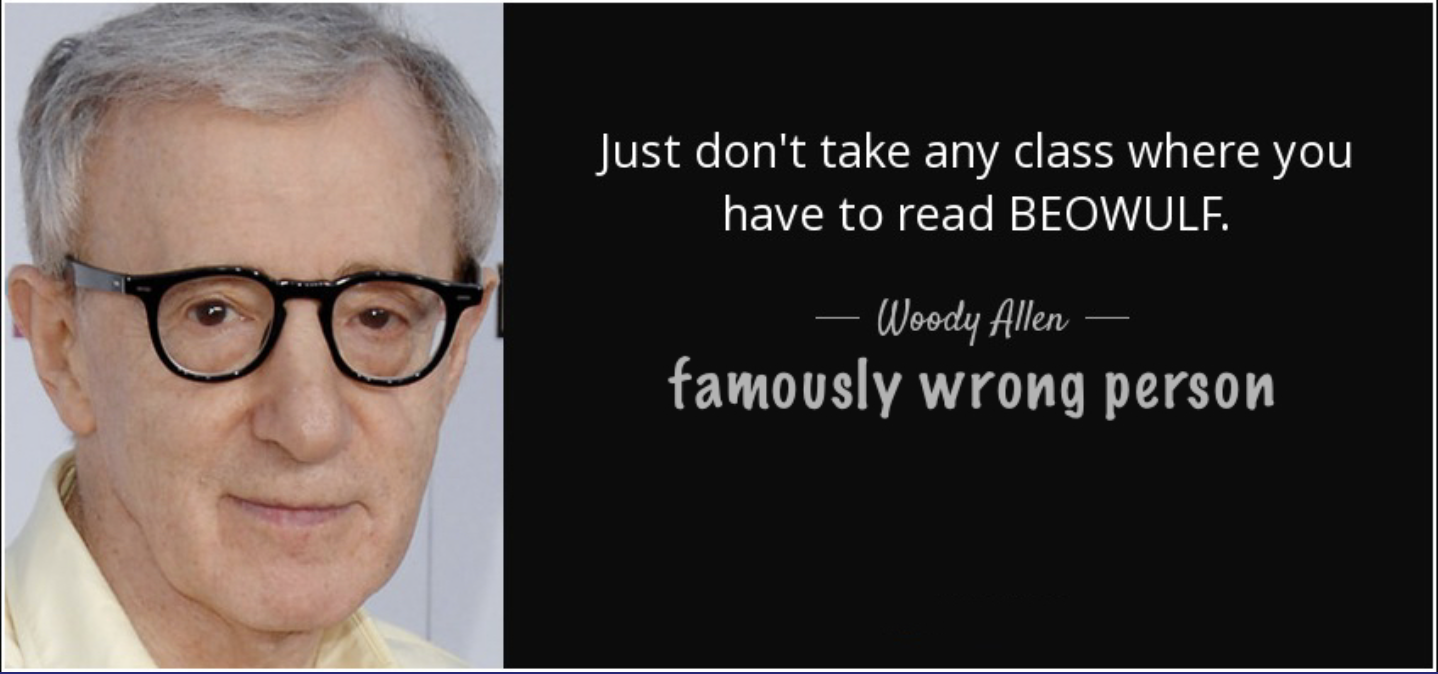
Woody Allen was one of my heroes as a kid, but this line from Annie Hall should’ve been my first warning that there was something wrong with him.
Beowulf is already a hero when he lies down in Heorot, King Hrothgar’s famous mead-hall, to await the arrival of Grendel, the manslaying monster. Beowulf has come with his Geatish pals to Denmark specifically so that he can defeat Grendel. He discusses in advance his plans to engage in hand-to-hand combat with the monster, putting aside weapons and armor.
So: why doesn’t he wait by the door?
Beowulf may want to draw Grendel into the hall, not warn him off from the door. But that doesn’t explain what happens next. I’m not trying to roast Beowulf here, by the way, just trying to wrap my head around the scene.
Grendel bursts in, slamming the door of the hall open. He’s come to kill and eat, as he has so many times before.
Beowulf does nothing.
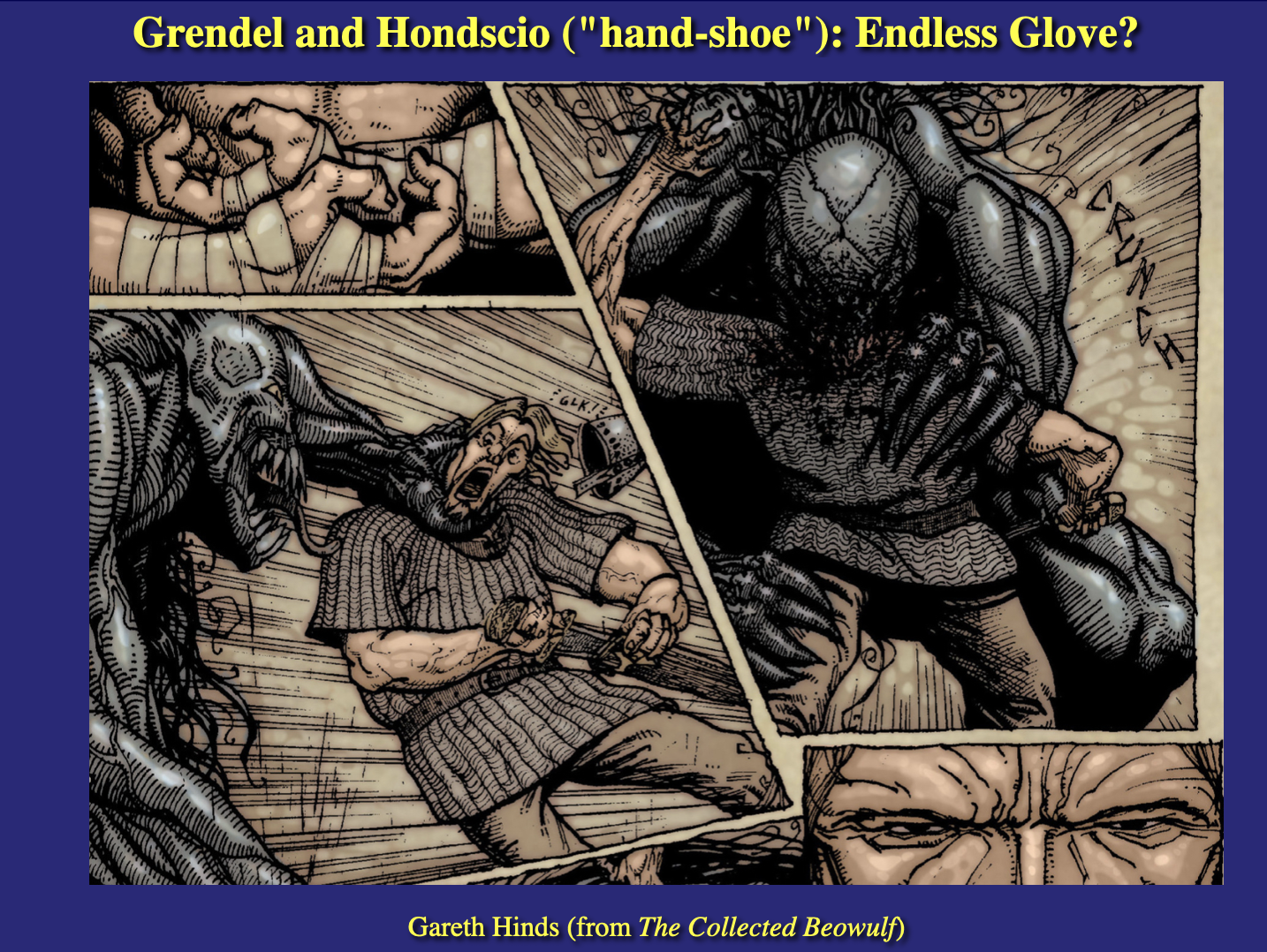
Grendel goes to one of Beowulf’s band of Geatish warriors, a guy (we will later learn) named Hondsciō (“glove”; compare modern German Handschuh “hand-shoe; glove”).
Beowulf does nothing.
Grendel kills Hondsciō and rips him to pieces.
Beowulf does nothing.
Grendel goes to where Beowulf is lying.
Beowulf does nothing.
Grendel grabs Beowulf, and then the fight is on. It’s WWE Raw Is War.
The (surviving) Geats leap up from where they’re lying and try to attack the monster but their swords have no effect. The Grendelkin seem to be immune to ordinary weapons.
Grendel soon realizes he’s out of his depth and tries to flee, but Beowulf won’t let go. Finally Beowulf rips Grendel’s arm off (hand, arm, shoulder), dealing him a mortal wound. Grendel flees back to his underwater lair to die.
The question that constantly bedevils me when rereading this passage is: why does Beowulf wait so long to start doing what he came there to do?
So far, my answer to this question (spoilers: I cannot really answer this question) comes in multiple parts.
The first part is geographical, and hinges on the design of these medieval Germanic halls like Heorot. They’re long buildings with a peaked roof, and a firepit running down the middle.
image above: a reconstructed Viking-era meadhall at Trelleborg in Sweden. image below: artist’s conception of such a hall’s interior from Gudmundson, Den islandske Bolig i Fristats-Tiden (1894)
After the feast, the tables etc would be stacked away (or used as beds?) and the henchmen would sleep in the hall by the firepit.
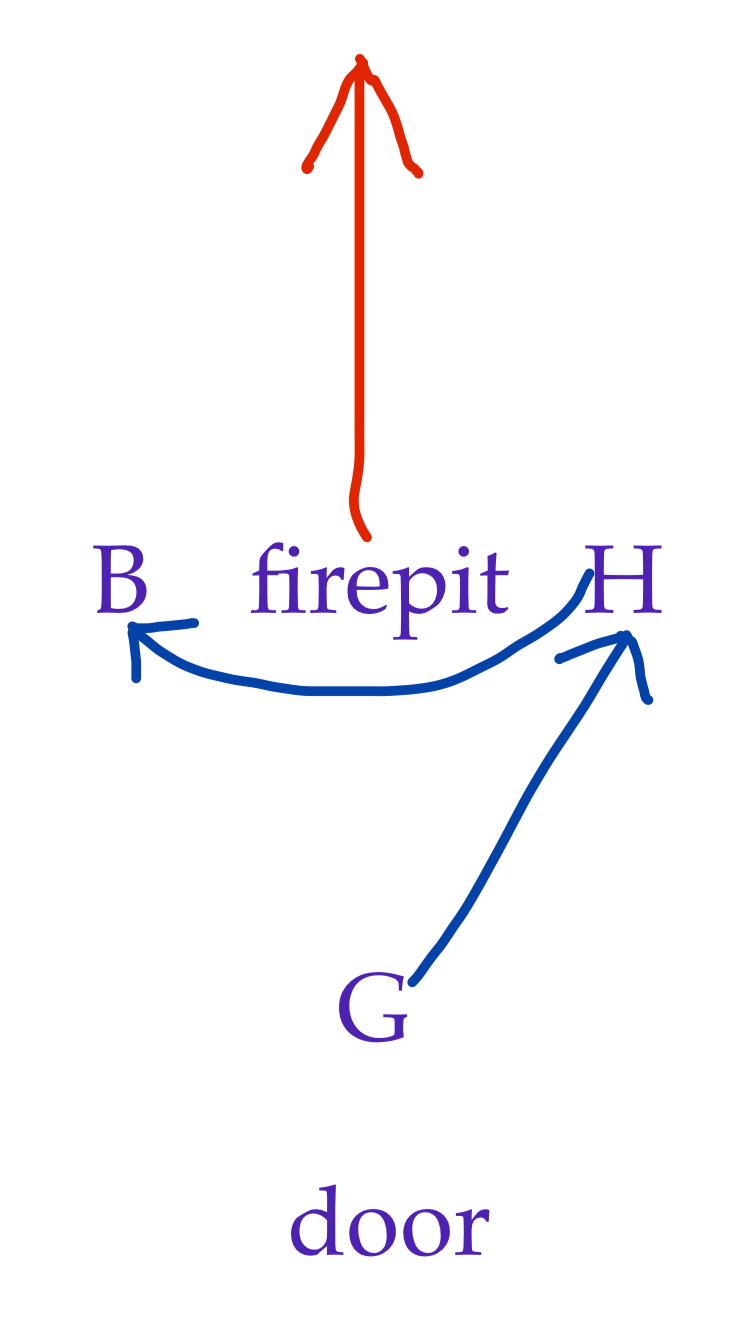
So the Geats come to Heorot, make a big deal about it being occupied again. (Grendel has been attacking it at night for twelve years, and people had given up sleeping there, lest they wake up dead.) The Geats lie down as if to sleep on either side of the firepit. Maybe Hondscio is on one side of the firepit and Beowulf is on the other. Grendel, like Buridan’s donkey, could go in one direction or the other. Unlike Buridan’s donkey, he’s not going to starve to death while making a decision. He launches himself against Hondscio, and then turns to the guy on the other side, who is Beowulf.
Professionally drawn graphic by a professional graphic-drawing guy.
Okay. But this still doesn’t explain why Beowulf takes so long to act. He’s not asleep and he’s not scared (according to the poet). It’s almost as if this is a turn-based game, like chess, and Beowulf has sacrificed a pawn to put the opposing player in an untenable position. That seems to conflict with the magnanimous nature of the hero as the poet represents him, though.
A bookish sort of explanation: Hondsciō’s death is necessary because it prefigures Grendel’s own death. In reparation for the loss of Hondsciō, Grendel loses his hand (along with his arm and shoulder), suffering a fatal wound.
A slide from my Norse myth class.
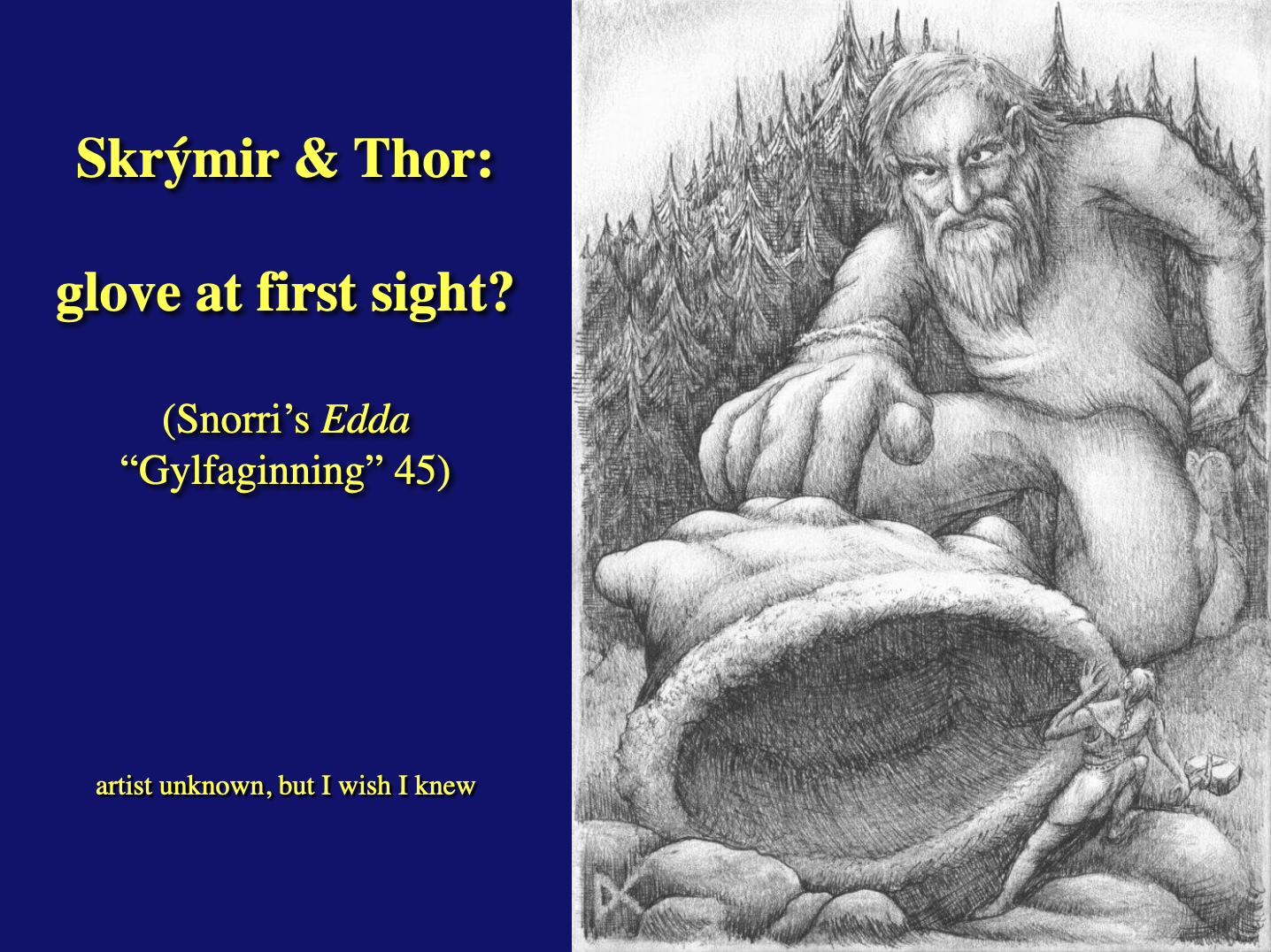
If this seems too academic and tweedy a reading for so savage a poem, I should add that Beowulf himself makes the connection when he’s retelling the tale to his uncle and king, Higelac, back in Geatland (line 2069b-2100). He talks about the hond-rǣs hæleða (“the hand-battle of heroes”) and goes on to describe the death of Hondciō, naming him for the first time in the poem. He mentions for the first time a weird glove (glōf) made of dragon-hide that Grendel had. Beowulf seems to describe Grendel’s habit of putting dead men into the glove. Which is really weird, does not clarify the situation, but does remind me of another mythological situation, where Thor and friends find themselves in a giant’s glove.
Beowulf concludes this part of his humblebrag by mentioning how Grendel’s right hand (swīðre… hand) remained behind in Heorot.
That line from hand to hand connects a lot of dots in the narrative. And maybe that’s enough. Beowulf describes Hondsciō as fey (“doomed”; fǣgum), and maybe that’s enough.
But maybe it’s not. It still doesn’t give a motivation for Beowulf’s odd stillness until he himself is attacked.
I wonder if the answer isn’t hidden inside Grendel’s identity. The Beowulf-poet famously or infamously grafts the Grendelkin onto the family tree of Adam and Eve, tracing their line of descent from Cain the murderer. But the Beowulf-poet is Christian, and this story probably pre-existed the arrival of Christianity in northwest Europe. So what was the pre-Christian identity of Grendel and his mother?
I think they were the restless dead, a perennial affliction in these Nordic stories. (Think of the Barrow Wights from The Lord of the Rings.) Glám, Grendel’s analogue in Grettir’s Saga (chs. 33-35), is one of the walking dead. And Grendel is repeatedly described as a ghost (ellengǣst “bold ghost”, 86a; se grimma gǣst “the cruel ghost”, 102a; wergan gāstes “accursed ghost” 133a).
But Beowulf kills Grendel. Killing someone who’s already dead seems like a definitional impossibility. But it is something that comes up a lot in these stories, and the answer is frequently some kind of mutilation, a practice known as “arm-pitting” (Greek μασχαλισμός). It’s precisely this kind of thing that Beowulf inflicts on Grendel.
But (not to beat a dead horse or monster here) why does it take Beowulf so long to act?
This is where I came in and this is where I go out, I guess, asking the same question. The only answer I can come up with is personal and has to do with nightmares. I don’t know if you’ve ever been attacked by a ghost or a sinister shadow in a dream. It used to happen to me pretty frequently, back when I was able to get a decent night’s sleep. (Deep sleep is a luxury old people have to learn how to do without. If you wonder why the old people in your life are increasingly crazy, that might be one of the reasons.)
When the ghost is coming for you in the dark, it seems to get the first move. You may see it; you may know it’s coming for you. But you can’t do anything about it. There’s a whole branch of magic in Morlock’s world devoted to stuff you can do in these situations. (See “A Stranger Comes to Town” for some practical applications.)
It may be that in the Ur-myth of Beowulf, he was in that nightmare state, watching the ghost approach and unable to stop it.
That’s not the the answer; as is common in myth and storytelling, there isn’t just one answer. But that’s the best I’ve got from this most recent reread.
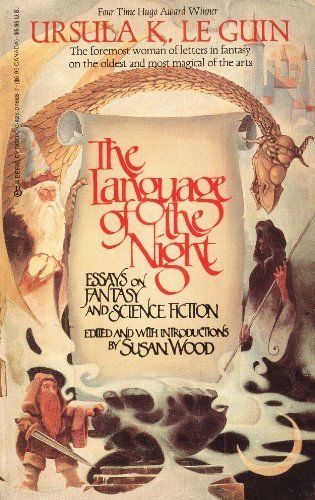
I’m not a big fan of literary criticism in any field (although I have committed some), but one of my big books from my late teens onward was Le Guin’s The Language of the Night (1979), especially for the essays “From Elfland to Poughkeepsie” and “A Citizen of Mondath”.
Le Guin has some great passages in “Citizen” about what she liked to read as a kid, and how she liked it.
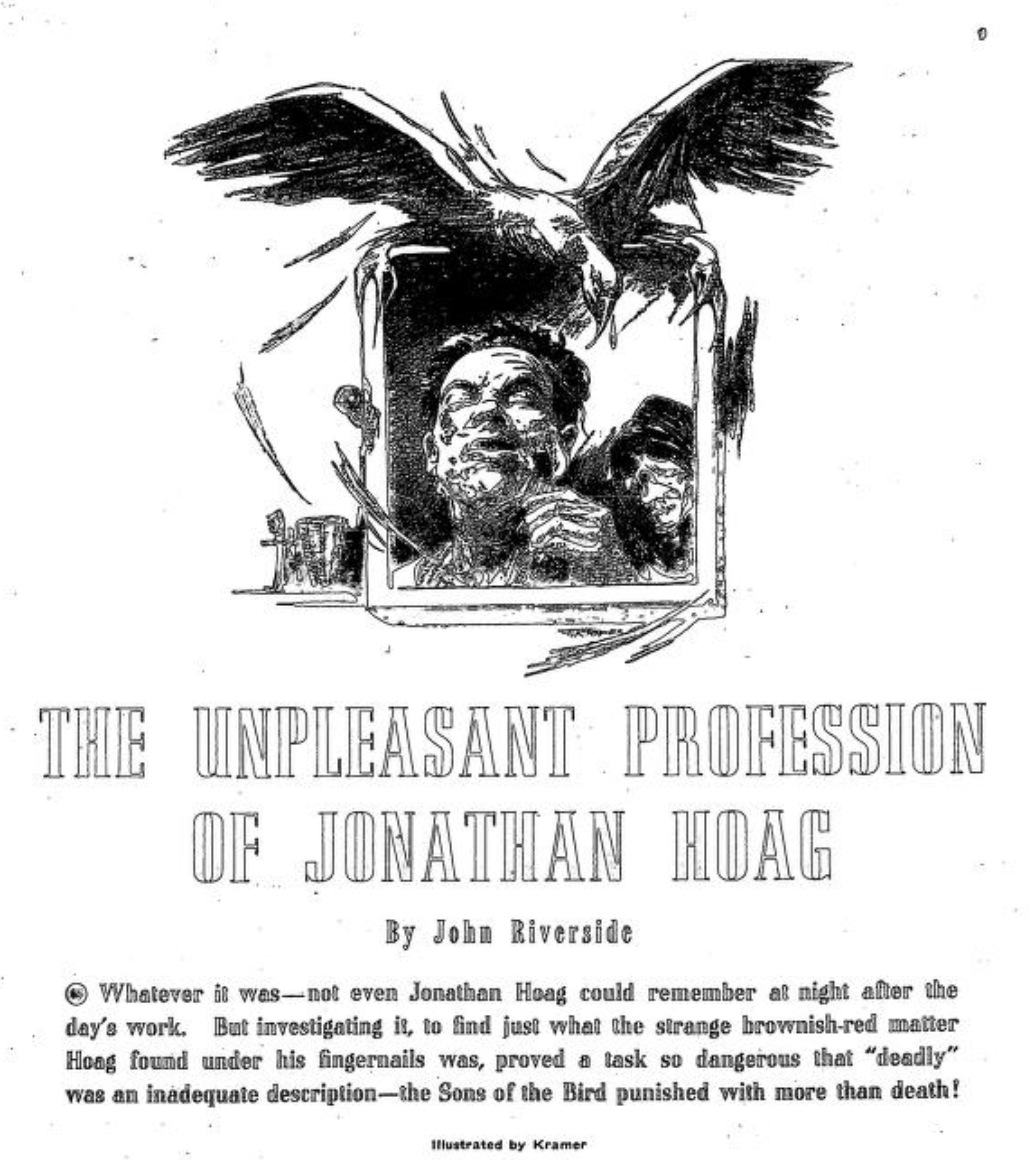
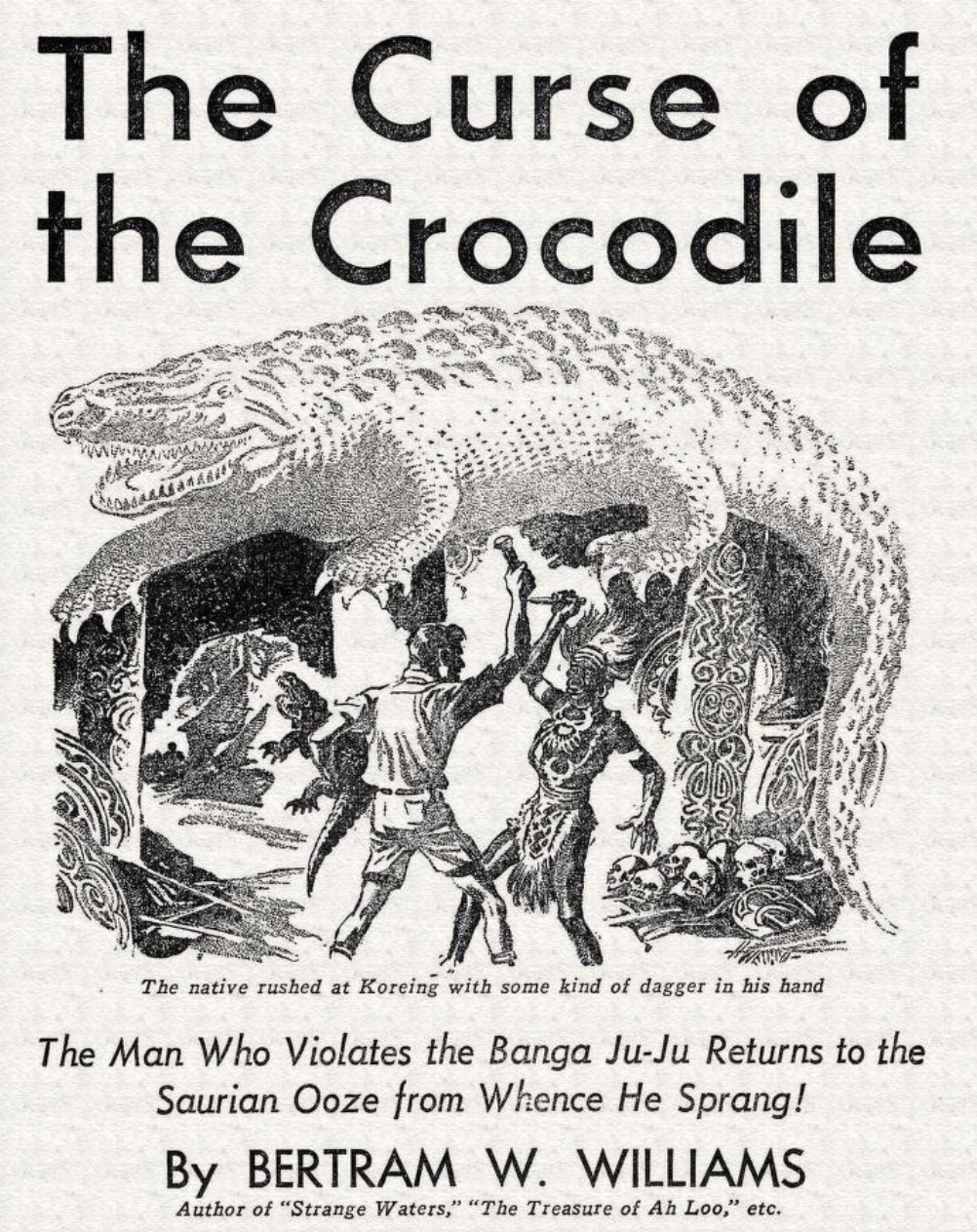
We kids read science fiction in the early forties: Thrilling Wonder, and Astounding in that giant format it had for a while, and so on. I liked “Lewis Padgett” best, and looked for his stories, but we looked for the trashiest magazines, mostly, because we liked trash. I recall one story that began “In the beginning was the Bird.” We really dug that bird. And the closing line from another (or the same?)—“Back to the saurian ooze from whence it sprung!” Karl made that into a useful chant: The saurian ooze from which it sprung / Unwept, unhonor’d, and unsung. I wonder how many hack writers who think they are writing down to “naive kids” and “teenagers” realize the kind of pleasure they sometimes give their readers. If they did, they would sink back into the saurian ooze from whence they sprung.
I’m pretty sure the first story she refers to is “The Unpleasant Profession of Jonathan Hoag” by Heinlein inUnknown (Oct 1942). It appeared under the false whiskers of “John Riverside” because at the time the Heinlein byline was reserved by John W. Campbell for RAH’s “future history” stories.
I never figured I’d find the source of the mysterious “saurian ooze”–except that maybe I just did. In looking for Henry Kuttner stories online I found this opus in Strange Tales (Aug, 1939). The appearance is pseudonymous, because he had a “Prince Raynor” novelette in the issue under his own name. And the crucial phrase was from the editorial blurb rather than the story itself.
Screenshot
Kuttner, of course, was roughly half of “Lewis Padgett”, along with C.L. Moore. And most of their work, whatever name it appeared under, seems to have been collaborative from the time they met and married, so Moore may have exuded some of that saurian ooze herself.
Le Guin’s accounts don’t exactly match up with these texts: “In the Beginning was the Bird” is a ritual phrase used by the Sons of the Bird in Heinlein’s story (one of his best fantasies, by the way), but it’s not the opener of the story. And the saurian ooze springs out at the reader at the Kuttner story’s beginning, not its end (and with a shift of ablaut at that). But given that Le Guin was writing about these stories 20-30 years after she’d read them, I’d say the shoes fit the footnotes pretty well.
I’m rereading Beowulf, preparatory to teaching it in a couple weeks to my Norse Myth class. This kind of thing always involves falling into the dictionary and getting swept away by a tide of weird words.
This afternoon’s discovery is morðcrundel. Morð means “death”; it’s the root of murder and Mordor (a linguistic fact that Asimov used in one of his stories of the Black Widowers), and is cognate with Latin mors, mortis “death”. (It occurs to me that this probably affects the spelling of Mordred’s name in Arthurian legend. The older spelling is Medraut/Modred, but it was changed in the Old French versions, maybe because storytellers associated Mordred with death and destruction—of his uncle-father Arthur in particular.)
Crundel (to my ear) sounds too friendly to be linked up with doomful morð, but Clark Hall & Merrit say it means “ravine”. (None of my dictionaries gave me an etymology for crundel, but I wonder if it’s cognate somehow with ground.) Hence morðcrundel “death-ravine”: the pit under a barrow where the dead are buried.
I expect morðcrundel (the word) and death-ravines (the phenomenon) will appear in my stories in the near future.
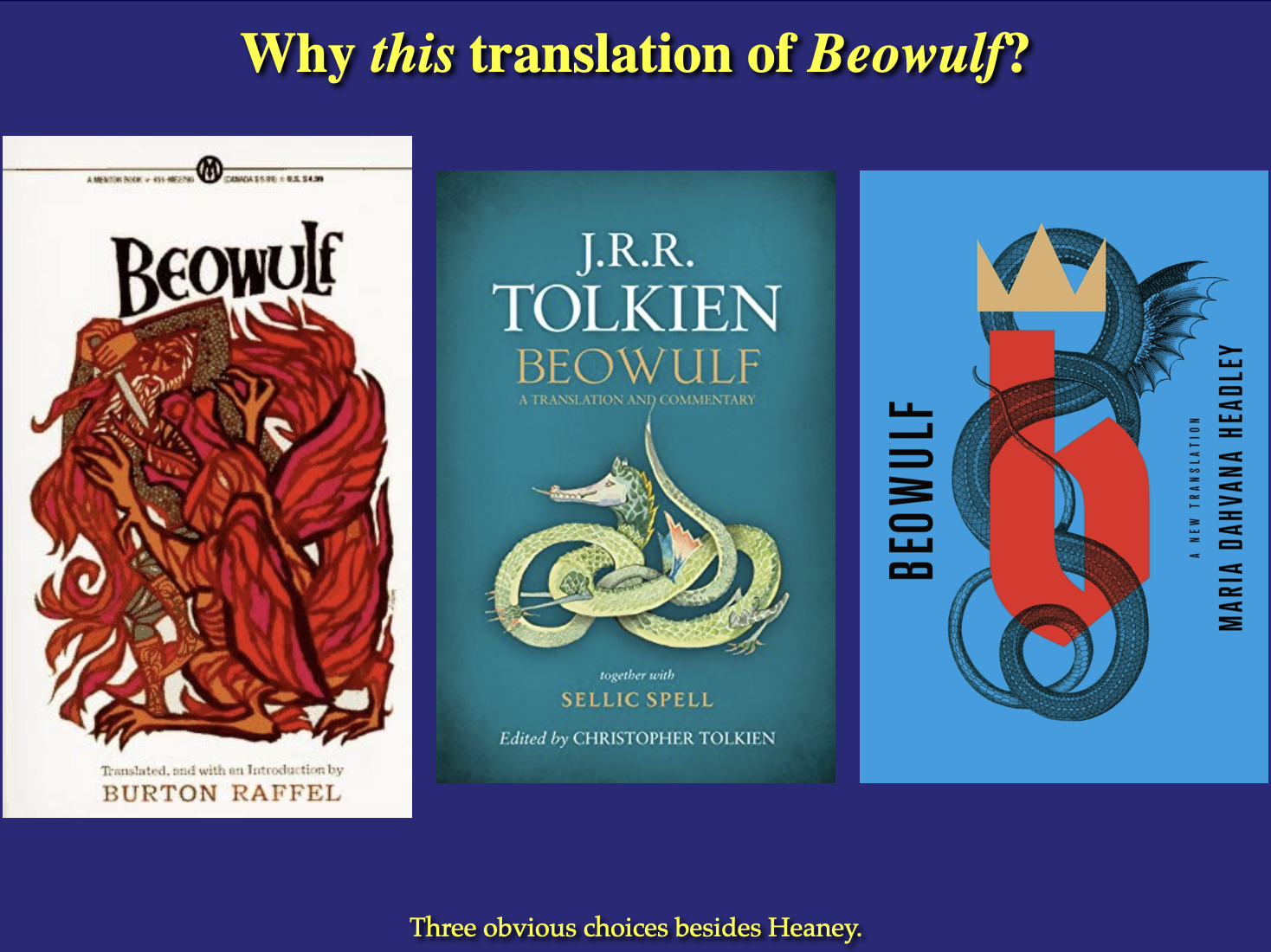
I’m reading Beowulf in stereo this time, comparing the Old English original to Heaney’s translation (which is the one I’ve been assigning to my classes for the past few years).
There’s no translation like no translation. Or, as they say in Italian: traduttore, traditore (“translator = traitor”). This kind of passage-by-passage comparison is the kind of reading that is most likely to make one unhappy with almost any translation. Heaney’s translation is clear and eloquent, a good match for the modern reader. They didn’t give this guy the Nobel Prize for nothing.
But in a couple passages he munges the meaning of things that (to my fantasy-oriented mind) are important.
One of the praise-songs about Beowulf in the text of Beowulf is about Sigmund the Dragonslayer. I particularly want to bring this passage to the attention of my students, because we’re also going to be reading the Volsunga Saga and the Eddic poetry about the screwed-up family of the Volsungs (and the screwed-up families they become entangled with). In those better-known versions, it’s Sigurð, son of Sigmund, who kills the dragon.
“Myth is multform” is the ritual incantation I always invoke on these occasions. Myth isn’t history; it’s more like quantum physics, where Schrödinger’s cat is both alive and dead until you open the box. Sigmund both is and is not the slayer or Fafnir, until you begin telling (or reading) a particular story. At that point the storyteller usually (not always) picks a version and sticks with it, a process analogous to wave-form collapse in quantum physics. Audiences of myths have the luxury of enjoying, even insisting on, particular versions (like toxic Star Wars fans). Students of mythology have to be sensitive to multiple versions and beware the temptations to over-historicize a particular rendition of a myth.
Anyway, in the story of Beowulf, it makes sense for the praise-singer to associate Sigmund with Beowulf. Sigmund famously killed a monster; Beowulf has just earned fame by killing a monster (Grendel). And the Beowulf-poet can use this celebration of young Beowulf’s victory to foreshadow old Beowulf’s final battle where he kills and is killed by a dragon. In fact, the Sigmund story might help explain old King Beowulf’s strange behavior toward his last enemy, how he insists on going alone against the dragon (just as Sigmund did) to earn treasure (just as Sigmund did).
I mostly like what Heaney does in his translation, but there was one part of this passage that I wasn’t crazy about.
The Beowulf-poet, describing how Sigmund slew the dragon says this:
hwæþre him gesǣlde, ðæt þæt swurd þurhwōd wrǣtlīcne wyrm, þæt hit on wealle æstōd, dryhtlīc īren; draca morðre swealt.
—Beowulf 890-892
“Nevertheless it befell him that the sword passed through the wondrous worm so that it on the wall stood fixed the illustrious iron; the deadly dragon died.”
Here’s what Heaney does with it.
“But it came to pass that his sword plunged right through those radiant scales and drove into the wall. The dragon died of it.”
Better than my dry literal version, certainly. But here’s Raffel’s (1963) version.
“Siegmund had gone down to the dragon alone, Entered the hole where it hid and swung His sword so savagely that it slit the creature Through, pierced its flesh and pinned it To a wall, hung it where his bright blade rested.”
Because Raffel is not binding himself to translate line by line (as Heaney does), his version rocks a little better, I think.
I’ll probably stick with Heaney. It’s still fresh, represents the original pretty well, and has a couple of different editions with distinctive advantages: one accompanied by the Old English text, another illustrated with copious images of the physical culture of northwest Europe in the early Middle Ages–weapons, jewelry, manuscript paintings of monsters, etc.
Still, I always try to keep the alternatives in mind. Myth is multiform, and every translator is a traitor. I can only be faithful to the original if I at least flirt with alternative translations.
I was thinking the other day about Hengist and Horsa, the two Saxon chieftains/gangsters who show up to assist and then overpower the usurper Vortigern in the run-up to King Arthur’s origin story. Horsa (Horsus in Geoffrey of Monmouth’s Latin) clearly means “horse” in modern English, but WTF is a hengist? Turns out that also means “horse” (going back to Proto-Germanic *xanxistaz; so says Orel). Horsa doesn’t really do much in the story; Hengist always takes the lead, bringing in Saxon goons and becoming Vortigern’s father-in-law, and in general making V’s life a living hell.
I wonder if “Horsa” didn’t start life as a more-transparent translation of Hengist’s name (“Hengist–i.e. Horse”), and then the name got promoted to full personhood by a storyteller who didn’t know the two words meant effectively the same thing.
Vortigern’s situation with the Saxons reminds me of a “bust out”, where organized crime infiltrates a business and then runs it into the ground (e.g. the Sopranos episode 2.10 “Bust Out”). Fortunately that situation could never happen to the U.S. govt. I guess.
Another thing I found out while horsing around was that English horse is cognate with Latin currere “to run” (going back to PIE *kers- “run”). Which makes sense, since initial k sound in Latin often corresponds to initial h in English (cf English horn and Latin cornu).
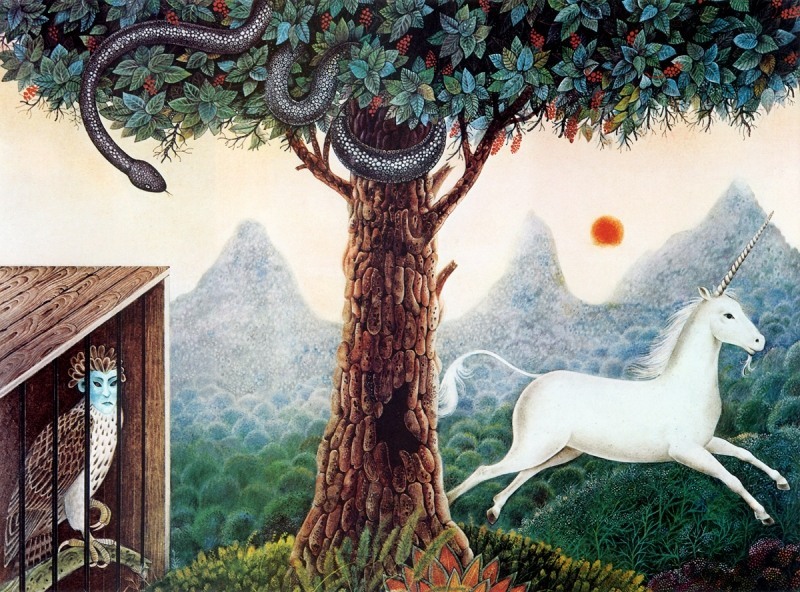
Gervasio Gallado’s cover painting for the Ballantine edition of Peter S. Beagle’s The Last Unicorn.
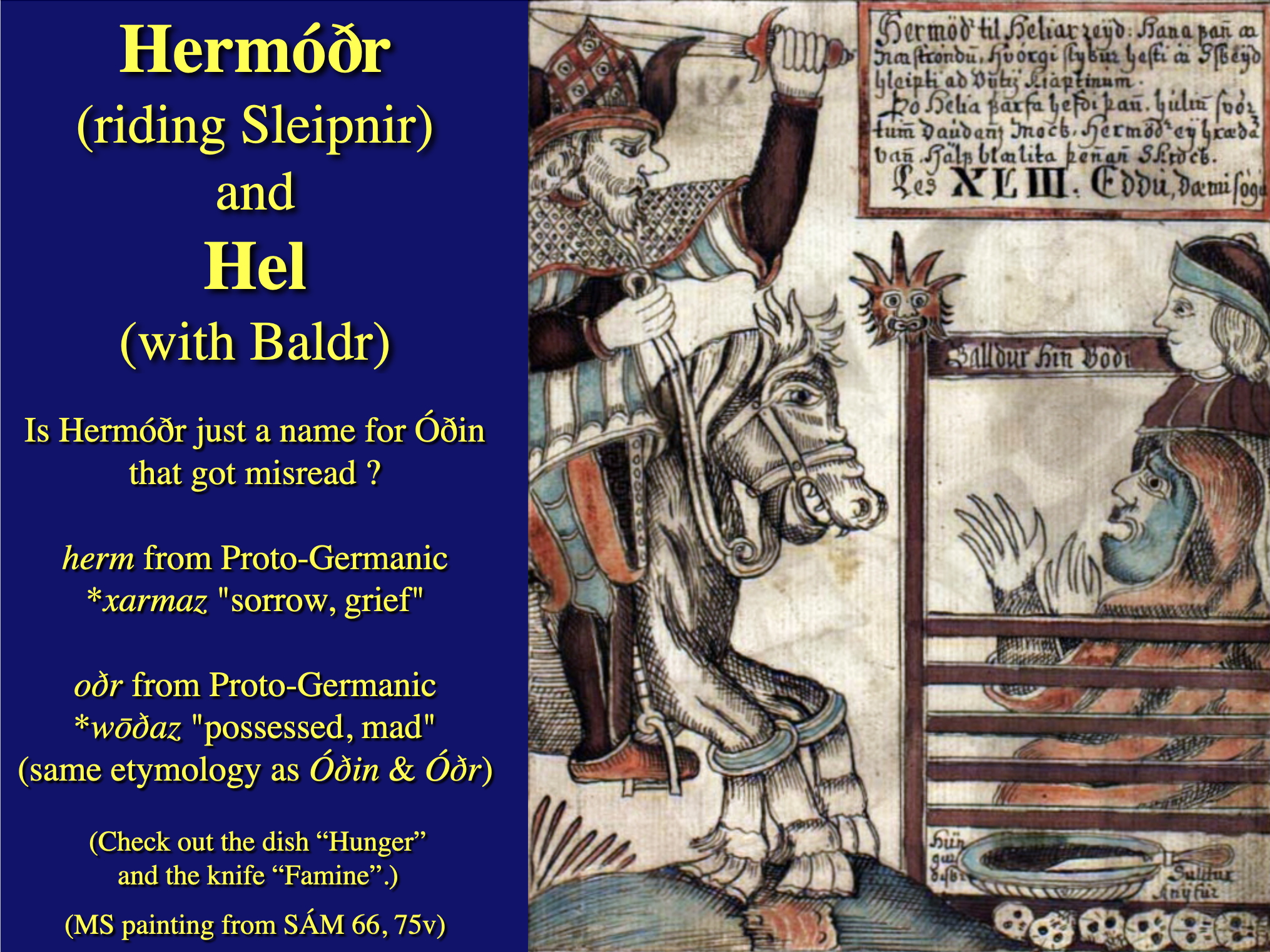
The h/k correspondence got me thinking about Hermóðr, Ódin and Frigg’s son who borrows Sleipnir, his dad’s eight-legged horse. The -óðr is pretty clearly the same root as in Óðin’s name, but what would *kerm- mean in Proto-Germanic or PIE? I looked it up in Orel’s Handbook of Germanic Etymology and it sort of snapped into focus.
Maybe there is no Hermóðr really. Maybe it’s just another name of Óðin that Snorri hypostasized into a son of Óðin. That’s explain why he’s riding Slepnir, among other things.
So my Norse Myth students got a generous side-portion of Germanic philology yesterday.
I was trying to figure out why you couldn’t say this in Latin, then thought, “Well, it could only improve garum”, and finally realized: oh, they mean cocina latina.
Some of these keywords for Bluesky feeds are deeply ambiguous. (“Conan” in the s&s feed is another one.) But I’m enjoying the surreal tangents they generate.
Snorri says that the first root of Yggdrasil comes down in Ásgarð and that next to it is the Pool of Weird. The Norns come out to it each day and splash some of its holy water onto Yggdrasil to keep it from rotting—a perennial danger for the sacred ash tree, so Snorri tells us.
En þat vatn er svá heilagt at allir hlutir þeir sem þar koma í brunninn verða svá hvítir sem hinna sú er skjall heitir, er innan liggr við eggskurn.
—Snorri, Edda: Gylfaginning 16
“And that water is so holy that everything which comes into the fountain becomes as white as the membrane called skjall which lies next to the eggshell.”
I translated hvítir as “white” above, because everyone does, and the dictionaries say that’s right, and the Norse word is cognate with English white, but I still think it’s wrong here. If you’ve ever managed to pluck part of the shell off an egg without breaking the membrane beneath, you’ve opened up a cloudy kind of window into the egg. And skjall is also used of a membrane stretched over a frame to create a window. So “translucent” might be a better way to translate hvítir here.
A pool that makes stuff become translucent or transparent: that’s an intriguing idea. I’m going to steal it for a story at the next opportunity and I urge everyone else to do so.
My eye was also caught by eggskurn. The egg part is “egg”, of course, but I was interested to learn that this was loaned into English from Old Norse, the English forms (ǣg > ey/ay) being displaced by the Norse one in the Middle English period, maybe because the ME forms are too easily confused with other words, e.g. aye or eye.
“Give me an ay, eh?”
“Aye, sir!”
“No, the round kind of ey.”
“You want me to rip out my eye?”
It would take forever to cook something with this kind of backchat going on.
The skurn part means “shell” and it’s akin to the Old Norse word skera “to cut”. The English word shell goes back to the same PIE root *skel– “cut”. The same sharp root also yields scale, shale, shoal, skoal (from a kind of drinking bowl), shield, scalp, skill (another ON borrowing, I guess referring originally to someone’s ability to separate issues or things), school (a division), cutlass, and shelf (a split piece of wood).
The Latin word for school, ludus, means “play”. The English word is a military term referring to the division of an army. Etymology is not destiny, but I wonder if this is one reason early education in the English-speaking world is often so dull and regimented. (I’m not knocking teachers. But the system needs to be knocked around a little; kudos to those who are doing that.)
[originally posted over on Facebook, but ported over here now that Faceplace is increasingly a den of iniquity and fascism]
Apparently the gands that appear in Gandalf and in Jǫrmungandr (the name of the world-girdling serpent in Norse myth) are really the same root. Cleasby and Vigfusson say “the exact sense of this word is somewhat dubious; it is mostly used in poetry and in compounds, and denotes ‘anything enchanted’ or ‘an object used by sorcerers’, almost like zauber in German, and hence ‘a monster, fiend’.”
Thinking of Gandalf as “Fiend-elf” certainly lends a new dimension to his character. I never associated him with Midgarð’s Serpent, either, but I think maybe Tolkien did. You’ll remember Gandalf’s description of the Balrog after they’d fallen into the deep water: “His fire was quenched, but now he was a thing of slime, stronger than a strangling snake.”
Gandalf and the Balrog are originally from the same class of supernatural being (the Maiar), so that’s another link in the monstery chain.
[images: GANDALF & BILBO by Tim Kirk; THOR, HYMIR, & JORMUNGANDR by Inga Torfadottir; THE WORM OUROBOROS by Keith Henderson]
[Originally posted on Facebook, but ported here, since the Facebots are turning more and more toward eeeeeeeeeeevil.]
![[personal profile]](https://www.dreamwidth.org/img/silk/identity/user.png)